
@trippfuller 7/ Benjamin decried passive messianism's waiting around, insisting that each generation must strive to exert its own 'messianic power' to bring justice to the world and the oppressed of the past. Redemption, he said, is a collective revolutionary task, performed in the present.
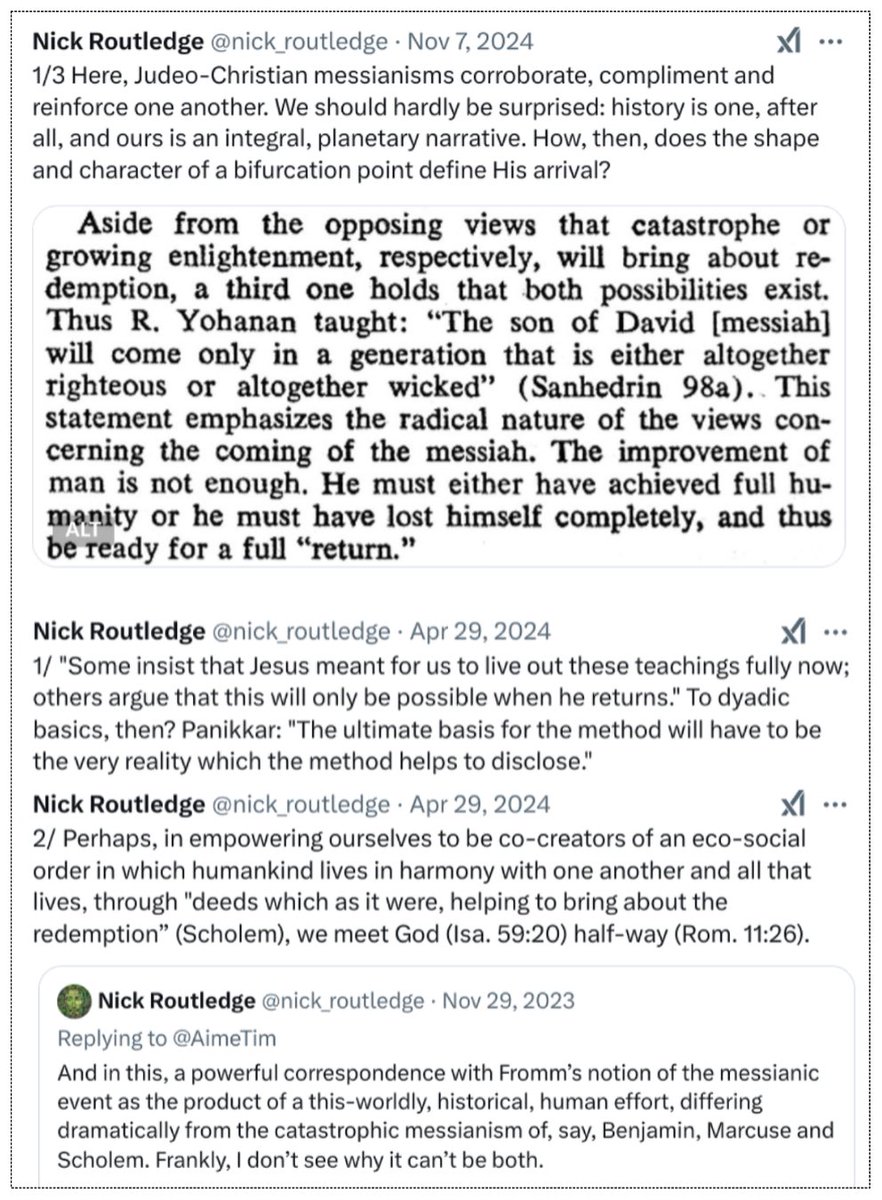
Image description
Original X alt text
Copy of tweets here: Including image of Erich Fromm’s You Shall Be As Gods, Page 113 Aside from the opposing views that catastrophe or growing enlightenment, respectively, will bring about re- demption, a third one holds that both possibilities exist. Thus R. Yohanan taught: "The son of David [messiah] will come only in a generation that is either altogether righteous or altogether wicked" (Sanhedrin 98a). This statement emphasizes the radical nature of the views concerning the coming of the messiah. The improvement of man is not enough. He must either have achieved full humanity or he must have lost himself completely, and thus be ready for a full "return."
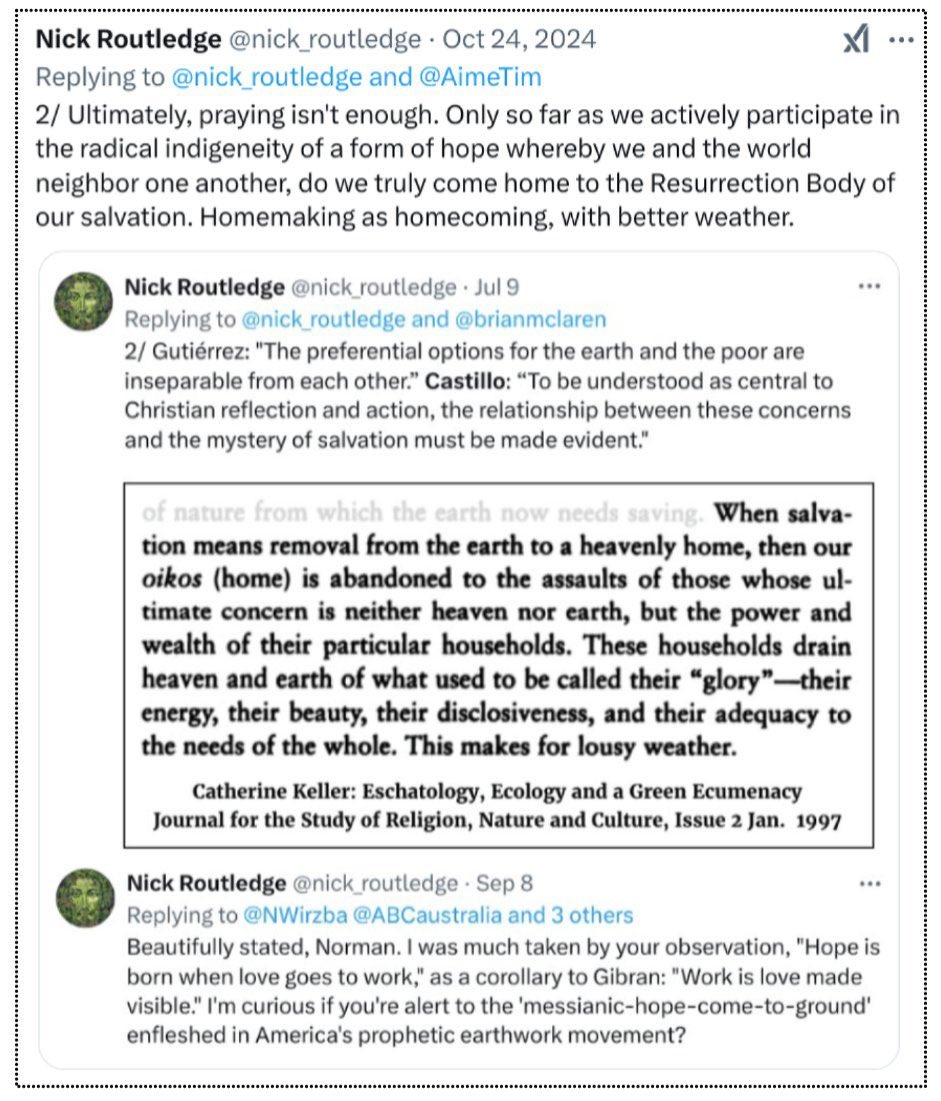
Image description
Original X alt text
Copy of tweet here:
Extended description
Pictured speaker / quoted attribution: Catherine Keller Recovered pictured passage; not a claim to the full source. Passage boundary: Source: archive.nickroutledge.org/post/1891148338214392165 Preserve quoted-author distinctions; the containing tweet does not confer authorship. then our oikos (home) is abandoned Retained uncertainty: [{"passage": "Faint first line preceding ‘When salvation…’", "reason": "Image starts mid-sentence ‘of nature from which the earth now needs saving.’ Complete preceding clause not pictured or saved; visible fragment recovered."}]
Open original documentExtended description
Pictured speaker / quoted attribution: Catherine Keller, citation Recovered pictured passage; not a claim to the full source. Passage boundary: Source: archive.nickroutledge.org/post/1891148338214392165 Preserve quoted-author distinctions; the containing tweet does not confer authorship. Catherine Keller: Eschatology, Ecology and a Green Ecumenacy Journal for the Study of Religion, Nature and Culture, Issue 2 Jan. 1997 Retained uncertainty: [{"passage": "Faint first line preceding ‘When salvation…’", "reason": "Image starts mid-sentence ‘of nature from which the earth now needs saving.’ Complete preceding clause not pictured or saved; visible fragment recovered."}]
Open original documentExtended description
Pictured speaker / quoted attribution: Catherine Keller, faint preceding fragment Recovered pictured passage; not a claim to the full source. Passage boundary: Source: archive.nickroutledge.org/post/1891148338214392165 Preserve quoted-author distinctions; the containing tweet does not confer authorship. of nature from which the earth now needs saving. Retained uncertainty: [{"passage": "Faint first line preceding ‘When salvation…’", "reason": "Image starts mid-sentence ‘of nature from which the earth now needs saving.’ Complete preceding clause not pictured or saved; visible fragment recovered."}]
Open original documentExtended description
Pictured speaker / quoted attribution: Nick Saved source record associated with pictured writing; full saved record, not an exact pictured excerpt. Passage boundary: Source: archive.nickroutledge.org/post/1849550677590278419 Preserve quoted-author distinctions; the containing tweet does not confer authorship. @AimeTim 2/ Ultimately, praying isn't enough. Only so far as we actively participate in the radical indigeneity of a form of hope whereby we and the world neighbor one another, do we truly come home to the Resurrection Body of our salvation. Homemaking as homecoming, with better weather. t.co/K2jTzNPLd9 Retained uncertainty: [{"passage": "Faint first line preceding ‘When salvation…’", "reason": "Image starts mid-sentence ‘of nature from which the earth now needs saving.’ Complete preceding clause not pictured or saved; visible fragment recovered."}]
Open original documentExtended description
Pictured speaker / quoted attribution: Nick quoting Gutiérrez and Castillo; Catherine Keller quote Saved source record associated with pictured writing; full saved record, not an exact pictured excerpt. Passage boundary: Source: Preserve quoted-author distinctions; the containing tweet does not confer authorship. to @brianmclaren 2/ Gutiérrez: "The preferential options for the earth and the poor are inseparable from each other.” Castillo: “To be understood as central to Christian reflection and action, the relationship between these concerns and the mystery of salvation must be made evident." When salvation means removal from the earth to a heavenly home, then our home is abandoned to the assaults of those whose ultimate concern is neither heaven nor earth, but the power and wealth of their particular households. These households drain heaven and earth of what used to be called their “glory” - their energy, their beauty, their disclosiveness, and their adequacy to the needs of the whole. This makes for lousy weather. Catherine Keller I was much taken by your observation, "Hope is born when love goes to work," as a corollary to Gibran: "Work is love made visible." I'm curious if you're alert to the 'messianic-hope-come-to-ground' enfleshed in America's prophetic earthwork movement? Retained uncertainty: [{"passage": "Faint first line preceding ‘When salvation…’", "reason": "Image starts mid-sentence ‘of nature from which the earth now needs saving.’ Complete preceding clause not pictured or saved; visible fragment recovered."}]
Open original documentExtended description
Pictured speaker / quoted attribution: Nick quoting Norman Wirzba and Gibran Saved source record associated with pictured writing; full saved record, not an exact pictured excerpt. Passage boundary: Source: archive.nickroutledge.org/post/1891148338214392165 Preserve quoted-author distinctions; the containing tweet does not confer authorship. Beautifully stated, Norman. I was much taken by your observation, "Hope is born when love goes to work," as a corollary to Gibran: "Work is love made visible." I'm curious if you're alert to the 'messianic-hope-come-to-ground' enfleshed in America's prophetic earthwork movement? Hence, the anthropogenic dynamism of New World Creation - the deep ecology of peacemaking effecting and requiring an integral, intra-realm response to a symbiotic eco-cultural challenge. Jim Wallis: "Jesus didn’t say, “Blessed are the peace-lovers.” He said, “peace-makers". Day Six. New World Creation as the arc of the moral universe bending irrevocably towards the dynamic reconciliation of path, justice and peace? Prophetic earthwork secures the teleology in the natural, immediate sequence of a concrete, native journey into Beauty’s deepest ground. Retained uncertainty: [{"passage": "Faint first line preceding ‘When salvation…’", "reason": "Image starts mid-sentence ‘of nature from which the earth now needs saving.’ Complete preceding clause not pictured or saved; visible fragment recovered."}]
Open original document@lukeburgis end/ Moreover, Kafka's observation, "The Messiah will come only when he is no longer necessary; he will come only on the day after his arrival," attests to the Messiah's servant role as a symbolic blessing of salvation, as distinct from its source. The actual Redeemer is the All.
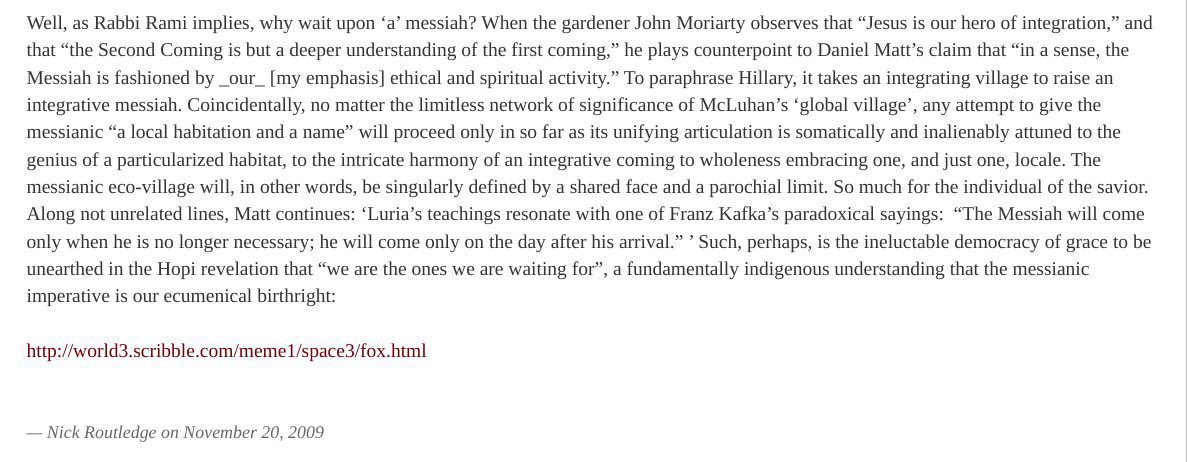
Image description
Original X alt text
Image from original tweet here:
Extended description
Pictured speaker / quoted attribution: Nick Routledge dated November 20 2009, quoting Moriarty, Daniel Matt/Kafka and Hopi saying Saved source record associated with pictured writing; full saved record, not an exact pictured excerpt. Passage boundary: Well as Rabbi Rami / messianic eco-village Source: Preserve quoted-author distinctions; the containing tweet does not confer authorship. First segment of alt-text for tweet above, of image originally tweeted here: Well, as Rabbi Rami implies, why wait upon ‘a’ messiah? When the gardener John Moriarty observes that “Jesus is our hero of integration,” and that “the Second Coming is but a deeper understanding of the first coming,” he plays counterpoint to Daniel Matt’s claim that “in a sense, the Messiah is fashioned by _our_ [my emphasis] ethical and spiritual activity.” To paraphrase Hillary, it takes an integrating village to raise an integrative messiah. Coincidentally, no matter the limitless network of significance of McLuhan’s ‘global village’, any attempt to give the messianic “a local habitation and a name” will proceed only in so far as its unifying articulation is somatically and inalienably attuned to the genius of a particularized habitat, to the intricate harmony of an integrative coming to wholeness embracing one, and just one, locale.
Open original documentExtended description
Pictured speaker / quoted attribution: Nick Routledge quoting Daniel Matt/Kafka and Hopi saying Saved source record associated with pictured writing; full saved record, not an exact pictured excerpt. Passage boundary: Along not unrelated lines / our ecumenical birthright Source: Preserve quoted-author distinctions; the containing tweet does not confer authorship. Second segment of alt-text for tweet above, of a text image originally tweeted here: The messianic eco-village will, in other words, be singularly defined by a shared face and a parochial limit. So much for the individual of the savior. Along not unrelated lines, Matt continues: ‘Luria’s teachings resonate with one of Franz Kafka’s paradoxical sayings: “The Messiah will come only when he is no longer necessary; he will come only on the day after his arrival.” * Such, perhaps, is the ineluctable democracy of grace to be unearthed in the Hopi revelation that “we are the ones we are waiting for”, a fundamentally indigenous understanding that the messianic imperative is our ecumenical birthright: — Nick Routledge on November 20, 2009
Open original document