
@trippfuller 6/ At the heart of "the redemption of the future from the power of history" (Adorno) stands what Benjamin refers to as "the messianic arrest", "the crystal of the total Event" (Eph 1:10). "The Messiah breaks off history; the Messiah does not appear at the end of a development."
Image description
Original X alt text
Agamben says that there is a disjunction within time, “a disconnection within the present moment that allows us to grasp time.” And this suddenly seized and gathered now is the only time that can stand against the immense force of the Law and the State. Agamben takes his lead from Walter Benjamin, who viewed the messianic as an experience within time rather than as the end of time. “Every day, every instant,” Benjamin wrote, “is the small gate through which the messiah enters.” Agamben expands this thought. “The time of the messiah cannot designate a chronological period or duration but, instead, must represent nothing less than a qualitative change in how time is experienced.” Other writers also agree with Agamben and Illich in finding that time opens inwardly. Blake, in his Vision of the Last Judgment, argues that a last judgment is a moment within time, not at the end of it. “Whenever any Individual Rejects Error and Embraces Truth, a Last Judgment passes upon that individual.”...
Image description
Original X alt text
…Plato, too, refers to time’s paradoxical character in a way reminiscent of Agamben’s definition of “the time that remains” as “the time time takes to come to an end.” In the Parmenides, Plato points out that when rest becomes motion or motion rest, there must be a transition in which the change from one to the other is effected. But when does this transition occur, he asks, since there can be no time when things are not either at rest or in motion? Between them occurs what Plato calls “this queer thing, the instant” that “occupies no time at all.” And this instantaneous occurrence, he says, is true of all transitions, supervening between the many and the one, the like and the unlike, the small and the great, just as it does between motion and rest. A change of state occupies no time, but it occurs in time. Rightly regarded, then, it is always a surprise and, to that extent, a gift. “Time,” Blake says, “is the mercy of eternity.” David Cayley Ivan Illich: An Intellectual Journey, 2021
Image description
Original X alt text
Qualitative time, studded with messianic splinters, stands radically opposed to the empty flow of the purely quantitative time of historicism and ‘progressism’. We are, here, in the rupture between messianic redemption and the ideology of progress, at the heart of the constellation formed by the conceptions of history of Benjamin, Scholem and Franz Rosenzweig, who draw on the Jewish religious tradition to contest the model of thought that is common to Christian theodicy, the Enlightenment and the Hegelian philosophy of history. By abandoning the Western teleological model, we pass from a time of necessity to a time of possibilities, a random time, open at any moment to the unforeseeable irruption of the new…The ‘splinters [Benjamin] of messianic time’ are the moments of revolt, the brief instants that save a past moment, while effecting a fleeting interruption of historical continuity, a break in the heart of the present. [Alt-text continues with next image]
Image description
Original X alt text
[Alt-text cont] As fragmentary, partial redemptions, they prefigure and herald the possibility of universal salvation. These ‘splinters’ refer, then, to the imminent or potential presence of the messianic era in history. Walter Löwy - The messianic intervention arises against all expectation and in untimely fashion, and flashes up the possibility of fulfilling desires that history had buried beneath the rubble. The messianic moment is that suspended moment or that suspension of time at which there emerges the fervent, incandescent, happy possibility that justice will at last come. Françoise Proust L’Histoire à Contretemps What Benjamin…borrows from religious experience is precisely the extreme attention to the qualitative difference of time, to the matchless uniqueness of each moment. If there is a point at which political vigilance connects most intimately to religious sensibility it is certainly here – at the very nub of the perception of time. Stéphane Mosès The Angel of History
@holdengraber @Samantharhill Benjamin also foresaw the ‘messianic eclipse’ bound within such catastrophic permanency ending in the game-ending 'blast' of a "tempieternal explosion” (Panikkar); a sudden, 'messianic arrest' yoking the architecture of redemptive time to everyday, temporal, political reality.
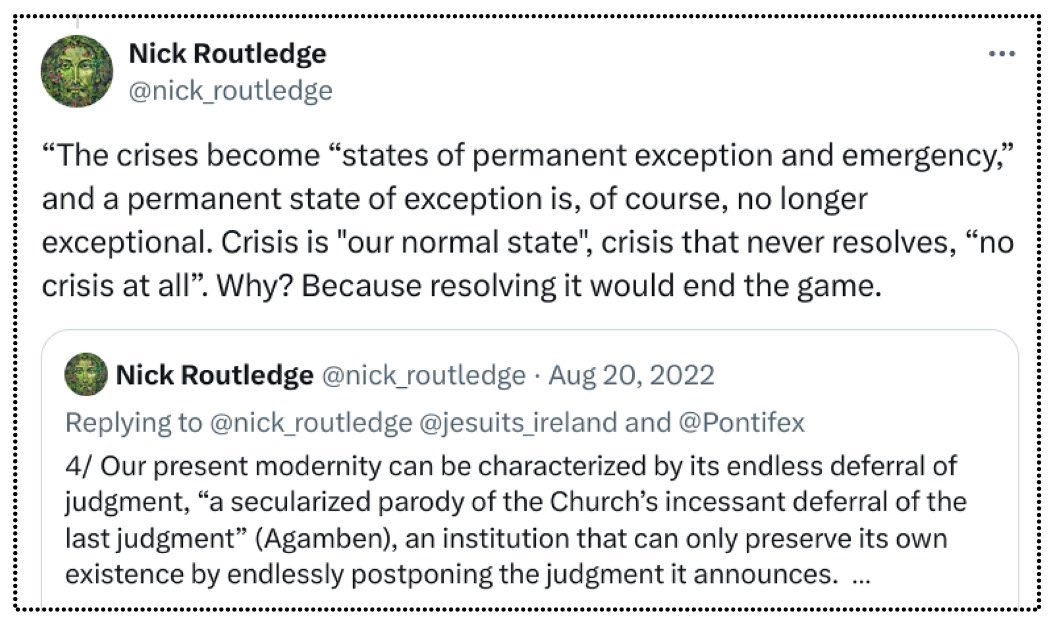
Image description
Original X alt text
Copy of tweet and quote tweet here: “The crises become “states of permanent exception and emergency,” and a permanent state of exception is, of course, no longer exceptional. Crisis is "our normal state", crisis that never resolves, “no crisis at all”. Why? Because resolving it would end the game. 4/ Our present modernity can be characterized by its endless deferral of judgment, “a secularized parody of the Church’s incessant deferral of the last judgment” (Agamben), an institution that can only preserve its own existence by endlessly postponing the judgment it announces.