
@lukeburgis end/ Moreover, Kafka's observation, "The Messiah will come only when he is no longer necessary; he will come only on the day after his arrival," attests to the Messiah's servant role as a symbolic blessing of salvation, as distinct from its source. The actual Redeemer is the All.
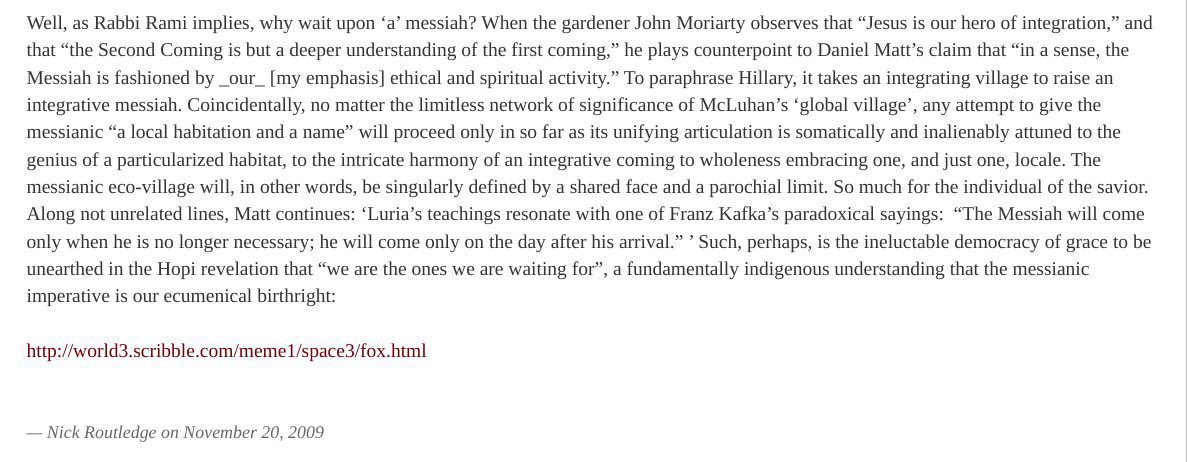
Image description
Original X alt text
Image from original tweet here:
Extended description
Pictured speaker / quoted attribution: Nick Routledge dated November 20 2009, quoting Moriarty, Daniel Matt/Kafka and Hopi saying Saved source record associated with pictured writing; full saved record, not an exact pictured excerpt. Passage boundary: Well as Rabbi Rami / messianic eco-village Source: Preserve quoted-author distinctions; the containing tweet does not confer authorship. First segment of alt-text for tweet above, of image originally tweeted here: Well, as Rabbi Rami implies, why wait upon ‘a’ messiah? When the gardener John Moriarty observes that “Jesus is our hero of integration,” and that “the Second Coming is but a deeper understanding of the first coming,” he plays counterpoint to Daniel Matt’s claim that “in a sense, the Messiah is fashioned by _our_ [my emphasis] ethical and spiritual activity.” To paraphrase Hillary, it takes an integrating village to raise an integrative messiah. Coincidentally, no matter the limitless network of significance of McLuhan’s ‘global village’, any attempt to give the messianic “a local habitation and a name” will proceed only in so far as its unifying articulation is somatically and inalienably attuned to the genius of a particularized habitat, to the intricate harmony of an integrative coming to wholeness embracing one, and just one, locale.
Open original documentExtended description
Pictured speaker / quoted attribution: Nick Routledge quoting Daniel Matt/Kafka and Hopi saying Saved source record associated with pictured writing; full saved record, not an exact pictured excerpt. Passage boundary: Along not unrelated lines / our ecumenical birthright Source: Preserve quoted-author distinctions; the containing tweet does not confer authorship. Second segment of alt-text for tweet above, of a text image originally tweeted here: The messianic eco-village will, in other words, be singularly defined by a shared face and a parochial limit. So much for the individual of the savior. Along not unrelated lines, Matt continues: ‘Luria’s teachings resonate with one of Franz Kafka’s paradoxical sayings: “The Messiah will come only when he is no longer necessary; he will come only on the day after his arrival.” * Such, perhaps, is the ineluctable democracy of grace to be unearthed in the Hopi revelation that “we are the ones we are waiting for”, a fundamentally indigenous understanding that the messianic imperative is our ecumenical birthright: — Nick Routledge on November 20, 2009
Open original document@Plough Until we begin truly moving upon God's coming and arrival, as distinct from waiting still, the 'eschatological proviso' will remain just that, a clause. And how and where do we imagine this actuality will manifest this time round? Through the usual channels? Ad-supported? C'mon.
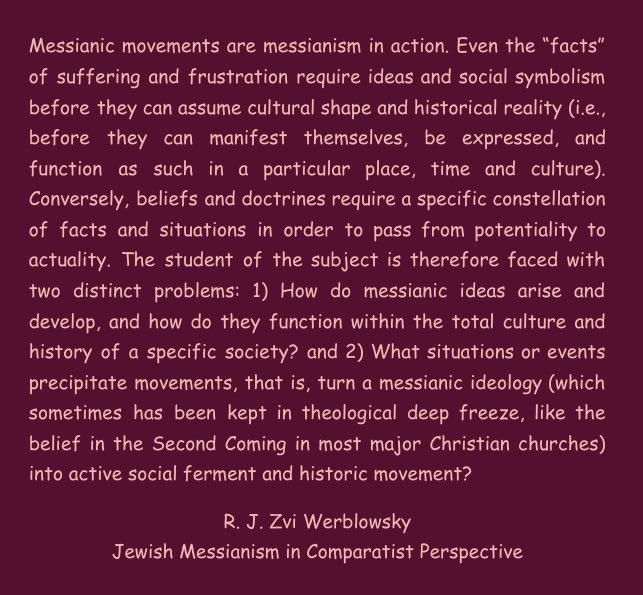
Image description
Original X alt text
Messianic movements are messianism in action. Even the “facts” of suffering and frustration require ideas and social symbolism before they can assume cultural shape and historical reality (i.e., before they can manifest themselves, be expressed, and function as such in a particular place, time and culture). Conversely, beliefs and doctrines require a specific constellation of facts and situations in order to pass from potentiality to actuality. The student of the subject is therefore faced with two distinct problems: 1) How do messianic ideas arise and develop, and how do they function within the total culture and history of a specific society? and 2) What situations or events precipitate movements, that is, turn a messianic ideology (which sometimes has been kept in theological deep freeze, like the belief in the Second Coming in most major Christian churches) into active social ferment and historic movement? R. J. Zvi Werblowsky Jewish Messianism in Comparatist Perspective
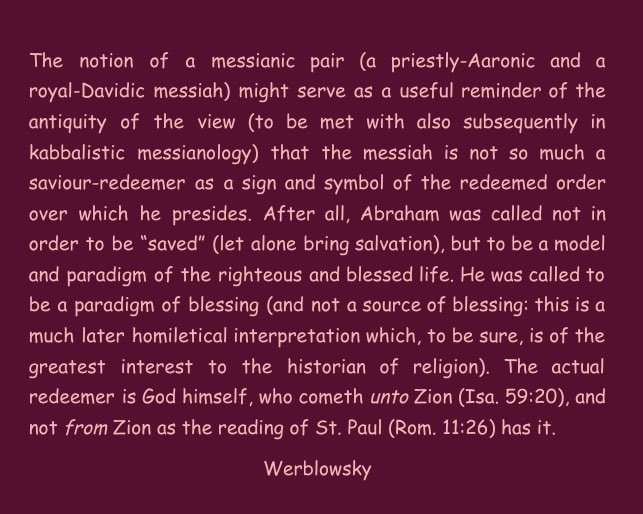
Image description
Original X alt text
The notion of a messianic pair (a priestly-Aaronic and a royal-Davidic messiah) might serve as a useful reminder of the antiquity of the view (to be met with also subsequently in kabbalistic messianology) that the messiah is not so much a saviour-redeemer as a sign and symbol of the redeemed order over which he presides. After all, Abraham was called not in order to be “saved” (let alone bring salvation), but to be a model and paradigm of the righteous and blessed life. He was called to be a paradigm of blessing (and not a source of blessing: this is a much later homiletical interpretation which, to be sure, is of the greatest interest to the historian of religion). The actual redeemer is God himself, who cometh unto Zion (Isa. 59:20), and not from Zion as the reading of St. Paul (Rom. 11:26) has it. Werblowsky
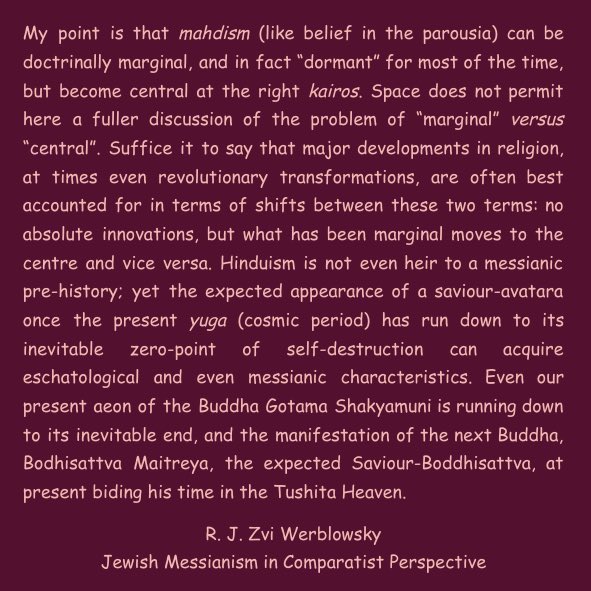
Image description
Original X alt text
My point is that mahdism (like belief in the parousia) can be doctrinally marginal, and in fact “dormant” for most of the time, but become central at the right kairos. Space does not permit here a fuller discussion of the problem of “marginal” versus “central”. Suffice it to say that major developments in religion, at times even revolutionary transformations, are often best accounted for in terms of shifts between these two terms: no absolute innovations, but what has been marginal moves to the centre and vice versa. Hinduism is not even heir to a messianic pre-history; yet the expected appearance of a saviour-avatara once the present yuga (cosmic period) has run down to its inevitable zero-point of self-destruction can acquire eschatological and even messianic characteristics. Even our present aeon of the Buddha Gotama Shakyamuni is running down to its inevitable end, and the manifestation of the next Buddha, the expected Saviour-Boddhisattva, Maitreya. R. J. Zvi Werblowsky