
RT @nick_routledge: @tenshi_anna 1/3 Love the term, "theopolitical inflection point." More? A hinge in the moral-cosmic order of public life, a phase change in public meaning, a crossing where metaphysics turns civic, a rupture where neutrality collapses, a meaning-regime pivot, a chronos-to-kairos crossover…
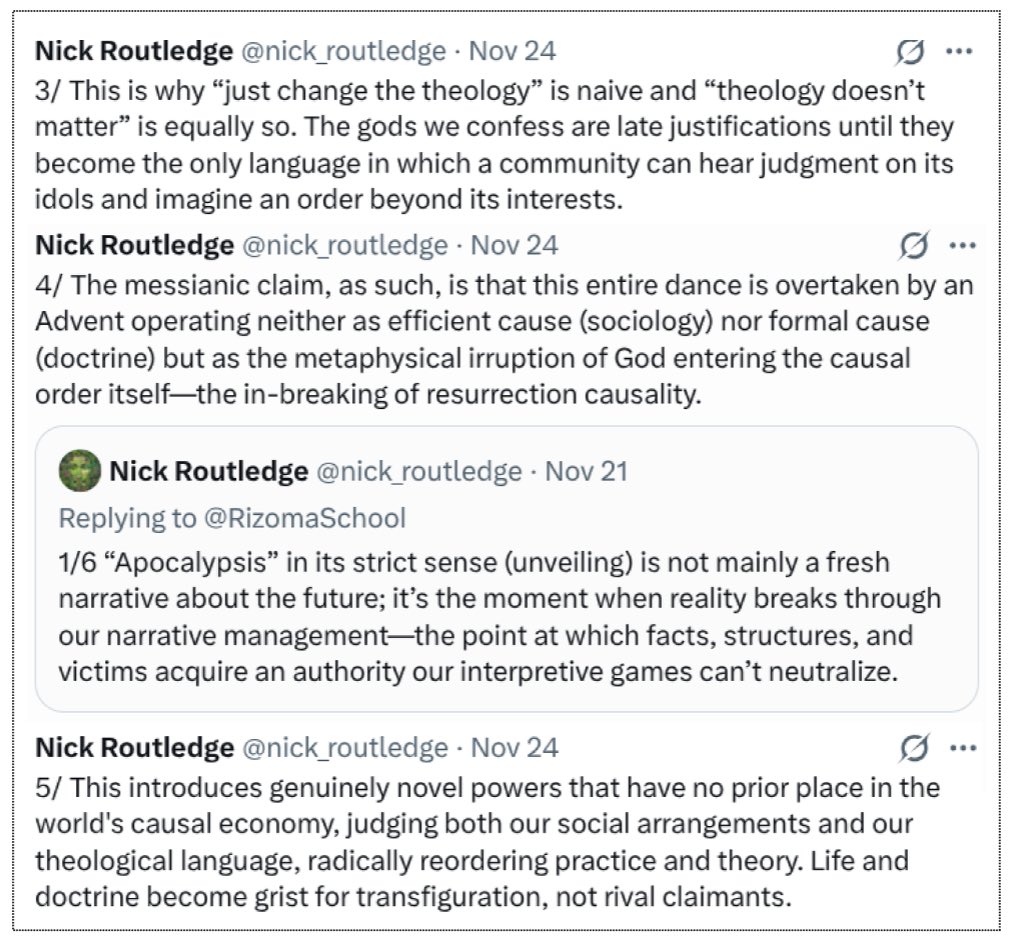
Image description
Extended description
Alt- text here: and 3/ This is why “just change the theology” is naive and “theology doesn’t matter” is equally so. The gods we confess are late justifications until they become the only language in which a community can hear judgment on its idols and imagine an order beyond its interests. 4/ The messianic claim, as such, is that this entire dance is overtaken by an Advent operating neither as efficient cause (sociology) nor formal cause (doctrine) but as the metaphysical irruption of God entering the causal order itself—the in-breaking of resurrection causality. 1/6 “Apocalypsis” in its strict sense (unveiling) is not mainly a fresh narrative about the future; it’s the moment when reality breaks through our narrative management—the point at which facts, structures, and victims acquire an authority our interpretive games can’t neutralize. 5/ This introduces genuinely novel powers that have no prior place in the world's causal economy, judging both our social arrangements and our theological language, radically reordering practice and theory. Life and doctrine become grist for transfiguration, not rival claimants.
Open original documentWith Bible study at the feet of the Southern Baptists on pause for Christmas, the Presbyterians of Cottage Grove, OR, have set my Advent homework this week: Matthew 1:18–25. An ancient claim about how God enters history—and what that entry demands of our faithfulness.
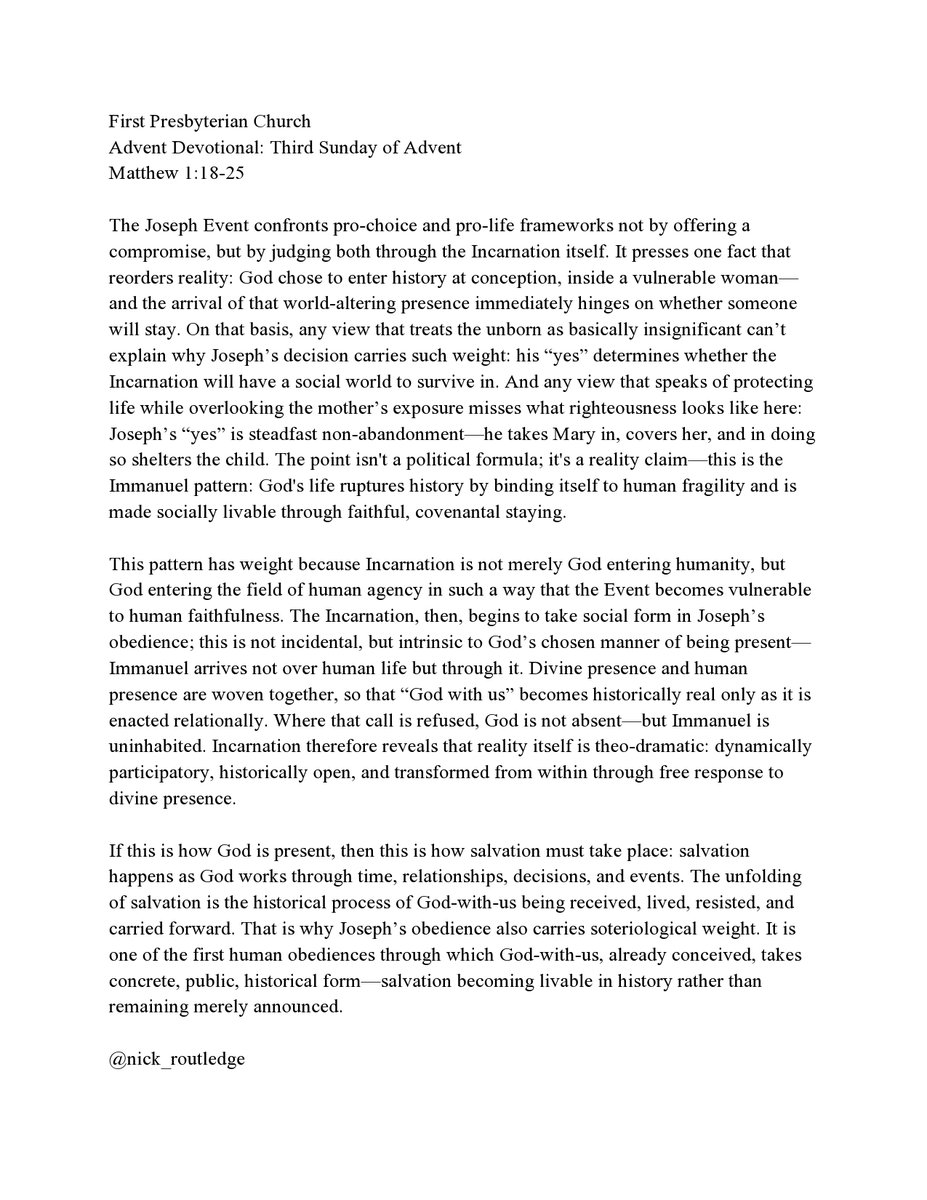
Image description
Extended description
First Presbyterian Church Advent Devotional: Third Sunday of Advent Matthew 1:18-25 The Joseph Event confronts pro-choice and pro-life frameworks not by offering a compromise, but by judging both through the Incarnation itself. It presses one fact that reorders reality: God chose to enter history at conception, inside a vulnerable woman—and the arrival of that world-altering presence immediately hinges on whether someone will stay. On that basis, any view that treats the unborn as basically insignificant can’t explain why Joseph’s decision carries such weight: his “yes” determines whether the Incarnation will have a social world to survive in. And any view that speaks of protecting life while overlooking the mother’s exposure misses what righteousness looks like here: Joseph’s “yes” is steadfast non-abandonment—he takes Mary in, covers her, and in doing so shelters the child. The point isn't a political formula; it's a reality claim—this is the Immanuel pattern: God's life ruptures history by binding itself to human fragility and is made socially livable through faithful, covenantal staying. This pattern has weight because Incarnation is not merely God entering humanity, but God entering the field of human agency in such a way that the Event becomes vulnerable to human faithfulness. The Incarnation, then, begins to take social form in Joseph’s obedience; this is not incidental, but intrinsic to God’s chosen manner of being present—Immanuel arrives not over human life but through it. Divine presence and human presence are woven together, so that “God with us” becomes historically real only as it is enacted relationally. Where that call is refused, God is not absent—but Immanuel is uninhabited. Incarnation therefore reveals that reality itself is theo-dramatic: dynamically participatory, historically open, and transformed from within through free response to divine presence. If this is how God is present, then this is how salvation must take place: salvation happens as God works through time, relationships, decisions, and events. The unfolding of salvation is the historical process of God-with-us being received, lived, resisted, and carried forward. That is why Joseph’s obedience also carries soteriological weight. It is one of the first human obediences through which God-with-us, already conceived, takes concrete, public, historical form—salvation becoming livable in history rather than remaining merely announced.
Open original document