
With Bible study at the feet of the Southern Baptists on pause for Christmas, the Presbyterians of Cottage Grove, OR, have set my Advent homework this week: Matthew 1:18–25. An ancient claim about how God enters history—and what that entry demands of our faithfulness.
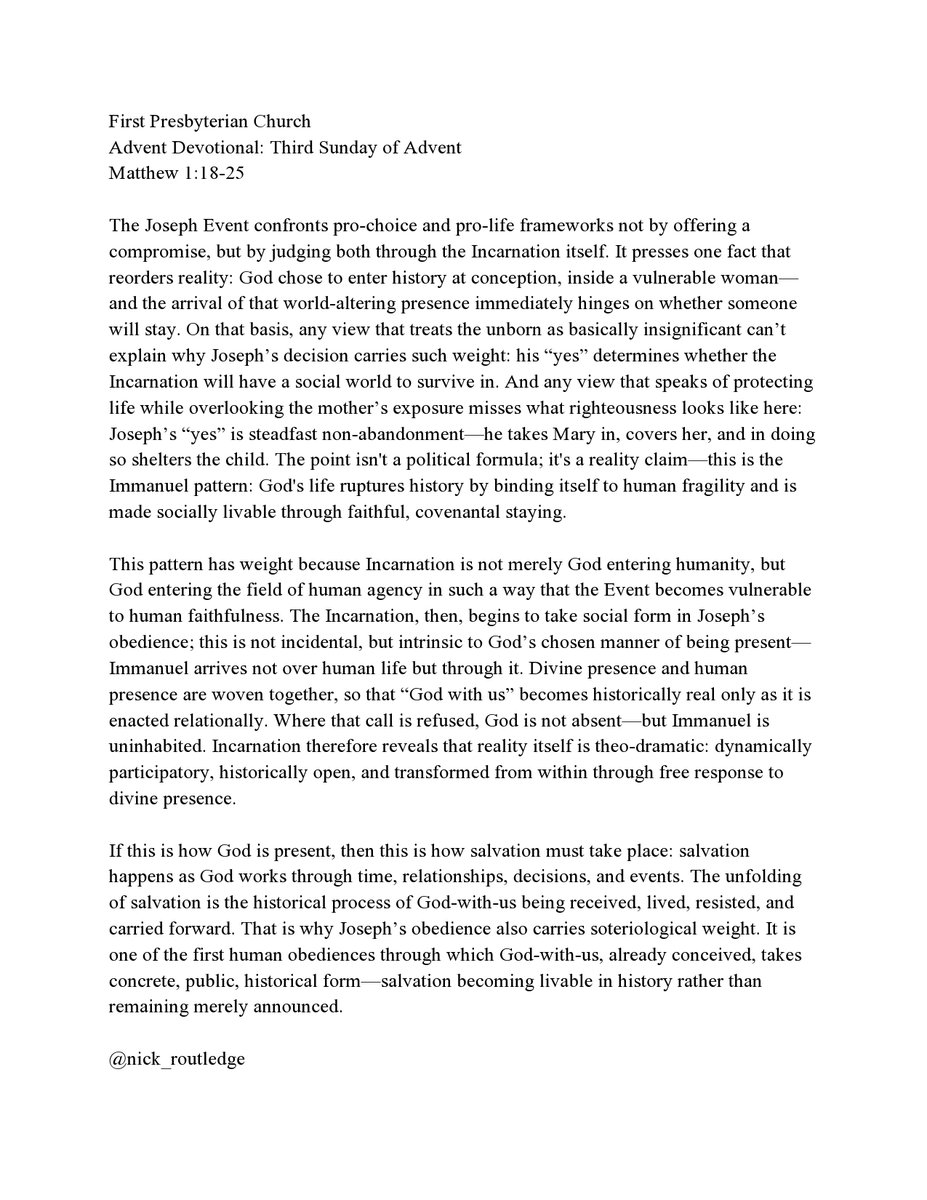
Image description
Extended description
First Presbyterian Church Advent Devotional: Third Sunday of Advent Matthew 1:18-25 The Joseph Event confronts pro-choice and pro-life frameworks not by offering a compromise, but by judging both through the Incarnation itself. It presses one fact that reorders reality: God chose to enter history at conception, inside a vulnerable woman—and the arrival of that world-altering presence immediately hinges on whether someone will stay. On that basis, any view that treats the unborn as basically insignificant can’t explain why Joseph’s decision carries such weight: his “yes” determines whether the Incarnation will have a social world to survive in. And any view that speaks of protecting life while overlooking the mother’s exposure misses what righteousness looks like here: Joseph’s “yes” is steadfast non-abandonment—he takes Mary in, covers her, and in doing so shelters the child. The point isn't a political formula; it's a reality claim—this is the Immanuel pattern: God's life ruptures history by binding itself to human fragility and is made socially livable through faithful, covenantal staying. This pattern has weight because Incarnation is not merely God entering humanity, but God entering the field of human agency in such a way that the Event becomes vulnerable to human faithfulness. The Incarnation, then, begins to take social form in Joseph’s obedience; this is not incidental, but intrinsic to God’s chosen manner of being present—Immanuel arrives not over human life but through it. Divine presence and human presence are woven together, so that “God with us” becomes historically real only as it is enacted relationally. Where that call is refused, God is not absent—but Immanuel is uninhabited. Incarnation therefore reveals that reality itself is theo-dramatic: dynamically participatory, historically open, and transformed from within through free response to divine presence. If this is how God is present, then this is how salvation must take place: salvation happens as God works through time, relationships, decisions, and events. The unfolding of salvation is the historical process of God-with-us being received, lived, resisted, and carried forward. That is why Joseph’s obedience also carries soteriological weight. It is one of the first human obediences through which God-with-us, already conceived, takes concrete, public, historical form—salvation becoming livable in history rather than remaining merely announced.
Open original documentImmanuel isn’t a doctrine about where God is. It’s the recovery of reality itself—not more belief, but the restoration of the real—until “God as Reality” ceases to be a topic and becomes encounter: the nearest actuality, the active “is,” reality’s very reality, the Living God.
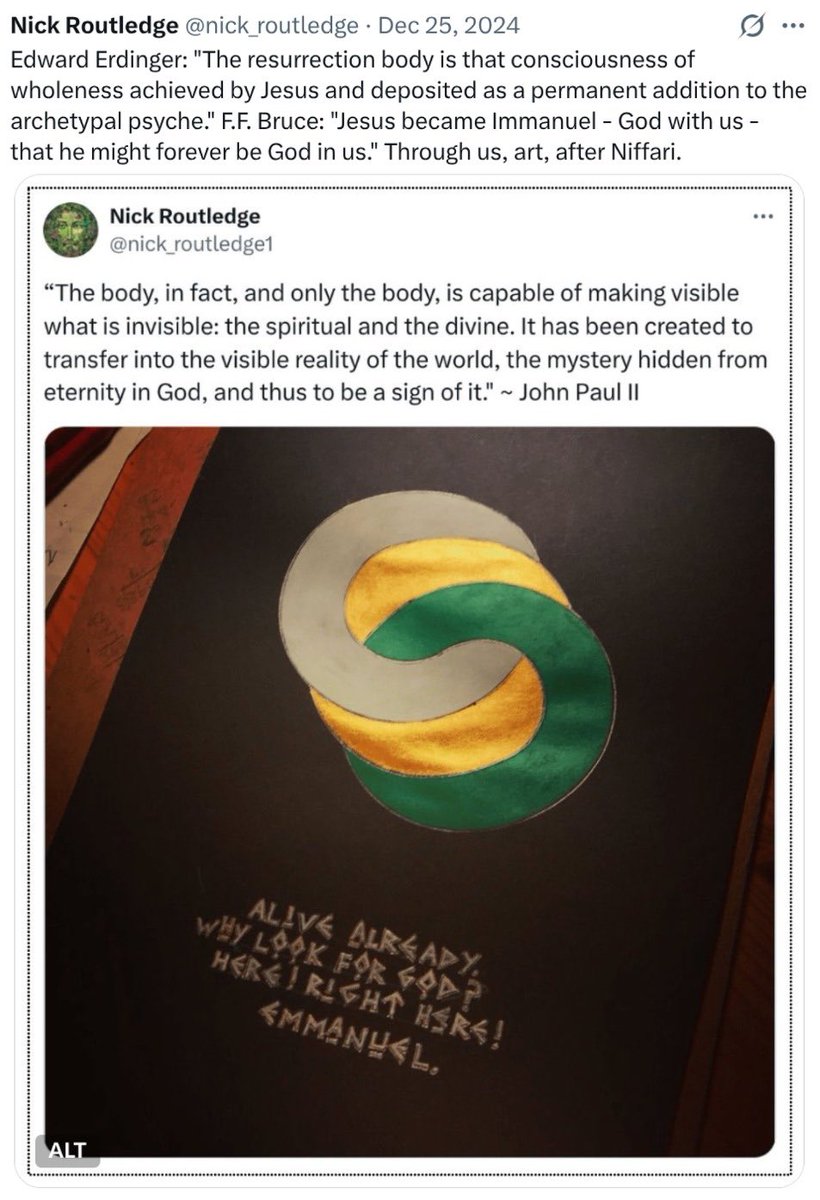
Image description
Original X alt text
Edward Erdinger: "The resurrection body is that consciousness of wholeness achieved by Jesus and deposited as a permanent addition to the archetypal psyche." F.F. Bruce: "Jesus became Immanuel - God with us - that he might forever be God in us." Through us, art, after Niffari. John Paul II: “The body, in fact, and only the body, is capable of making visible what is invisible: the spiritual and the divine. It has been created to transfer into the visible reality of the world, the mystery hidden from eternity in God, and thus to be a sign of it." Painting of three interlocking rings with calligraphy reading, Alive already. Why look for God? Here! Right here! Emmanuel. [After Abd-ul-Jabbar Niffari: "Why look for God up there? He's here! Here!"]