
@tenshi_anna 2/ ...a present bent by its teleological horizon, the moment when the hidden God shows itself, the katechon-to-eschaton crossover, the eschatonic flashpoint, Grace as the Real becoming obvious, the Hour of Unveiling, the Cloud Event as eschatological proviso and disclosure…
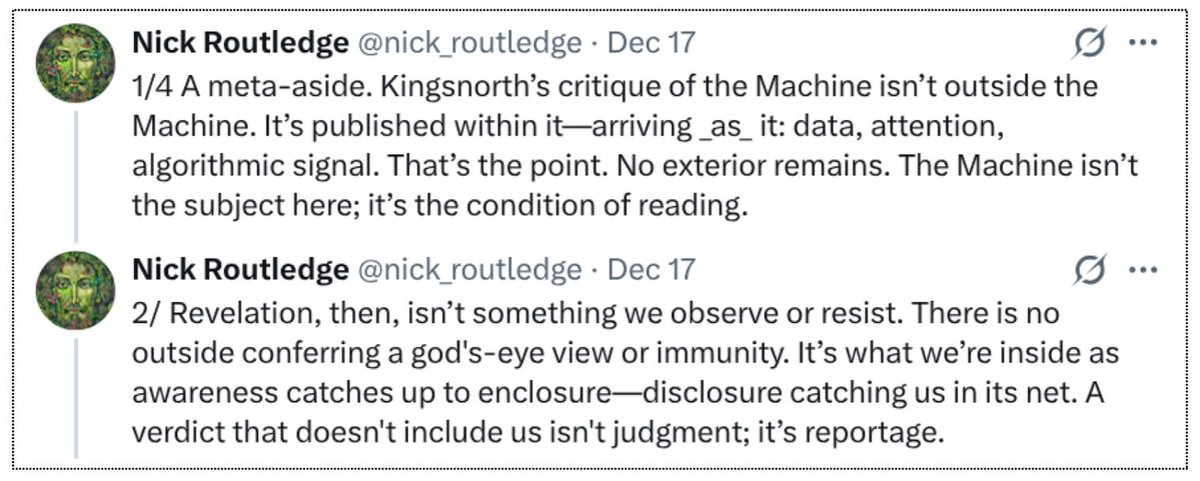
Image description
Original X alt text
@nick_routledge· 1/4 A meta-aside. Kingsnorth’s critique of the Machine isn’t outside the Machine. It’s published within it—arriving _as_ it: data, attention, algorithmic signal. That’s the point. No exterior remains. The Machine isn’t the subject here; it’s the condition of reading. 2/ Revelation, then, isn’t something we observe or resist. There is no outside conferring a god's-eye view or immunity. It’s what we’re inside as awareness catches up to enclosure—disclosure catching us in its net. A verdict that doesn't include us isn't judgment; it’s reportage.
@Plough 3/ That’s the apocalyptic fact. The Machine becomes the site of judgment-mercy—verdict _as_ unveiling. Reader and text, biosphere and logosphere, chronos and kairos, human and divine are driven into answerability at once, in real time. The Event authenticates itself by happening.
View this post’s context →