
@sentantiq end\ Here diachrony confronts its constitutive limit: it can train the eye but cannot summon what the eye beholds. Revelation's Subject remains sovereign over revelation's timing. This is the grammar of transcendence—arriving not as yield but as Grace. The Hour remains God's.
@tenshi_anna 1/3 Love the term, "theopolitical inflection point." More? A hinge in the moral-cosmic order of public life, a phase change in public meaning, a crossing where metaphysics turns civic, a rupture where neutrality collapses, a meaning-regime pivot, a chronos-to-kairos crossover…
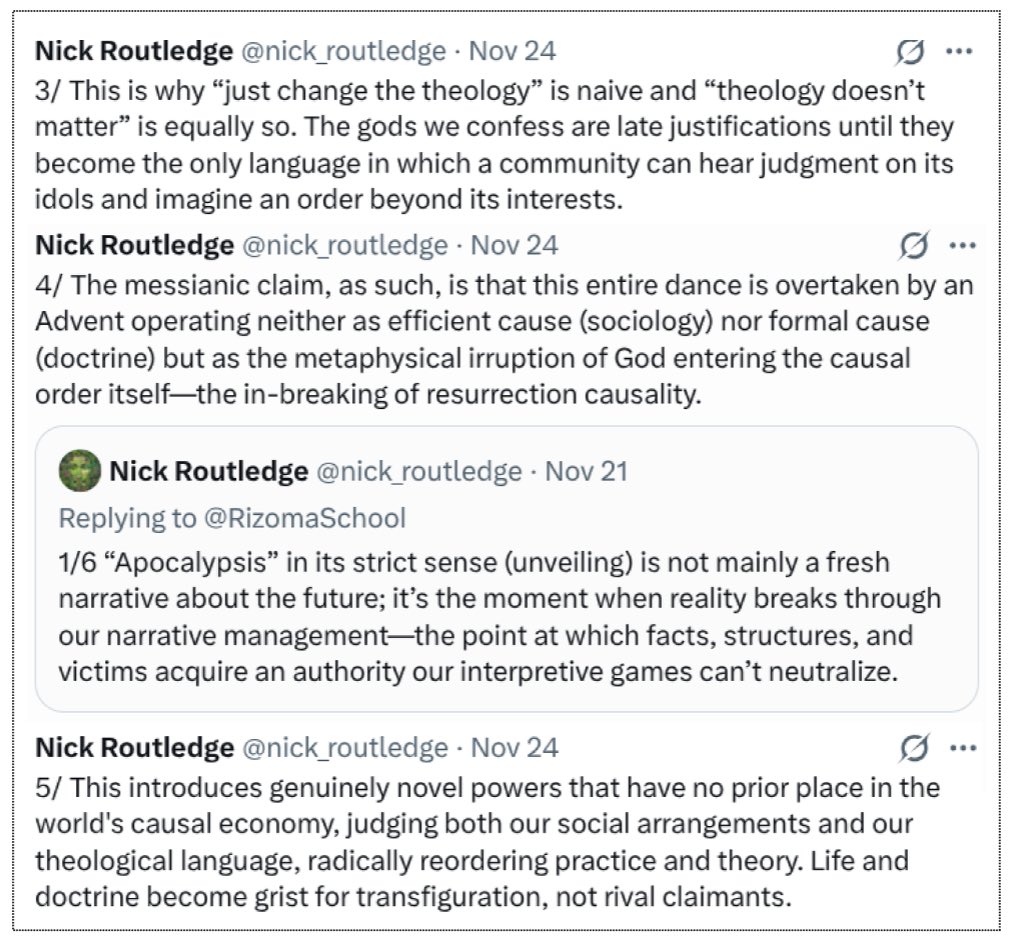
Image description
Extended description
Alt- text here: and 3/ This is why “just change the theology” is naive and “theology doesn’t matter” is equally so. The gods we confess are late justifications until they become the only language in which a community can hear judgment on its idols and imagine an order beyond its interests. 4/ The messianic claim, as such, is that this entire dance is overtaken by an Advent operating neither as efficient cause (sociology) nor formal cause (doctrine) but as the metaphysical irruption of God entering the causal order itself—the in-breaking of resurrection causality. 1/6 “Apocalypsis” in its strict sense (unveiling) is not mainly a fresh narrative about the future; it’s the moment when reality breaks through our narrative management—the point at which facts, structures, and victims acquire an authority our interpretive games can’t neutralize. 5/ This introduces genuinely novel powers that have no prior place in the world's causal economy, judging both our social arrangements and our theological language, radically reordering practice and theory. Life and doctrine become grist for transfiguration, not rival claimants.
Open original document