
RT @nick_routledge: @alon_mizrahi 1/8 “The iron bridge of the Messiah”—Kafka’s image of the brittle threshold between history and redemption. The Messiah crosses just as the bridge collapses. What brought us this far—iron, empire, machine—cannot cross into the new world. Collapse is not failure. It is release.
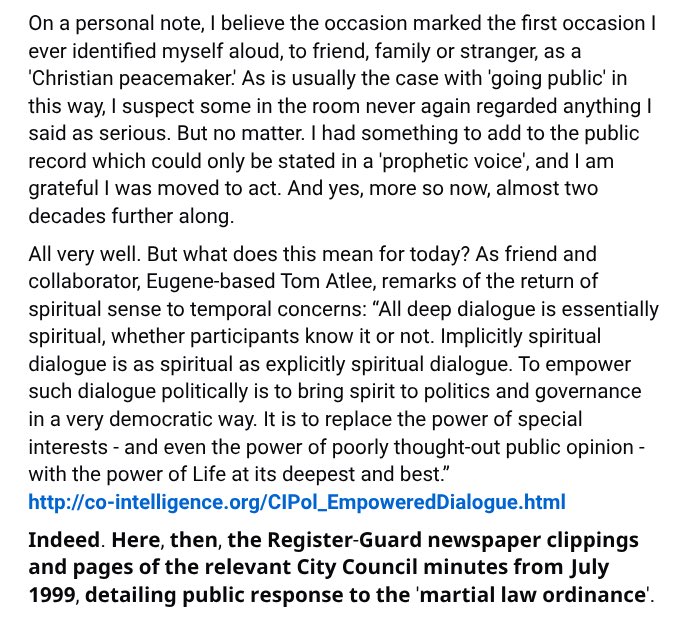
Image description
Original X alt text
[Edited for length] ...All very well. But what does this mean for today? As friend and collaborator, Eugene-based Tom Atlee, remarks of the return of spiritual sense to temporal concerns: “All deep dialogue is essentially spiritual, whether participants know it or not. Implicitly spiritual dialogue is as spiritual as explicitly spiritual dialogue. To empower such dialogue politically is to bring spirit to politics and governance in a very democratic way. It is to replace the power of special interests - and even the power of poorly thought-out public opinion - with the power of Life at its deepest and best.” Indeed. Here, then, the Register-Guard newspaper clippings and pages of the relevant City Council minutes from July 1999, detailing public response to the 'martial law ordinance'.
@lukeburgis end/ Moreover, Kafka's observation, "The Messiah will come only when he is no longer necessary; he will come only on the day after his arrival," attests to the Messiah's servant role as a symbolic blessing of salvation, as distinct from its source. The actual Redeemer is the All.
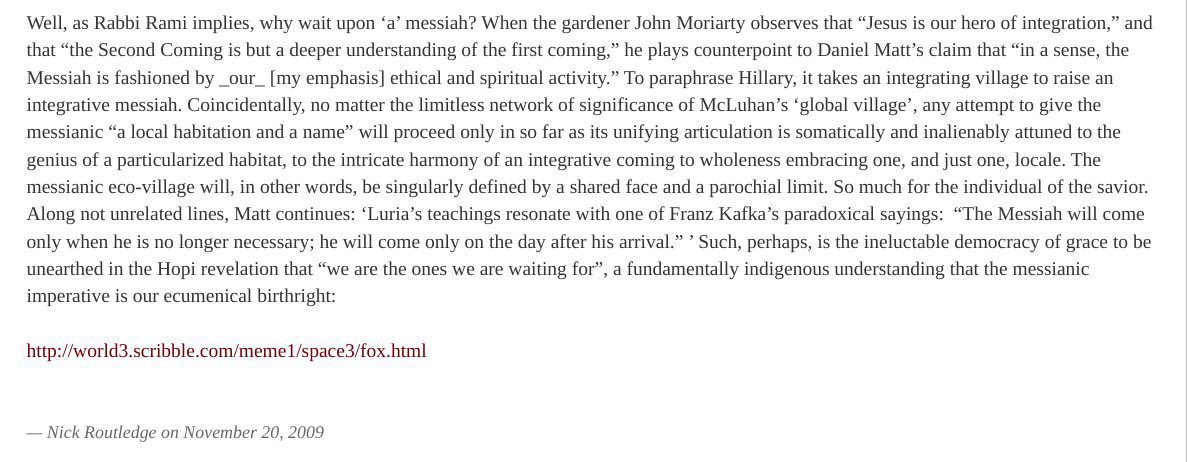
Image description
Original X alt text
Image from original tweet here:
Extended description
Pictured speaker / quoted attribution: Nick Routledge dated November 20 2009, quoting Moriarty, Daniel Matt/Kafka and Hopi saying Saved source record associated with pictured writing; full saved record, not an exact pictured excerpt. Passage boundary: Well as Rabbi Rami / messianic eco-village Source: Preserve quoted-author distinctions; the containing tweet does not confer authorship. First segment of alt-text for tweet above, of image originally tweeted here: Well, as Rabbi Rami implies, why wait upon ‘a’ messiah? When the gardener John Moriarty observes that “Jesus is our hero of integration,” and that “the Second Coming is but a deeper understanding of the first coming,” he plays counterpoint to Daniel Matt’s claim that “in a sense, the Messiah is fashioned by _our_ [my emphasis] ethical and spiritual activity.” To paraphrase Hillary, it takes an integrating village to raise an integrative messiah. Coincidentally, no matter the limitless network of significance of McLuhan’s ‘global village’, any attempt to give the messianic “a local habitation and a name” will proceed only in so far as its unifying articulation is somatically and inalienably attuned to the genius of a particularized habitat, to the intricate harmony of an integrative coming to wholeness embracing one, and just one, locale.
Open original documentExtended description
Pictured speaker / quoted attribution: Nick Routledge quoting Daniel Matt/Kafka and Hopi saying Saved source record associated with pictured writing; full saved record, not an exact pictured excerpt. Passage boundary: Along not unrelated lines / our ecumenical birthright Source: Preserve quoted-author distinctions; the containing tweet does not confer authorship. Second segment of alt-text for tweet above, of a text image originally tweeted here: The messianic eco-village will, in other words, be singularly defined by a shared face and a parochial limit. So much for the individual of the savior. Along not unrelated lines, Matt continues: ‘Luria’s teachings resonate with one of Franz Kafka’s paradoxical sayings: “The Messiah will come only when he is no longer necessary; he will come only on the day after his arrival.” * Such, perhaps, is the ineluctable democracy of grace to be unearthed in the Hopi revelation that “we are the ones we are waiting for”, a fundamentally indigenous understanding that the messianic imperative is our ecumenical birthright: — Nick Routledge on November 20, 2009
Open original document