
@lukeburgis 2/ History following an apocalyptic logic goes both ways, of course. Yes, humanity's vocation to betterment; but simultaneously conjoined with the equally mysterious advance of a dark corruption. Until, that is, 'apocalypsis', our Day, Hour or Moment of vision and decision.
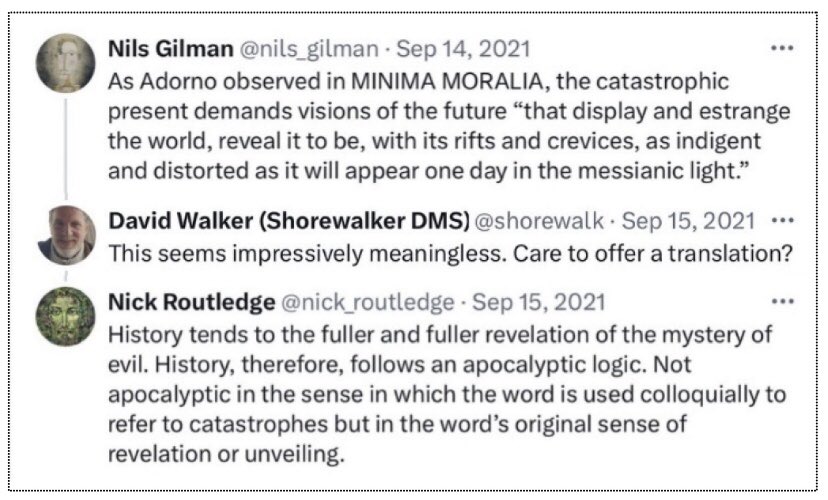
Image description
Original X alt text
Copy of tweet thread here: As Adorno observed in MINIMA MORALIA, the catastrophic present demands visions of the future “that display and estrange the world, reveal it to be, with its rifts and crevices, as indigent and distorted as it will appear one day in the messianic light.” This seems impressively meaningless. Care to offer a translation? History tends to the fuller and fuller revelation of the mystery of evil. History, therefore, follows an apocalyptic logic. Not apocalyptic in the sense in which the word is used colloquially to refer to catastrophes but in the word’s original sense of revelation or unveiling.
@BrianZahnd And fascinating, isn't it, how clean the cut, here, in this stuff, cleaving truth from falsehood, wheat from tares, and the New World Creation from an Extinction Tyranny. Cosmic severance for real, in real time, delineating in the minutiae of Twitter posts and comments. #osint
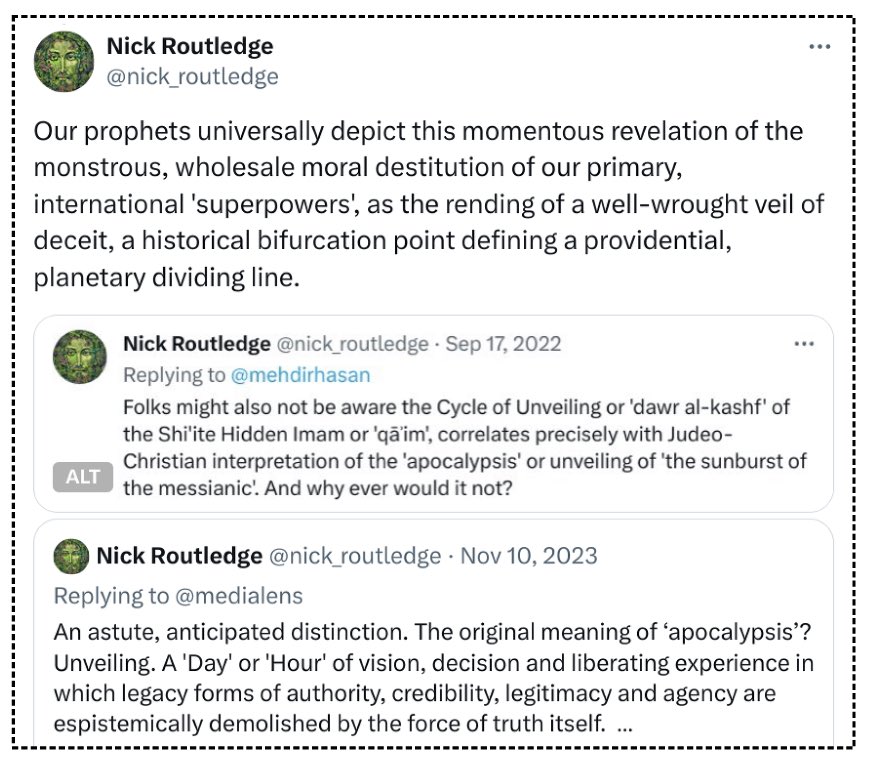
Image description
Original X alt text
Copy of tweet here: Our prophets universally depict this momentous revelation of the monstrous, wholesale moral destitution of our primary, international 'superpowers', as the rending of a well-wrought veil of deceit, a historical bifurcation point defining a providential, planetary dividing line. Folks might also not be aware the Cycle of Unveiling or 'dawr al-kashf' of the Shi'ite Hidden Imam or 'qāʾim', correlates precisely with Judeo-Christian interpretation of the 'apocalypsis' or unveiling of 'the sunburst of the messianic'. And why ever would it not? An astute, anticipated distinction. The original meaning of ‘apocalypsis’? Unveiling. A 'Day' or 'Hour' of vision, decision and liberating experience in which legacy forms of authority, credibility, legitimacy and agency are espistemically demolished by the force of truth itself.
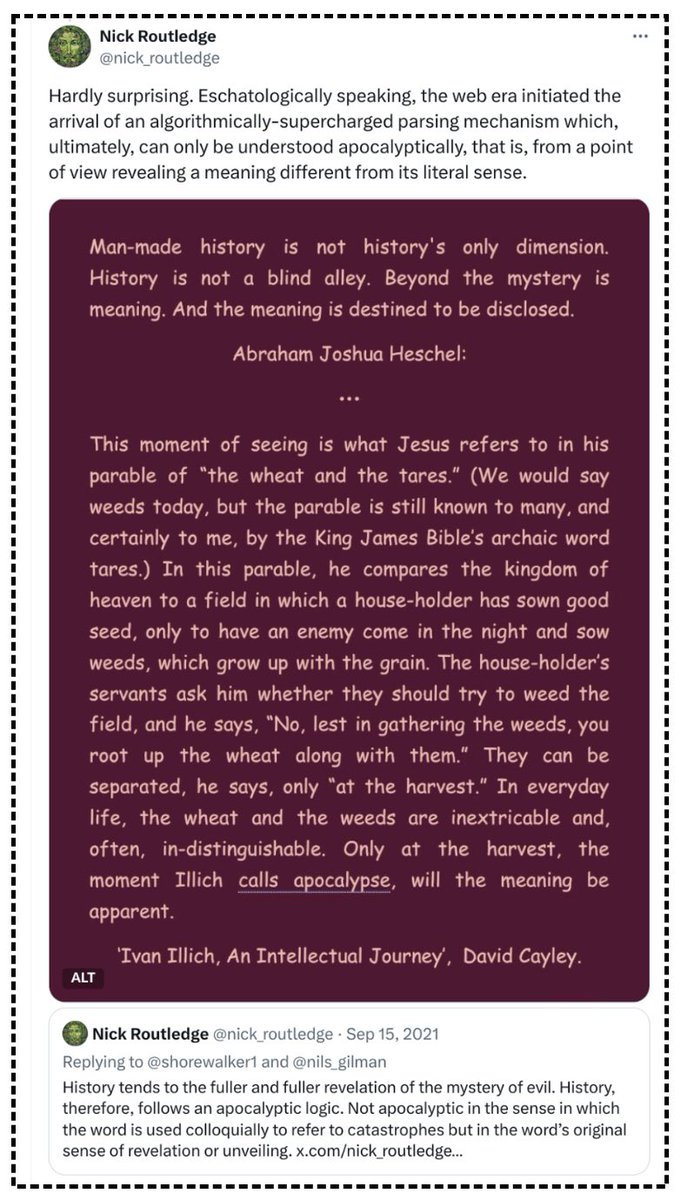
Image description
Original X alt text
Copy of tweet, image and quote tweet here:
Extended description
Pictured speaker / quoted attribution: Nick Routledge Saved source record associated with pictured writing; full saved record, not an exact pictured excerpt. Passage boundary: Hardly surprising Source: Preserve quoted-author distinctions; the containing tweet does not confer authorship. @johnrobb Hardly surprising. Eschatologically speaking, the web era initiated the arrival of an algorithmically-supercharged parsing mechanism which, ultimately, can only be understood apocalyptically, that is, from a point of view revealing a meaning different from its literal sense. t.co/xau7I0DMyP
Open original documentExtended description
Pictured speaker / quoted attribution: Abraham Joshua Heschel; David Cayley, Ivan Illich An Intellectual Journey Saved source record associated with pictured writing; full saved record, not an exact pictured excerpt. Passage boundary: Man-made history / This moment of seeing / History tends Source: archive.nickroutledge.org/post/1835654830611919293 Preserve quoted-author distinctions; the containing tweet does not confer authorship. Hardly surprising. Eschatologically speaking, the web era initiated the arrival of an algorithmically-supercharged parsing mechanism which, ultimately, can only be understood apocalyptically, that is, from a point of view revealing a meaning different from its literal sense. Man-made history is not history's only dimension. History is not a blind alley. Beyond the mystery is meaning. And the meaning is destined to be disclosed. - Abraham Joshua Heschel This moment of seeing is what Jesus refers to in his parable of “the wheat and the tares.” (We would say weeds today, but the parable is still known to many, and certainly to me, by the King James Bible’s archaic word tares.) In this parable, he compares the kingdom of heaven to a field in which a house-holder has sown good seed, only to have an enemy come in the night and sow weeds, which grow up with the grain. The house-holder’s servants ask him whether they should try to weed the field, and he says, “No, lest in gathering the weeds, you root up the wheat along with them.” They can be separated, he says, only “at the harvest.” In everyday life, the wheat and the weeds are inextricable and, often, in-distinguishable. Only at the harvest, the moment Illich calls apocalypse, will the meaning be apparent. - Ivan Illich, An Intellectual JourneyDavid Cayley. Subtweet: History tends to the fuller and fuller revelation of the mystery of evil. History, therefore, follows an apocalyptic logic. Not apocalyptic in the sense in which the word is used colloquially to refer to catastrophes but in the word’s original sense of revelation or unveiling.
Open original document