
@TimMiddleton1 @SST_Theology @calebwgordon Thoughts? Hervieu-Lèger and Orsi argue the study of 'lived religion' key to illuminating 'theology for Real.' Given that the incarnational dynamism of new world creation, in practice, gives rise to no less than a New Reality, perhaps broaden the ontological terms of engagement?
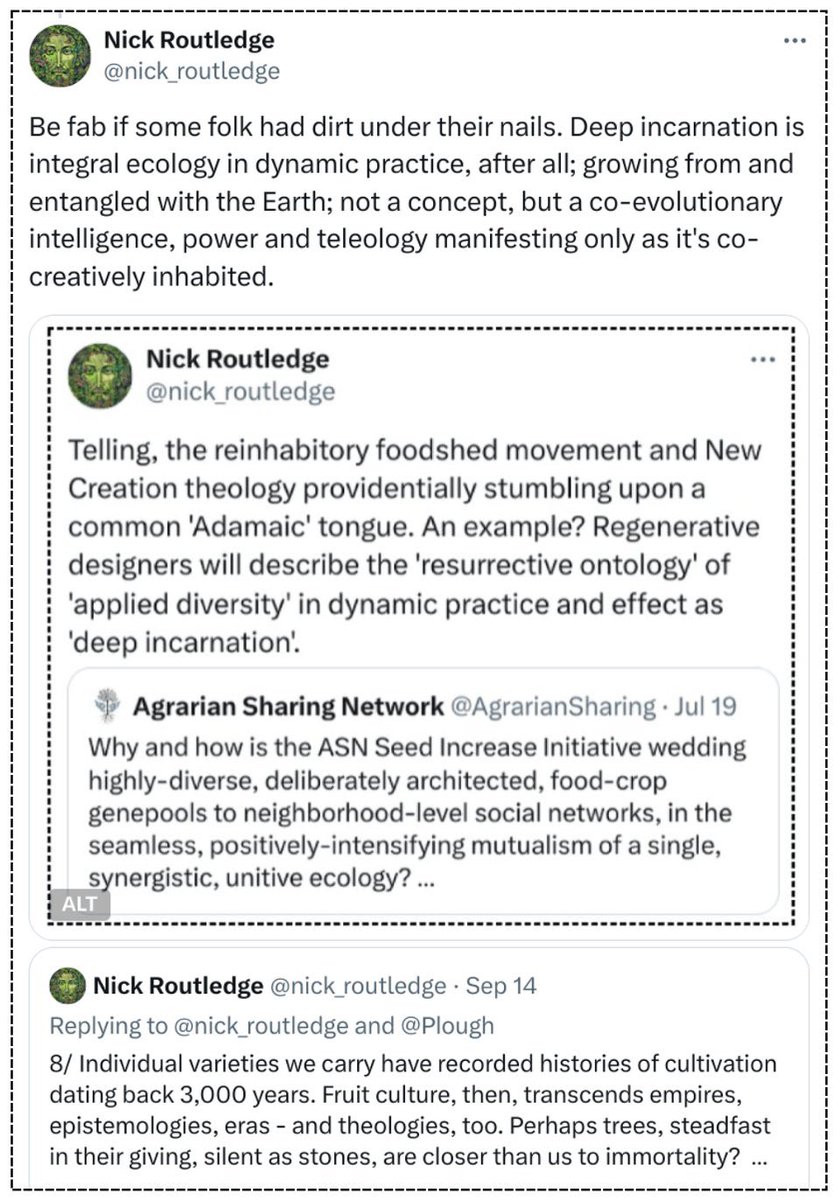
Image description
Original X alt text
Copy of tweet, image and quote tweet here:
Extended description
Pictured speaker / quoted attribution: Nick Routledge; Agrarian Sharing Network in deepest quote Saved source record associated with pictured writing; full saved record, not an exact pictured excerpt. Passage boundary: Be fab / Telling / Why and how Source: Preserve quoted-author distinctions; the containing tweet does not confer authorship. Copy of tweet hereL Be fab if some folk had dirt under their nails. Deep incarnation is integral ecology in dynamic practice, after all; growing from and entangled with the Earth; not a concept, but a co-evolutionary intelligence, power and teleology manifesting only as it's co-creatively inhabited. Telling, the reinhabitory foodshed movement and New Creation theology providentially stumbling upon a common 'Adamaic' tongue. An example? Regenerative designers will describe the 'resurrective ontology' of 'applied diversity' in dynamic practice and effect as 'deep incarnation'. Quote tweet: Why and how is the ASN Seed Increase Initiative wedding highly-diverse, deliberately architected, food-crop genepools to neighborhood-level social networks, in the seamless, positively-intensifying mutualism of a single, synergistic, unitive ecology?
Open original documentExtended description
Pictured speaker / quoted attribution: Nick Routledge Saved source record associated with pictured writing; full saved record, not an exact pictured excerpt. Passage boundary: 8 Individual varieties Source: archive.nickroutledge.org/post/1843448168022978709 Preserve quoted-author distinctions; the containing tweet does not confer authorship. @Plough 8/ Individual varieties we carry have recorded histories of cultivation dating back 3,000 years. Fruit culture, then, transcends empires, epistemologies, eras - and theologies, too. Perhaps trees, steadfast in their giving, silent as stones, are closer than us to immortality? t.co/Pn0wSB57H9 t.co/7OtYk4bWT3
Open original document@BrianZahnd @UniteThePoor 3/ Home is where all our attempts to escape cease. Deep Incarnation, then, a complete form of Belonging in which the synchronous resurrection of heaven and earth dynamically complete one another; the World Soul's homecoming, the all in all, in us. What is found now is found then.
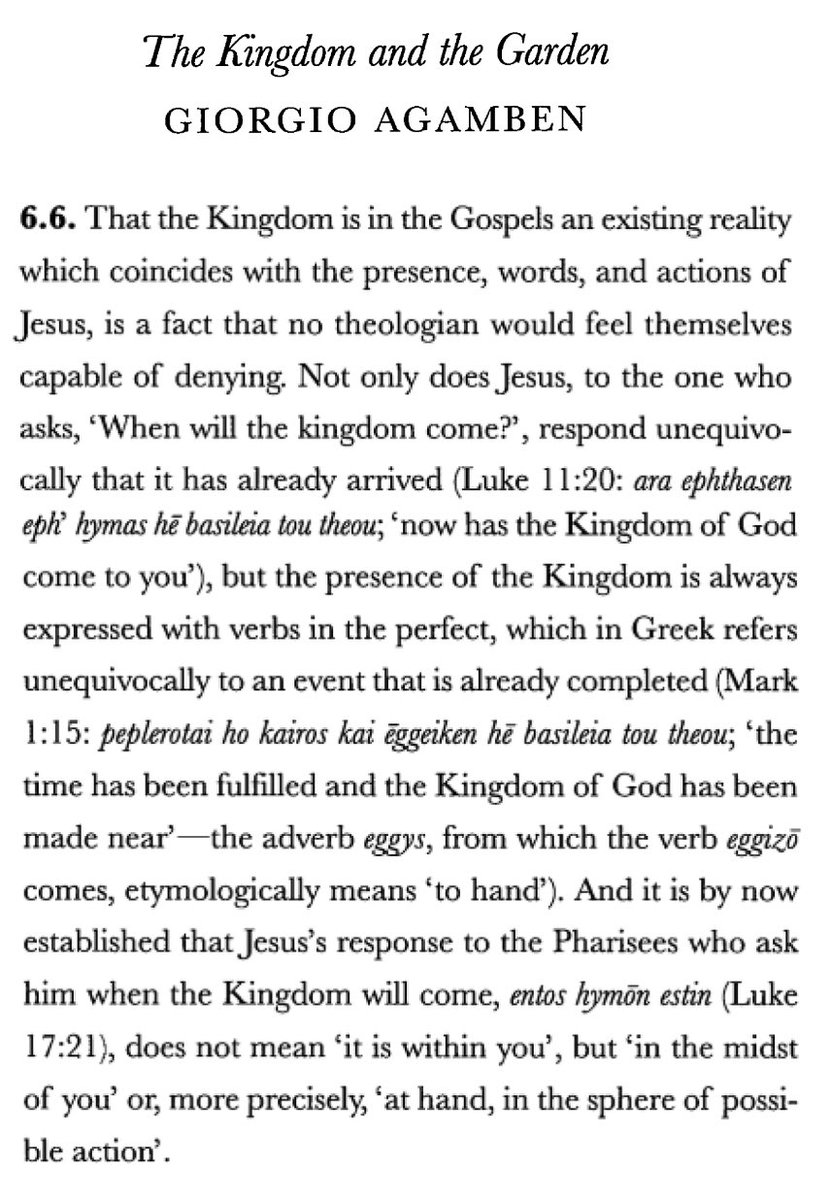
Image description
Original X alt text
The Kingdom and the Garden AGAMBEN 6.6. That the Kingdom is in the Gospels an existing reality which coincides with the presence, words, and actions of Jesus, is a fact that no theologian would feel themselves capable of denying, Not only does Jesus, to the one who asks, “When will the kingdom come?” respond unequivocally that it has already arrived (“now has the Kingdom of God come to you’), but the presence of the Kingdom is always expressed with verbs in the perfect, which in Greek refers unequivocally to an event that is already completed (‘the time has been fulfilled and the Kingdom of God has been made near’ — the adverb egys, from which the verb eggizo comes, etymologically means ‘to hand’). And it is by now established that Jesus's response to the Pharisees who ask him when the Kingdom will come, entos ymin estin (Luke 17:21), does not mean ‘it is within you’, but ‘in the midst of you’ or, more precisely, ‘at hand, in the sphere of possible action’.
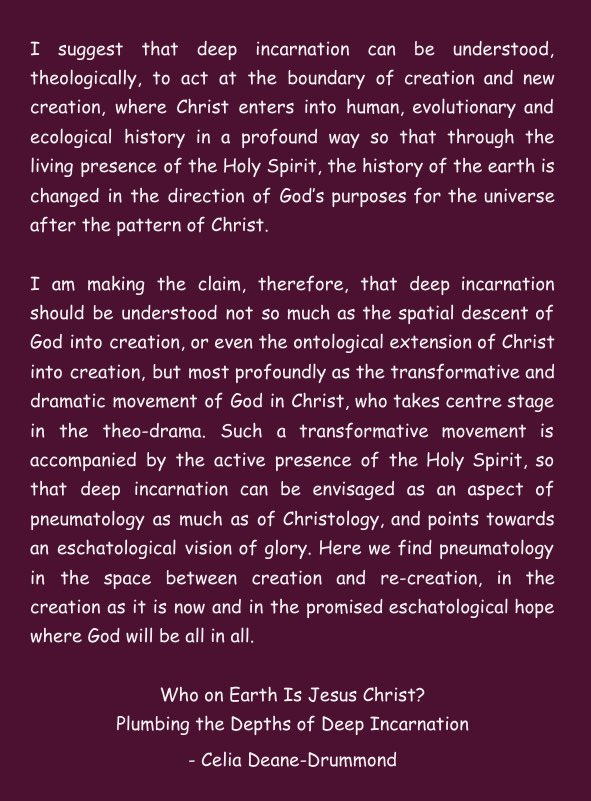
Image description
Original X alt text
I suggest that deep incarnation can be understood, theologically, to act at the boundary of creation and new creation, where Christ enters into human, evolutionary and ecological history in a profound way so that through the living presence of the Holy Spirit...deep incarnation should be understood not so much as the spatial descent of God into creation, or even the ontological extension of Christ into creation, but most profoundly as the transformative and dramatic movement of God in Christ, who takes centre stage in the theo-drama...accompanied by the active presence of the Holy Spirit, so that deep incarnation can be envisaged as an aspect of pneumatology as much as of Christology, an eschatological vision of glory. Here we find pneumatology in the space between creation and re-creation, in the creation as it is now and in the promised eschatological hope where God will be all in all. Who on Earth Is Jesus Christ? Plumbing the Depths of Deep Incarnation - Celia Deane-Drummond