
@BrianZahnd @UniteThePoor 3/ Home is where all our attempts to escape cease. Deep Incarnation, then, a complete form of Belonging in which the synchronous resurrection of heaven and earth dynamically complete one another; the World Soul's homecoming, the all in all, in us. What is found now is found then.
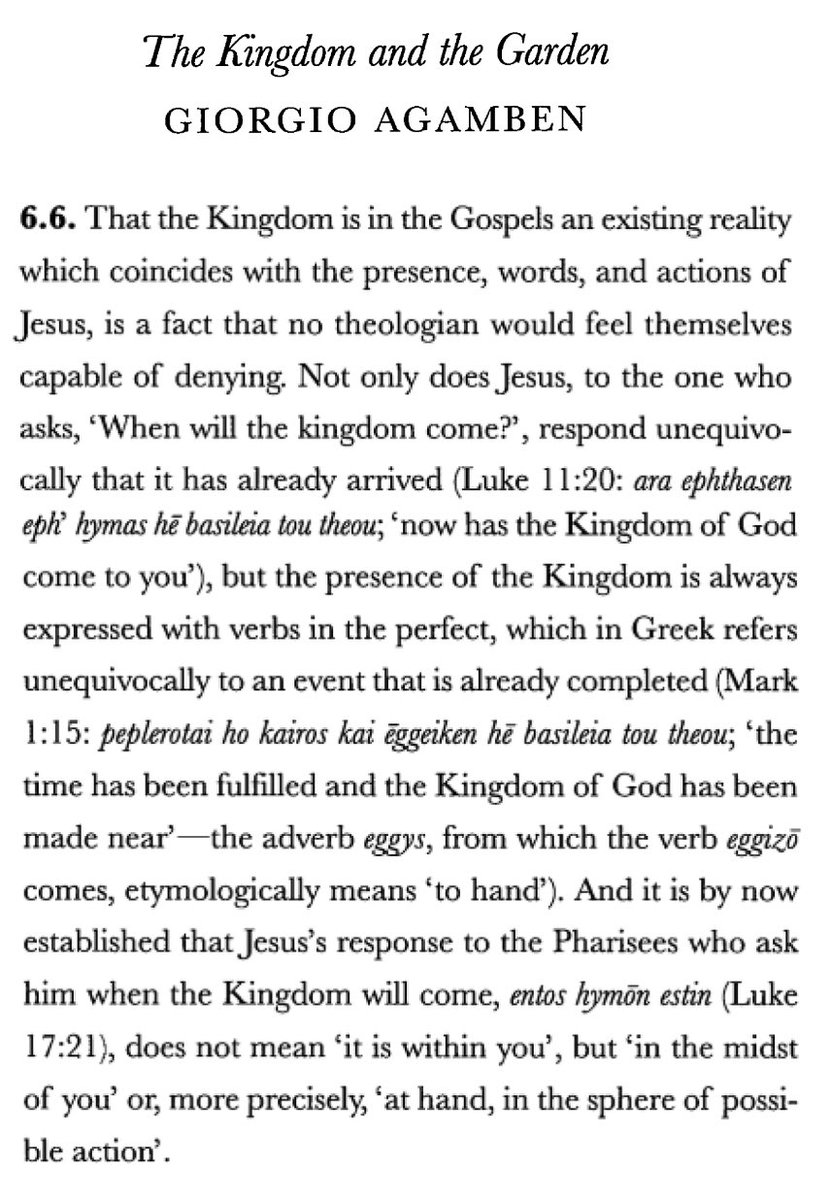
Image description
Original X alt text
The Kingdom and the Garden AGAMBEN 6.6. That the Kingdom is in the Gospels an existing reality which coincides with the presence, words, and actions of Jesus, is a fact that no theologian would feel themselves capable of denying, Not only does Jesus, to the one who asks, “When will the kingdom come?” respond unequivocally that it has already arrived (“now has the Kingdom of God come to you’), but the presence of the Kingdom is always expressed with verbs in the perfect, which in Greek refers unequivocally to an event that is already completed (‘the time has been fulfilled and the Kingdom of God has been made near’ — the adverb egys, from which the verb eggizo comes, etymologically means ‘to hand’). And it is by now established that Jesus's response to the Pharisees who ask him when the Kingdom will come, entos ymin estin (Luke 17:21), does not mean ‘it is within you’, but ‘in the midst of you’ or, more precisely, ‘at hand, in the sphere of possible action’.
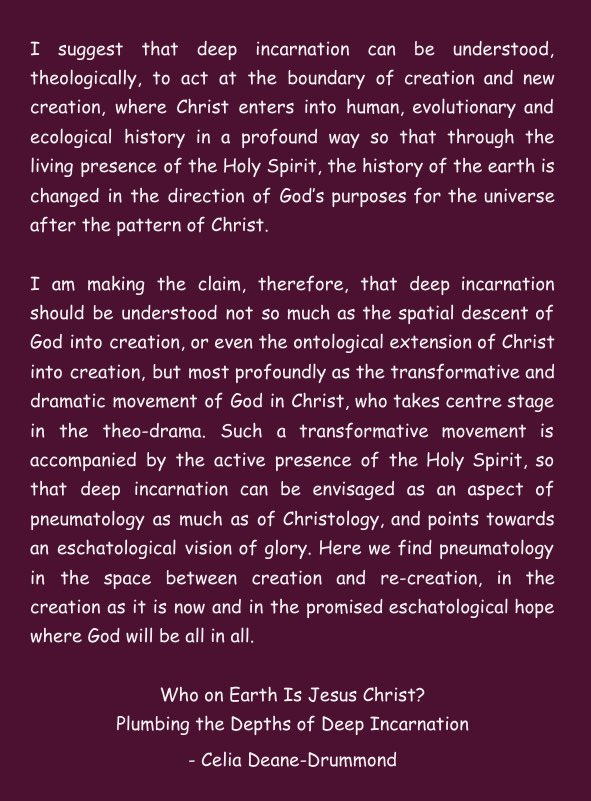
Image description
Original X alt text
I suggest that deep incarnation can be understood, theologically, to act at the boundary of creation and new creation, where Christ enters into human, evolutionary and ecological history in a profound way so that through the living presence of the Holy Spirit...deep incarnation should be understood not so much as the spatial descent of God into creation, or even the ontological extension of Christ into creation, but most profoundly as the transformative and dramatic movement of God in Christ, who takes centre stage in the theo-drama...accompanied by the active presence of the Holy Spirit, so that deep incarnation can be envisaged as an aspect of pneumatology as much as of Christology, an eschatological vision of glory. Here we find pneumatology in the space between creation and re-creation, in the creation as it is now and in the promised eschatological hope where God will be all in all. Who on Earth Is Jesus Christ? Plumbing the Depths of Deep Incarnation - Celia Deane-Drummond
@AimeTim I shouldn't worry about Thiel or his ilk. Ultimately, he represents the precarious order of false transcendence of a demonic-complex unmasked, like a thief in the night, by the closing of an incarnational circuit 'not of (t)his world.' Kingdom Reality for Real takes no prisoners.
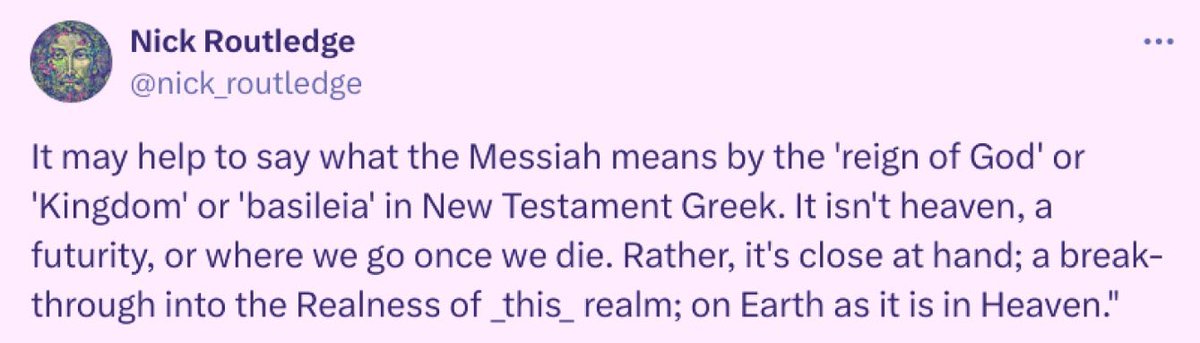
Image description
Original X alt text
Copy of tweet here: It may help to say what the Messiah means by the 'reign of God' or 'Kingdom' or 'basileia' in New Testament Greek. It isn't heaven, a futurity, or where we go once we die. Rather, it's close at hand; a break-through into the Realness of _this_ realm; on Earth as it is in Heaven."