
Nick Routledge@nick_routledge
Reply to @lukeburgis

@lukeburgis Beyond the technological limitation of the question, beyond the Book, another dimension? "The principle of hierachy in writing is always in conflict with the principle of association.” - Jay David Bolter, 'Writing Space: The Computer, Hypertext, and the History of Writing', 1991

Quoted or linked post

Nick Routledge@nick_routledge · 24 Apr 2024

@brianmclaren 22/ A universal chorus describes the period of occlusion as a ‘confusion of tongues’ and, fittingly, when Elias returns, it is with a 'heavenly scripture' revealing the unity of common, universal metaphysical principles self-evidently enabling the synergistic summation of faiths.
Two tweets:

@nick_routledge Replying to @DalrympleWill
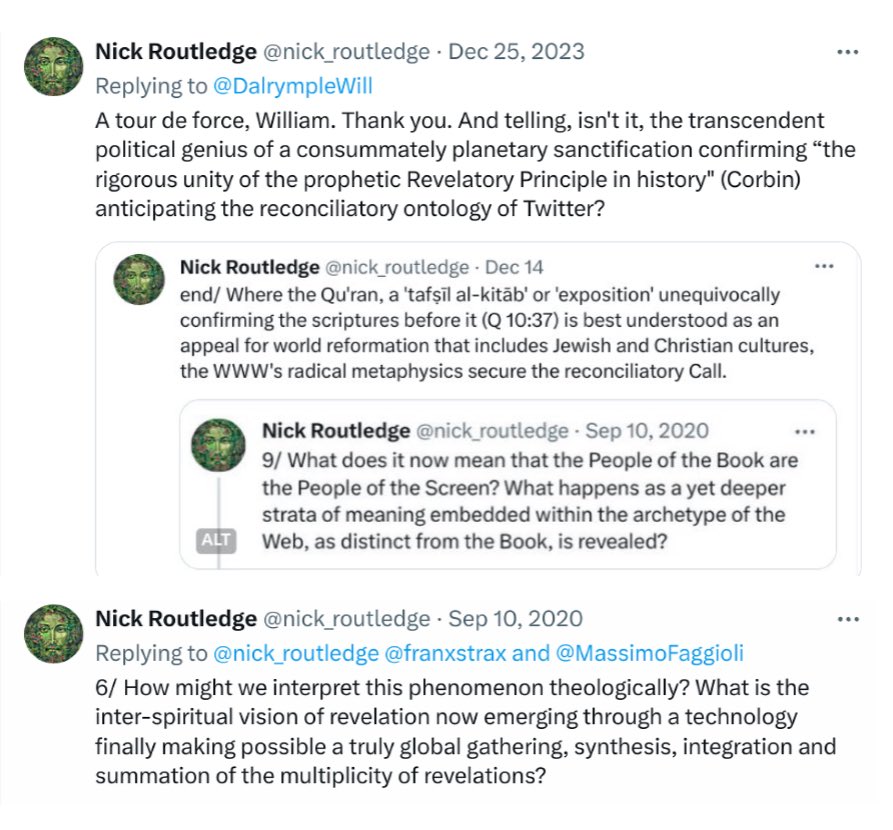
A tour de force, William. Thank you. And telling, isn't it, the transcendent political genius of a consummately planetary sanctification confirming “the rigorous unity of the prophetic Revelatory Principle in history" (Corbin) anticipating the reconciliatory ontology of Twitter?

end/ Where the Qu'ran, a 'tafṣīl al-kitāb' or 'exposition' unequivocally confirming the scriptures before it (Q 10:37) is best understood as an appeal for world reformation that includes Jewish and Christian cultures, the WWW's radical metaphysics secure the reconciliatory Call.

What does it now mean that the People of the Book are the People of the Screen? What happens as a yet deeper strata of meaning embedded within the archetype of the Web, as distinct from the Book, is revealed?

–

Second tweet:

 //twitter.com/nick_routledge/status/1304065966083420168

[Not enough room for alt-text here]
Image description

Original X alt text

Two tweets: @nick_routledge Replying to @DalrympleWill A tour de force, William. Thank you. And telling, isn't it, the transcendent political genius of a consummately planetary sanctification confirming “the rigorous unity of the prophetic Revelatory Principle in history" (Corbin) anticipating the reconciliatory ontology of Twitter? end/ Where the Qu'ran, a 'tafṣīl al-kitāb' or 'exposition' unequivocally confirming the scriptures before it (Q 10:37) is best understood as an appeal for world reformation that includes Jewish and Christian cultures, the WWW's radical metaphysics secure the reconciliatory Call. What does it now mean that the People of the Book are the People of the Screen? What happens as a yet deeper strata of meaning embedded within the archetype of the Web, as distinct from the Book, is revealed? – Second tweet: //twitter.com/nick_routledge/status/1304065966083420168 [Not enough room for alt-text here]

View this post’s context →

Context in the archive

Quoted byRT @nick_routledge: @DanielGilmanHQ Eloquently stated, Daniel. And worth noting that for all its and our flaws, the fundamental structural ontology of Twitter and the corresponding social ecology it peculiarly enables, remains "a possibility space" unparalleled in the history and reality of human interaction.Quoted by@DanielGilmanHQ Eloquently stated, Daniel. And worth noting that for all its and our flaws, the fundamental structural ontology of Twitter and the corresponding social ecology it peculiarly enables, remains "a possibility space" unparalleled in the history and reality of human interaction.Quoted byRT @nick_routledge: @Plough Wholly captivating, the author's pilgrim words, holiness upon holiness, exquisitely crafted. And, yes, read upon a scroll. Me, I love Books, and the Screen as sacred complement, not secular substitute. Kelly: "Hypertext creates its own possibility space." This place? Holy, too.Quoted by@Plough Wholly captivating, the author's pilgrim words, holiness upon holiness, exquisitely crafted. And, yes, read upon a scroll. Me, I love Books, and the Screen as sacred complement, not secular substitute. Kelly: "Hypertext creates its own possibility space." This place? Holy, too.