
@brianmclaren 22/ A universal chorus describes the period of occlusion as a ‘confusion of tongues’ and, fittingly, when Elias returns, it is with a 'heavenly scripture' revealing the unity of common, universal metaphysical principles self-evidently enabling the synergistic summation of faiths.
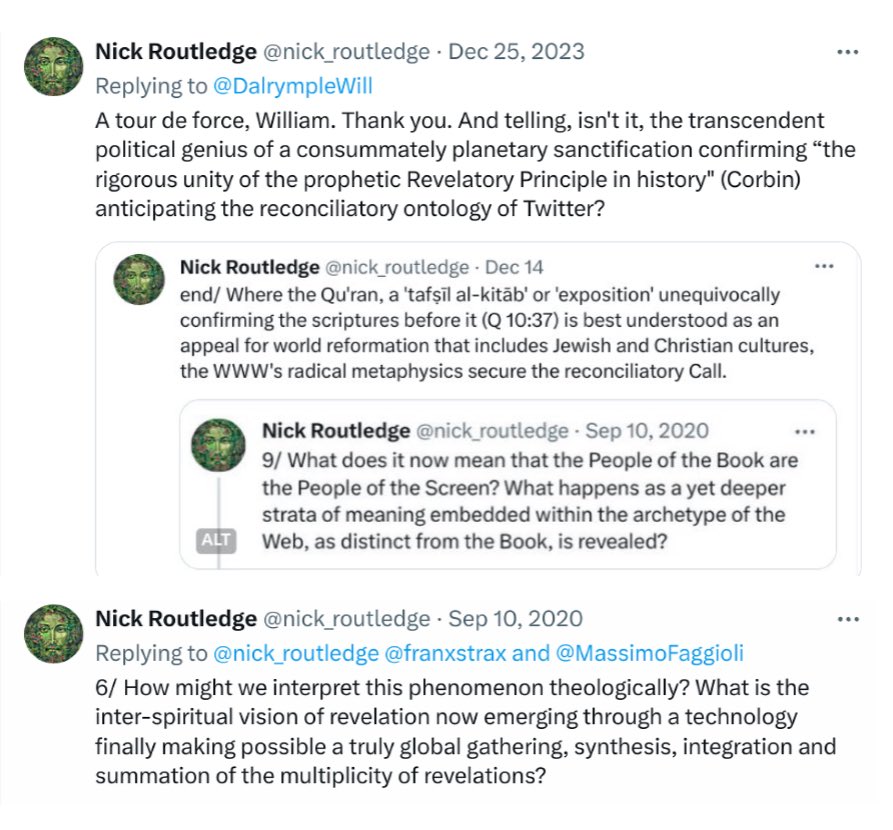
Image description
Original X alt text
Two tweets: @nick_routledge Replying to @DalrympleWill A tour de force, William. Thank you. And telling, isn't it, the transcendent political genius of a consummately planetary sanctification confirming “the rigorous unity of the prophetic Revelatory Principle in history" (Corbin) anticipating the reconciliatory ontology of Twitter? end/ Where the Qu'ran, a 'tafṣīl al-kitāb' or 'exposition' unequivocally confirming the scriptures before it (Q 10:37) is best understood as an appeal for world reformation that includes Jewish and Christian cultures, the WWW's radical metaphysics secure the reconciliatory Call. What does it now mean that the People of the Book are the People of the Screen? What happens as a yet deeper strata of meaning embedded within the archetype of the Web, as distinct from the Book, is revealed? – Second tweet: //twitter.com/nick_routledge/status/1304065966083420168 [Not enough room for alt-text here]
@rdnxyz @lukeburgis Theo-onological literacy anew, then, for the People of the Space. Brian Eno calls it, "just about as big a change of consciousness as we are capable of." De Chardin recognized it as essentially Christological: “Cosmos > Cosmogenesis > Biogenesis > Noogenesis > Christogenesis”.
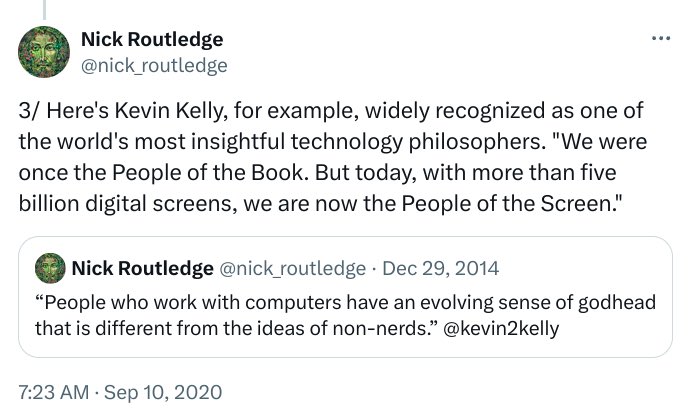
Image description
Original X alt text
Copy of tweet here: 3/ Here's Kevin Kelly, for example, widely recognized as one of the world's most insightful technology philosophers. "We were once the People of the Book. But today, with more than five billion digital screens, we are now the People of the Screen." Quote Tweet: Nick Routledge “People who work with computers have an evolving sense of godhead that is different from the ideas of non-nerds.” @kevin2kelly
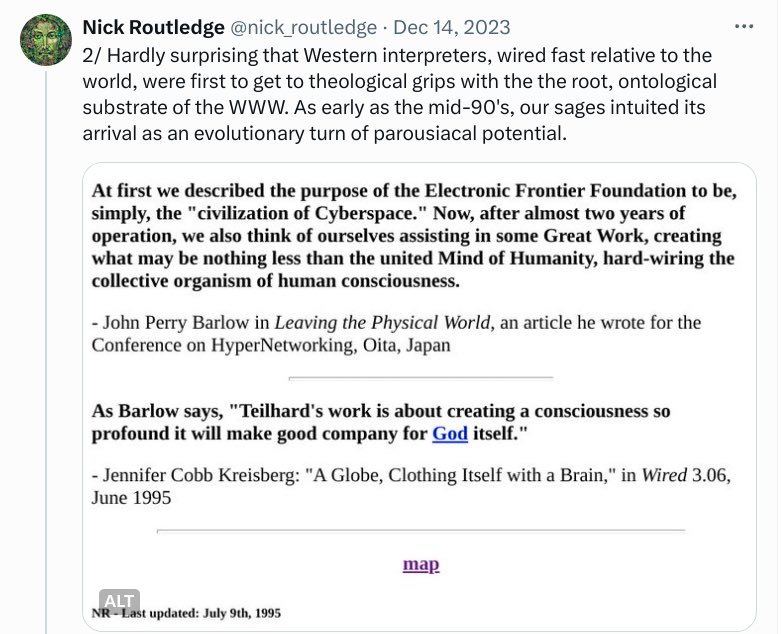
Image description
Original X alt text
Copy of tweet here: 2/ Hardly surprising that Western interpreters, wired fast relative to the world, were first to get to theological grips with the the root, ontological substrate of the WWW. As early as the mid-90's, our sages intuited its arrival as an evolutionary turn of parousiacal potential. At first we described the purpose of the Electronic Frontier Foundation to be, simply, the "civilization of Cyberspace." Now, after almost two years of operation, we also think of ourselves assisting in some Great Work, creating what may be nothing less than the united Mind of Humanity, hard-wiring the collective organism of human consciousness. - John Perry Barlow As Barlow says, "Teilhard's work is about creating a consciousness so profound it will make good company for God itself." - Jennifer Cobb Kreisberg: "A Globe, Clothing Itself with a Brain," in Wired 3.06, June 1995 NR Last updated: July 9th, 1995