
RT @nick_routledge: @Plough Wholly captivating, the author's pilgrim words, holiness upon holiness, exquisitely crafted. And, yes, read upon a scroll. Me, I love Books, and the Screen as sacred complement, not secular substitute. Kelly: "Hypertext creates its own possibility space." This place? Holy, too.
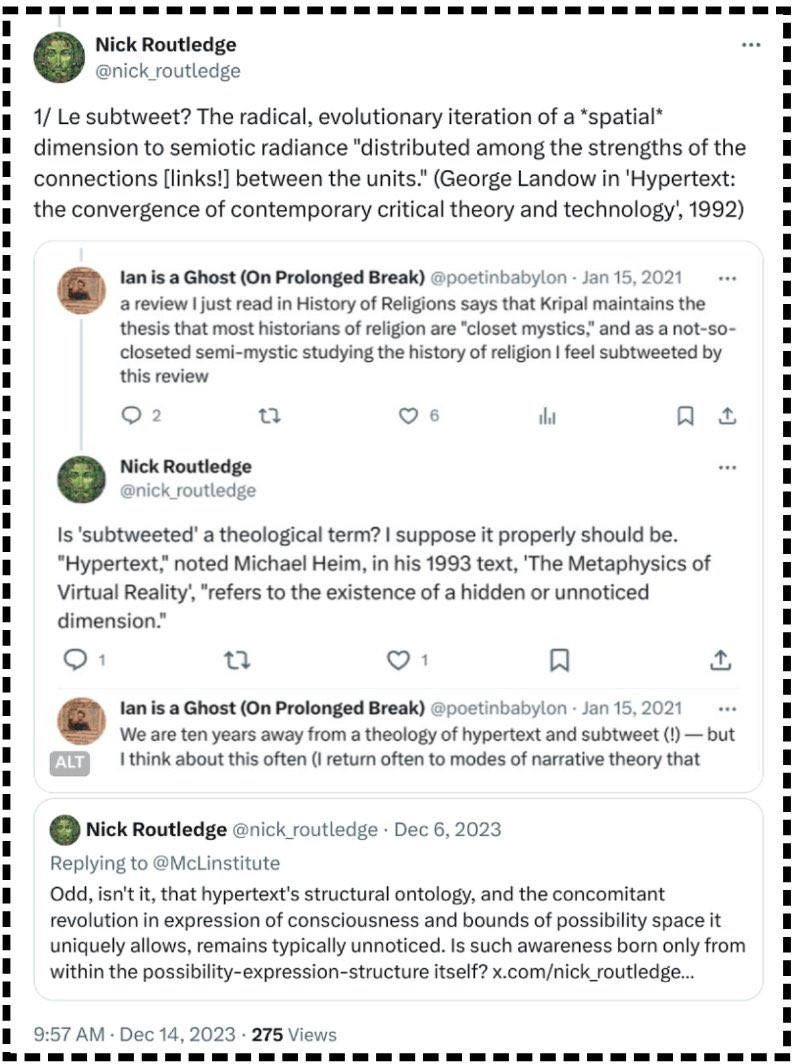
Image description
Original X alt text
Copy of tweet and quote tweet here:
Extended description
Pictured speaker / quoted attribution: Nick Routledge quoting George Landow Saved source record associated with pictured writing; full saved record, not an exact pictured excerpt. Passage boundary: 1 Le subtweet Source: Preserve quoted-author distinctions; the containing tweet does not confer authorship. @MassimoFaggioli 1/ Le subtweet? The radical, evolutionary iteration of a *spatial* dimension to semiotic radiance "distributed among the strengths of the connections [links!] between the units." (George Landow in 'Hypertext: the convergence of contemporary critical theory and technology', 1992) t.co/NndDM2EGav
Open original documentExtended description
Pictured speaker / quoted attribution: Ian is a Ghost @poetinbabylon; Nick Routledge quoting Michael Heim Saved source record associated with pictured writing; full saved record, not an exact pictured excerpt. Passage boundary: a review / Is subtweeted / We are ten years Source: Preserve quoted-author distinctions; the containing tweet does not confer authorship. Copy of tweet thread here: a review I just read in History of Religions says that Kripal maintains the thesis that most historians of religion are "closet mystics," and as a not-so-closeted semi-mystic studying the history of religion I feel subtweeted by this review Is 'subtweeted' a theological term? I suppose it properly should be. "Hypertext," noted Michael Heim, in his 1993 text, 'The Metaphysics of Virtual Reality', "refers to the existence of a hidden or unnoticed dimension." We are ten years away from a theology of hypertext and subtweet (!) — but I think about this often (I return often to modes of narrative theory that
Open original documentExtended description
Pictured speaker / quoted attribution: Nick Routledge Saved source record associated with pictured writing; full saved record, not an exact pictured excerpt. Passage boundary: Odd isn't it Source: Preserve quoted-author distinctions; the containing tweet does not confer authorship. @McLinstitute Odd, isn't it, that hypertext's structural ontology, and the concomitant revolution in expression of consciousness and bounds of possibility space it uniquely allows, remains typically unnoticed. Is such awareness born only from within the possibility-expression-structure itself?
Open original document@lukeburgis Beyond the technological limitation of the question, beyond the Book, another dimension? "The principle of hierachy in writing is always in conflict with the principle of association.” - Jay David Bolter, 'Writing Space: The Computer, Hypertext, and the History of Writing', 1991