
@johnmilbank3 In the dialectics of planetary prophetology, the Fall is the calamity that happened to us as perceivers, where the ‘Revelatory Principle’ restores our capacity to recognize our surroundings as the Paradise we never left, in a theophany of cognitive recalibration or reintegration.
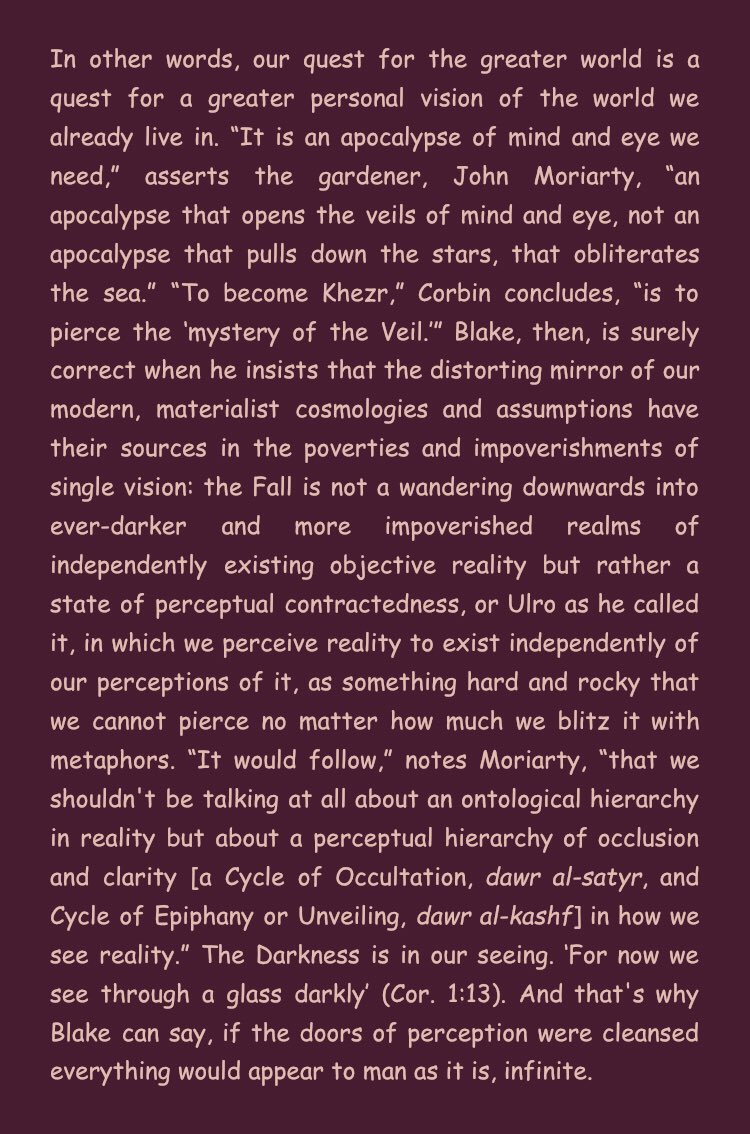
Image description
Original X alt text
“It is an apocalypse of mind and eye we need,” asserts the gardener, John Moriarty, “an apocalypse that opens the veils of mind and eye, not an apocalypse that pulls down the stars, that obliterates the sea.” “To become Khezr,” Corbin concludes, “is to pierce the ‘mystery of the Veil.’ ” Blake, then, is surely correct when he insists that the distorting mirror of our modern, materialist cosmologies and assumptions have their sources in the poverties and impoverishments of single vision: the Fall is not a wandering downwards into ever-darker and more impoverished realms of independently existing objective reality but rather a state of perceptual contractedness, or Ulro as he called it. “It would follow,” notes Moriarty, “that we shouldn't be talking at all about an ontological hierarchy in reality but about a perceptual hierarchy of occlusion and clarity [a Cycle of Occultation, dawr al-satyr, and Cycle of Epiphany or Unveiling, dawr al-kashf] in how we see reality.”
@jbralston 2/ ...where few interpreters describe the evolutionary ontology of a Cycle of Occultation, 'dawr al-satyr', and Cycle of Epiphany or Unveiling, 'dawr al-kashf' (or 'apocalypsis' as it's described with reference to the Parousia of Christ) as precisely as Shi'ite sources.
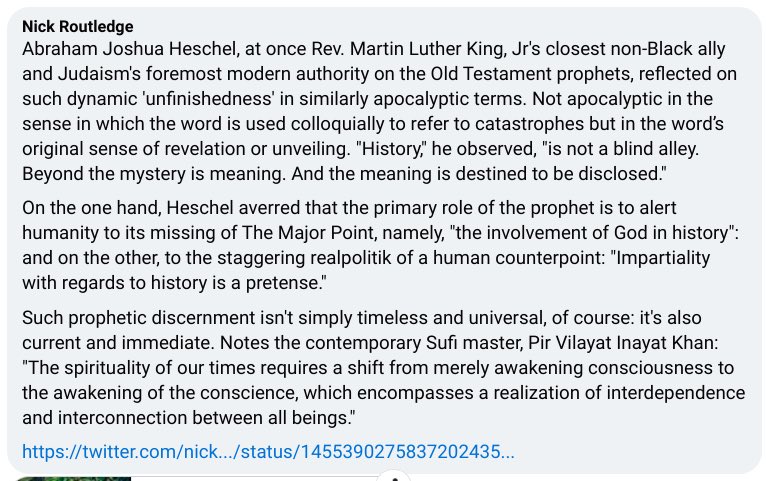
Image description
Original X alt text
Abraham Joshua Heschel, at once Rev. Martin Luther King, Jr's closest non-Black ally and Judaism's foremost modern authority on the Old Testament prophets, reflected on such dynamic 'unfinishedness' in similarly apocalyptic terms. Not apocalyptic in the sense in which the word is used colloquially to refer to catastrophes but in the word’s original sense of revelation or unveiling. "History," he observed, "is not a blind alley. Beyond the mystery is meaning. And the meaning is destined to be disclosed." On the one hand, Heschel averred that the primary role of the prophet is to alert humanity to its missing of The Major Point, namely, "the involvement of God in history": and on the other, to the staggering realpolitik of a human counterpoint: "Impartiality with regards to history is a pretense." Such prophetic discernment isn't simply timeless and universal, of course: it's also current and immediate. Notes the...