
@lukeburgis An ontological correlative in Illich, whose leading thesis is that Western modernity represents a perverted attempt to encode and institutionalize the NT as rules of behavior, duty, and laws in a corrupting structural deception so pervasive that we no longer realize it’s there.
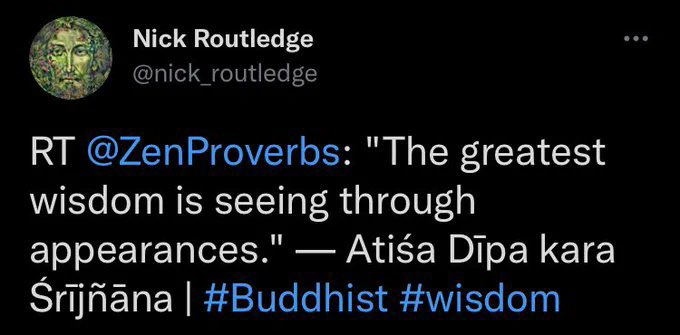
Image description
Original X alt text
RT @ZenProverbs: "The greatest wisdom is seeing through appearances." — Atisa Dipa kara Srijiana | #Buddhist #wisdom
@johnmilbank3 In the dialectics of planetary prophetology, the Fall is the calamity that happened to us as perceivers, where the ‘Revelatory Principle’ restores our capacity to recognize our surroundings as the Paradise we never left, in a theophany of cognitive recalibration or reintegration.
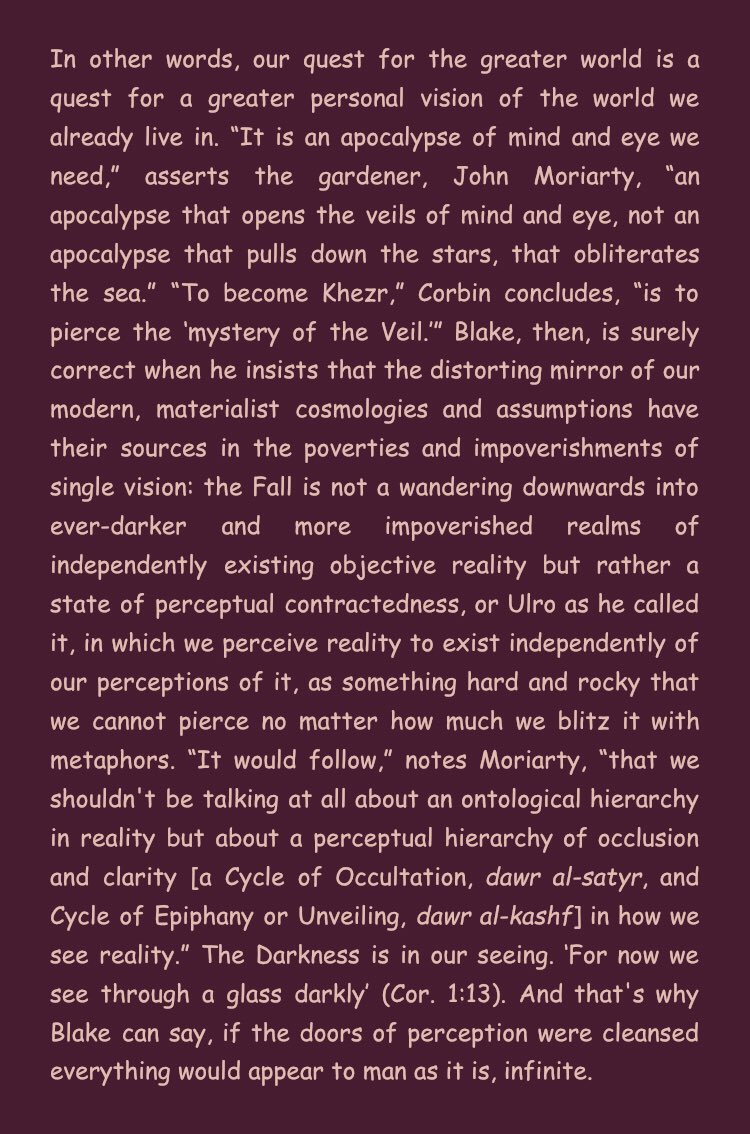
Image description
Original X alt text
“It is an apocalypse of mind and eye we need,” asserts the gardener, John Moriarty, “an apocalypse that opens the veils of mind and eye, not an apocalypse that pulls down the stars, that obliterates the sea.” “To become Khezr,” Corbin concludes, “is to pierce the ‘mystery of the Veil.’ ” Blake, then, is surely correct when he insists that the distorting mirror of our modern, materialist cosmologies and assumptions have their sources in the poverties and impoverishments of single vision: the Fall is not a wandering downwards into ever-darker and more impoverished realms of independently existing objective reality but rather a state of perceptual contractedness, or Ulro as he called it. “It would follow,” notes Moriarty, “that we shouldn't be talking at all about an ontological hierarchy in reality but about a perceptual hierarchy of occlusion and clarity [a Cycle of Occultation, dawr al-satyr, and Cycle of Epiphany or Unveiling, dawr al-kashf] in how we see reality.”