
@WeilFan420 @rosekhawal @nubianscribes @GabrielSaidR end/ As a manifest phenomenon, he articulates the hiddenness of God in history revealed in concrete reality. Moltmann: "The reconciliation of the world is the promise of the new creation of all things, and the new creation is the fulfillment of the reconciliation of the world."
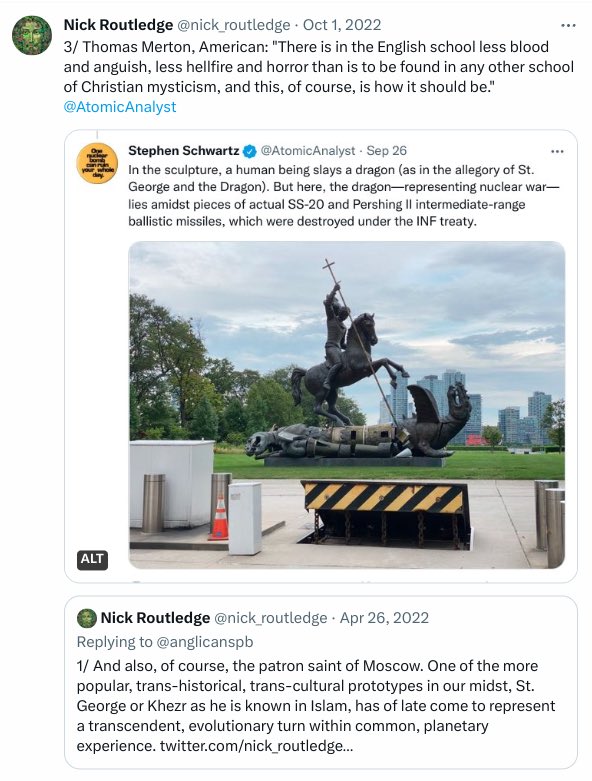
Image description
Original X alt text
Copy of tweet and QT: 3/ Thomas Merton, American: "There is in the English school less blood and anguish, less hellfire and horror than is to be found in any other school of Christian mysticism, and this, of course, is how it should be." @AtomicAnalyst Image of tweet: In the sculpture, a human being slays a dragon (as in the allegory of St. George and the Dragon). But here, the dragon—representing nuclear war—lies amidst pieces of actual SS-20 and Pershing II intermediate-range ballistic missiles, which were destroyed under the INF treaty. [Picture of sculpture created to commemorate the signing of the 1987 INF Treaty] Quote Tweet: 1/ And also, of course, the patron saint of Moscow. One of the more popular, trans-historical, trans-cultural prototypes in our midst, St. George or Khezr as he is known in Islam, has of late come to represent a transcendent, evolutionary turn within common, planetary experience.
@johnmilbank3 In the dialectics of planetary prophetology, the Fall is the calamity that happened to us as perceivers, where the ‘Revelatory Principle’ restores our capacity to recognize our surroundings as the Paradise we never left, in a theophany of cognitive recalibration or reintegration.
Image description
Original X alt text
“It is an apocalypse of mind and eye we need,” asserts the gardener, John Moriarty, “an apocalypse that opens the veils of mind and eye, not an apocalypse that pulls down the stars, that obliterates the sea.” “To become Khezr,” Corbin concludes, “is to pierce the ‘mystery of the Veil.’ ” Blake, then, is surely correct when he insists that the distorting mirror of our modern, materialist cosmologies and assumptions have their sources in the poverties and impoverishments of single vision: the Fall is not a wandering downwards into ever-darker and more impoverished realms of independently existing objective reality but rather a state of perceptual contractedness, or Ulro as he called it. “It would follow,” notes Moriarty, “that we shouldn't be talking at all about an ontological hierarchy in reality but about a perceptual hierarchy of occlusion and clarity [a Cycle of Occultation, dawr al-satyr, and Cycle of Epiphany or Unveiling, dawr al-kashf] in how we see reality.”