
Nick Routledge@nick_routledge
Reply to @nick_routledge

@jbralston 2/ ...where few interpreters describe the evolutionary ontology of a Cycle of Occultation, 'dawr al-satyr', and Cycle of Epiphany or Unveiling, 'dawr al-kashf' (or 'apocalypsis' as it's described with reference to the Parousia of Christ) as precisely as Shi'ite sources.
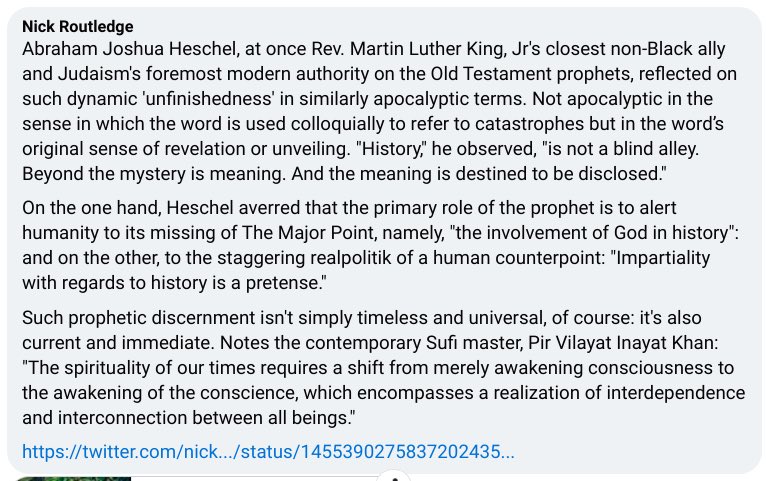
Abraham Joshua Heschel, at once Rev. Martin Luther King, Jr's closest non-Black ally and Judaism's foremost modern authority on the Old Testament prophets, reflected on such dynamic 'unfinishedness' in similarly apocalyptic terms. Not apocalyptic in the sense in which the word is used colloquially to refer to catastrophes but in the word’s original sense of revelation or unveiling. "History," he observed, "is not a blind alley. Beyond the mystery is meaning. And the meaning is destined to be disclosed."

On the one hand, Heschel averred that the primary role of the prophet is to alert humanity to its missing of The Major Point, namely, "the involvement of God in history": and on the other, to the staggering realpolitik of a human counterpoint: "Impartiality with regards to history is a pretense."

Such prophetic discernment isn't simply timeless and universal, of course: it's also current and immediate. Notes the...
Image description

Original X alt text

Abraham Joshua Heschel, at once Rev. Martin Luther King, Jr's closest non-Black ally and Judaism's foremost modern authority on the Old Testament prophets, reflected on such dynamic 'unfinishedness' in similarly apocalyptic terms. Not apocalyptic in the sense in which the word is used colloquially to refer to catastrophes but in the word’s original sense of revelation or unveiling. "History," he observed, "is not a blind alley. Beyond the mystery is meaning. And the meaning is destined to be disclosed." On the one hand, Heschel averred that the primary role of the prophet is to alert humanity to its missing of The Major Point, namely, "the involvement of God in history": and on the other, to the staggering realpolitik of a human counterpoint: "Impartiality with regards to history is a pretense." Such prophetic discernment isn't simply timeless and universal, of course: it's also current and immediate. Notes the...

Quoted or linked post

Nick Routledge@nick_routledge · 29 Aug 2022

6/ The original meaning of ‘apocalypsis’? Not 'cataclysm', but 'unveiling'. Our prophets, of course, have always anticipated this eschatological turn - planetary consciousness coalescing suddenly in a sunburst of revelation overturning the tables of temporality, once and for all.
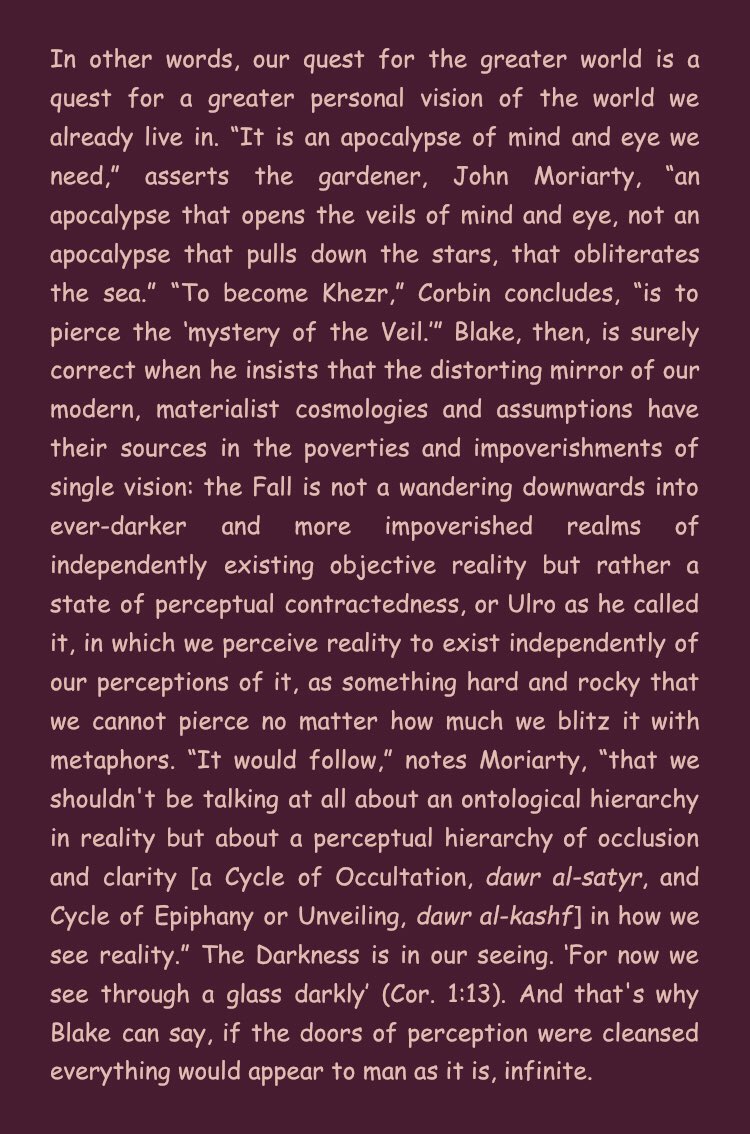
“It is an apocalypse of mind and eye we need,” asserts the gardener, John Moriarty, “an apocalypse that opens the veils of mind and eye, not an apocalypse that pulls down the stars, that obliterates the sea.” “To become Khezr,” Corbin concludes, “is to pierce the ‘mystery of the Veil.’ ” Blake, then, is surely correct when he insists that the distorting mirror of our modern, materialist cosmologies and assumptions have their sources in the poverties and impoverishments of single vision: the Fall is not a wandering downwards into ever-darker and more impoverished realms of independently existing objective reality but rather a state of perceptual contractedness, or Ulro as he called it. “It would follow,” notes Moriarty, “that we shouldn't be talking at all about an ontological hierarchy in reality but about a perceptual hierarchy of occlusion and clarity [a Cycle of Occultation, dawr al-satyr, and Cycle of Epiphany or Unveiling, dawr al-kashf] in how we see reality.”
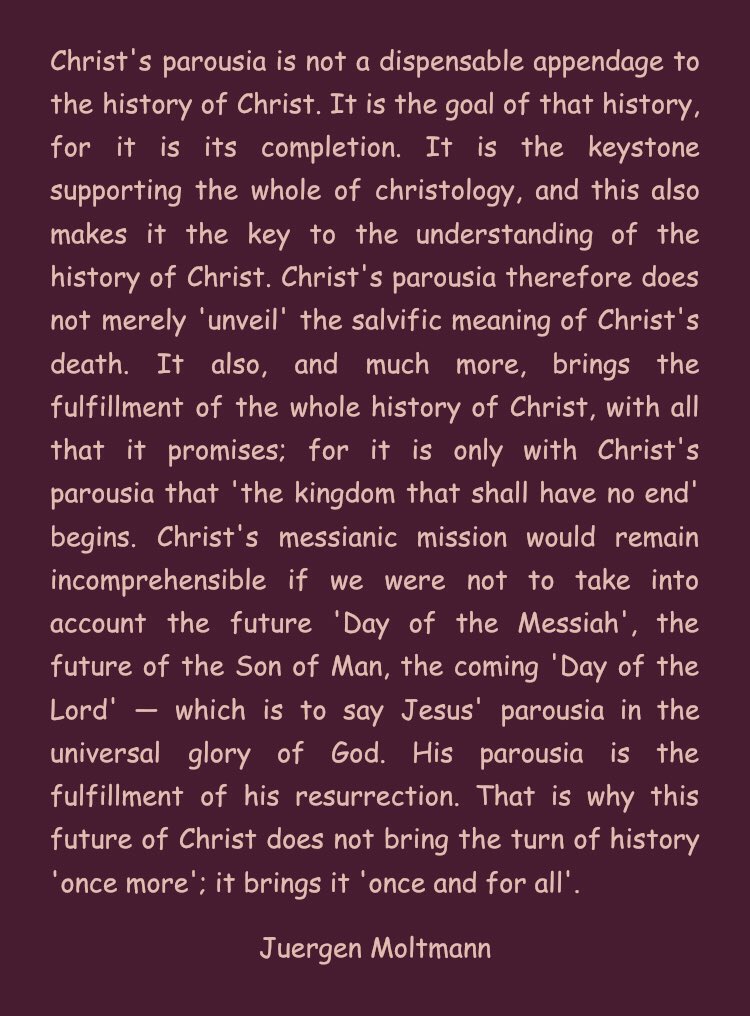
Image description

Original X alt text

“It is an apocalypse of mind and eye we need,” asserts the gardener, John Moriarty, “an apocalypse that opens the veils of mind and eye, not an apocalypse that pulls down the stars, that obliterates the sea.” “To become Khezr,” Corbin concludes, “is to pierce the ‘mystery of the Veil.’ ” Blake, then, is surely correct when he insists that the distorting mirror of our modern, materialist cosmologies and assumptions have their sources in the poverties and impoverishments of single vision: the Fall is not a wandering downwards into ever-darker and more impoverished realms of independently existing objective reality but rather a state of perceptual contractedness, or Ulro as he called it. “It would follow,” notes Moriarty, “that we shouldn't be talking at all about an ontological hierarchy in reality but about a perceptual hierarchy of occlusion and clarity [a Cycle of Occultation, dawr al-satyr, and Cycle of Epiphany or Unveiling, dawr al-kashf] in how we see reality.”

Christ's parousia is not a dispensable appendage to the history of Christ. It is the goal of that history, for it is its completion. It is the keystone supporting the whole of christology, and this also makes it the key to the understanding of the history of Christ. Christ's parousia therefore does not merely 'unveil' the salvific meaning of Christ's death. It also, and much more, brings the fulfillment of the whole history of Christ, with all that it promises; for it is only with Christ's parousia that 'the kingdom that shall have no end' begins. Christ's messianic mission would remain incomprehensible if we were not to take into account the future 'Day of the Messiah', the future of the Son of Man, the coming 'Day of the Lord' — which is to say Jesus' parousia in the universal glory of God. His parousia is the fulfillment of his resurrection. That is why this future of Christ does not bring the turn of history 'once more'; it brings it 'once and for all'.

Juergen Moltmann
Image description

Original X alt text

Christ's parousia is not a dispensable appendage to the history of Christ. It is the goal of that history, for it is its completion. It is the keystone supporting the whole of christology, and this also makes it the key to the understanding of the history of Christ. Christ's parousia therefore does not merely 'unveil' the salvific meaning of Christ's death. It also, and much more, brings the fulfillment of the whole history of Christ, with all that it promises; for it is only with Christ's parousia that 'the kingdom that shall have no end' begins. Christ's messianic mission would remain incomprehensible if we were not to take into account the future 'Day of the Messiah', the future of the Son of Man, the coming 'Day of the Lord' — which is to say Jesus' parousia in the universal glory of God. His parousia is the fulfillment of his resurrection. That is why this future of Christ does not bring the turn of history 'once more'; it brings it 'once and for all'. Juergen Moltmann
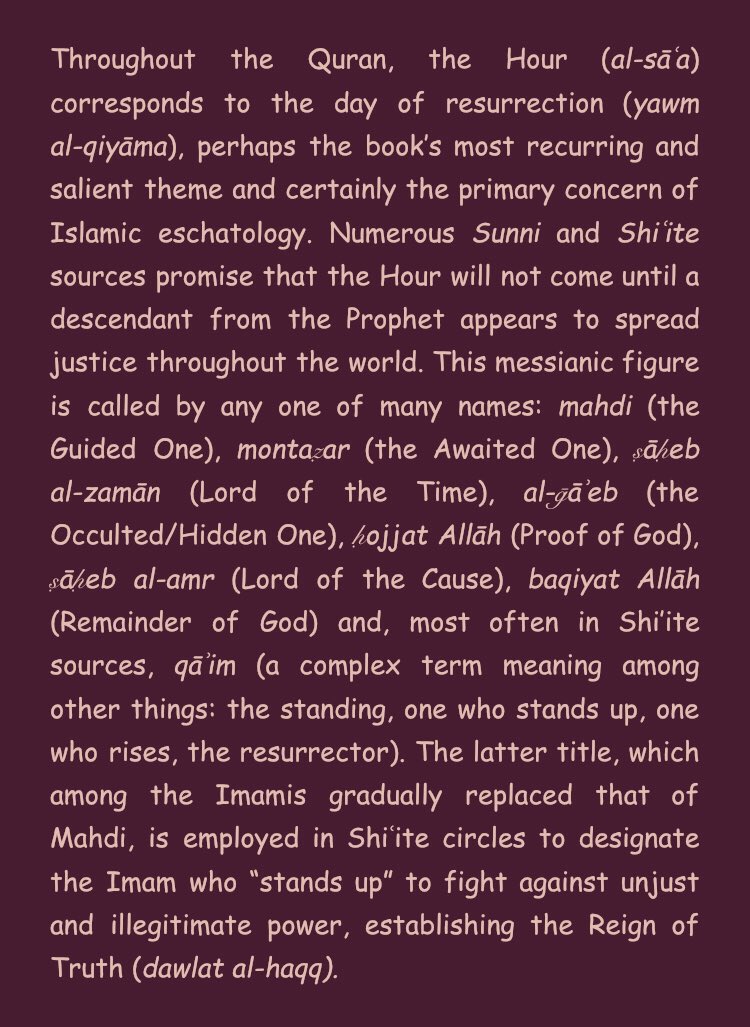
Throughout the Quran, the Hour (al-sāʿa) corresponds to the day of resurrection (yawm al-qiyāma), perhaps the book’s most recurring and salient theme and certainly the primary concern of Islamic eschatology. Numerous Sunni and Shiʿite sources promise that the Hour will not come until a descendant from the Prophet appears to spread justice throughout the world. This messianic figure is called by any one of many names: mahdi (the Guided One), montaẓar (the Awaited One), ṣāḥeb al-zamān (Lord of the Time), al-ḡāʾeb (the Occulted/Hidden One), ḥojjat Allāh (Proof of God), ṣāḥeb al-amr (Lord of the Cause), baqiyat Allāh (Remainder of God) and, most often in Shi’ite sources, qāʾim (a complex term meaning among other things: the standing, one who stands up, one who rises, the resurrector). The latter title, which among the Imamis gradually replaced that of Mahdi, is employed in Shiʿite circles to designate the Imam who “stands up” to fight against unjust and illegitimate power.
Image description

Original X alt text

Throughout the Quran, the Hour (al-sāʿa) corresponds to the day of resurrection (yawm al-qiyāma), perhaps the book’s most recurring and salient theme and certainly the primary concern of Islamic eschatology. Numerous Sunni and Shiʿite sources promise that the Hour will not come until a descendant from the Prophet appears to spread justice throughout the world. This messianic figure is called by any one of many names: mahdi (the Guided One), montaẓar (the Awaited One), ṣāḥeb al-zamān (Lord of the Time), al-ḡāʾeb (the Occulted/Hidden One), ḥojjat Allāh (Proof of God), ṣāḥeb al-amr (Lord of the Cause), baqiyat Allāh (Remainder of God) and, most often in Shi’ite sources, qāʾim (a complex term meaning among other things: the standing, one who stands up, one who rises, the resurrector). The latter title, which among the Imamis gradually replaced that of Mahdi, is employed in Shiʿite circles to designate the Imam who “stands up” to fight against unjust and illegitimate power.

It is the function of the Imam to reveal the esoteric sense of all the Divine Revelations; it is precisely this which is the Qiyāmat (resurrection). This function is perhaps best captured in titles used for the qāʾim, such as khudāvand-i rastakhīz (lord of the final rising of  liberation), khudāvand-i qiyāmat (the lord of the final rising), qāʾim al-qiyāma (the qāʾim of the resurrection or simply, the resurrector), ṣāḥib  al-qiyāma (the master of the resurrection), and ṣāḥib dawr al-kashf (the master of the Cycle of Unveiling). Rather than bring a new sharīʿa, the qāʾim ushers in “the day the interpretation (of the Book) (taʾwīluhu) comes” (Q 7:53) signaling the end of one era and the commencement of another. “And the earth will shine with the light of its Lord. The Book will be laid open. The Prophet and the witnesses will be brought forward. It is judged between them with truth and they will not  be wronged.” (Q 39:69). The qiyāma is the qāʾim’s universal initiation.
Image description

Original X alt text

It is the function of the Imam to reveal the esoteric sense of all the Divine Revelations; it is precisely this which is the Qiyāmat (resurrection). This function is perhaps best captured in titles used for the qāʾim, such as khudāvand-i rastakhīz (lord of the final rising of liberation), khudāvand-i qiyāmat (the lord of the final rising), qāʾim al-qiyāma (the qāʾim of the resurrection or simply, the resurrector), ṣāḥib al-qiyāma (the master of the resurrection), and ṣāḥib dawr al-kashf (the master of the Cycle of Unveiling). Rather than bring a new sharīʿa, the qāʾim ushers in “the day the interpretation (of the Book) (taʾwīluhu) comes” (Q 7:53) signaling the end of one era and the commencement of another. “And the earth will shine with the light of its Lord. The Book will be laid open. The Prophet and the witnesses will be brought forward. It is judged between them with truth and they will not be wronged.” (Q 39:69). The qiyāma is the qāʾim’s universal initiation.

View this post’s context →

Context in the archive

Quoted by@pauljpastor 3/ At the planetary level, meanwhile, a vast complex of democratic insight clarifies the ontic advent of the Hindu Kalki Avatara, Jewish Mashiach, Muslim Mahdi, Buddhist Maitreya, East Asian Great Savior, Zoroastrian Saoshyant and complementary Indigenous currents.Quoted by@johnmilbank3 In the dialectics of planetary prophetology, the Fall is the calamity that happened to us as perceivers, where the ‘Revelatory Principle’ restores our capacity to recognize our surroundings as the Paradise we never left, in a theophany of cognitive recalibration or reintegration.Quoted by@JTasioulas Rudolph Steiner claimed the Jesus Event brought the power of the Sun to the Earth, where "the sunburst of the messianic" (George Steiner) describes the anticipated advent - neither peculiarly Christian nor singularly religious - of planetary prophetology's unifying articulation.