
1/4 The Feast grounds pluriversality materially. Before we meet as competing systems of belief, we meet as creatures who must eat—our lives already passing through one another and through the earth: an intercarnational reality prior to any interpretation of it.
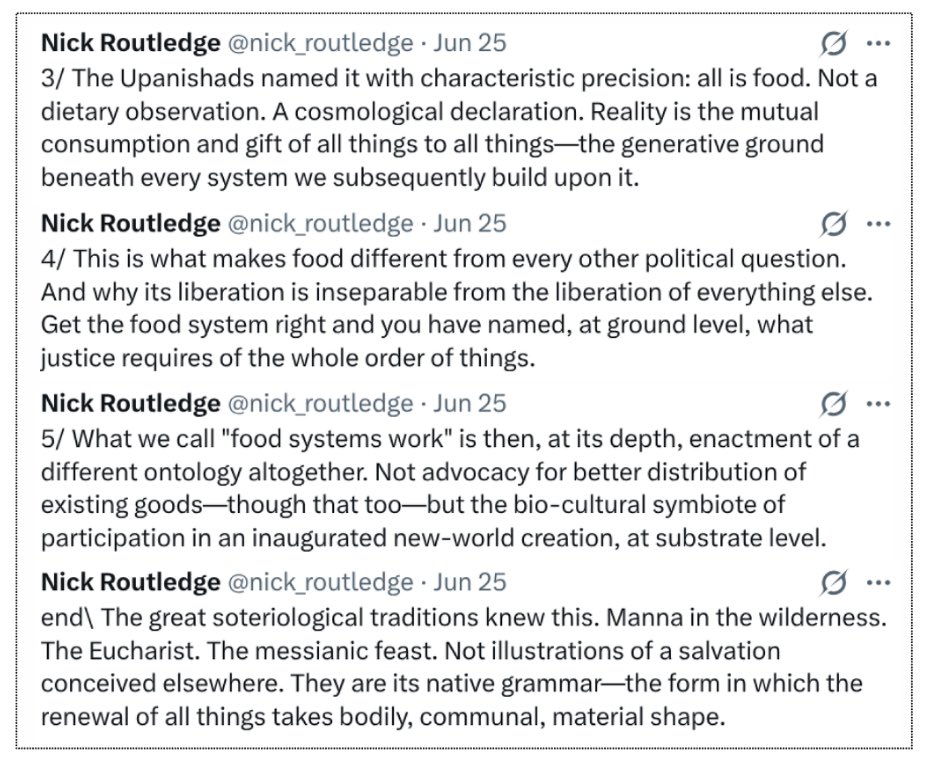
Image description
Extended description
3/ The Upanishads named it with characteristic precision: all is food. Not a dietary observation. A cosmological declaration. Reality is the mutual consumption and gift of all things to all things—the generative ground beneath every system we subsequently build upon it. 4/ This is what makes food different from every other political question. And why its liberation is inseparable from the liberation of everything else. Get the food system right and you have named, at ground level, what justice requires of the whole order of things. 5/ What we call "food systems work" is then, at its depth, enactment of a different ontology altogether. Not advocacy for better distribution of existing goods—though that too—but the bio-cultural symbiote of participation in an inaugurated new-world creation, at substrate level. end\ The great soteriological traditions knew this. Manna in the wilderness. The Eucharist. The messianic feast. Not illustrations of a salvation conceived elsewhere. They are its native grammar—the form in which the renewal of all things takes bodily, communal, material shape.
Open original document@jasonwblakely 2/ Every organism, every culture, every civilization is constituted by what it eats and what eats it—by the vast reciprocity of transformation that precedes every distinction we draw between nature and culture, economics and ecology, the human and the more-than-human.
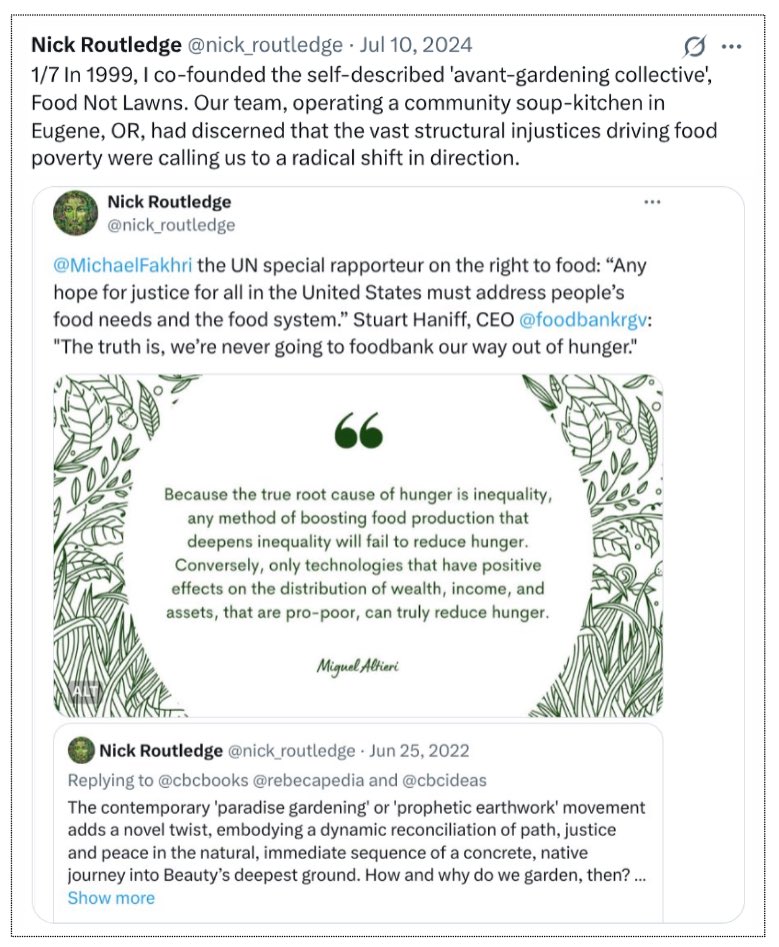
Image description
Extended description
1/7 In 1999, I co-founded the self-described 'avant-gardening collective', Food Not Lawns. Our team, operating a community soup-kitchen in Eugene, OR, had discerned that the vast structural injustices driving food poverty were calling us to a radical shift in direction. @MichaelFakhri the UN special rapporteur on the right to food: “Any hope for justice for all in the United States must address people’s food needs and the food system.” Stuart Haniff, CEO @foodbankrgv: "The truth is, we’re never going to foodbank our way out of hunger." Because the root cause of hunger is inequality, any method of boosting food production that deepens inequality will fail to reduce hunger. Conversely, only technologies that have positive effects on the distribution of wealth, income, and assets, that are pro-poor, can truly reduce hunger. -Miguel Altieri The contemporary 'paradise gardening' or 'prophetic earthwork' movement adds a novel twist, embodying a dynamic reconciliation of path, justice and peace in the natural, immediate sequence of a concrete, native journey into Beauty’s deepest ground. How and why do we garden, then? []
Open original document