
RT @nick_routledge: @NWirzba 2/ For all his remarkable achievements, Wendell Berry stands preeminent among political philosophers for articulating an incarnate soteriology of the polis—public life finds its salvation in the right ordering and inhabiting of living relations, not in their political simulation.
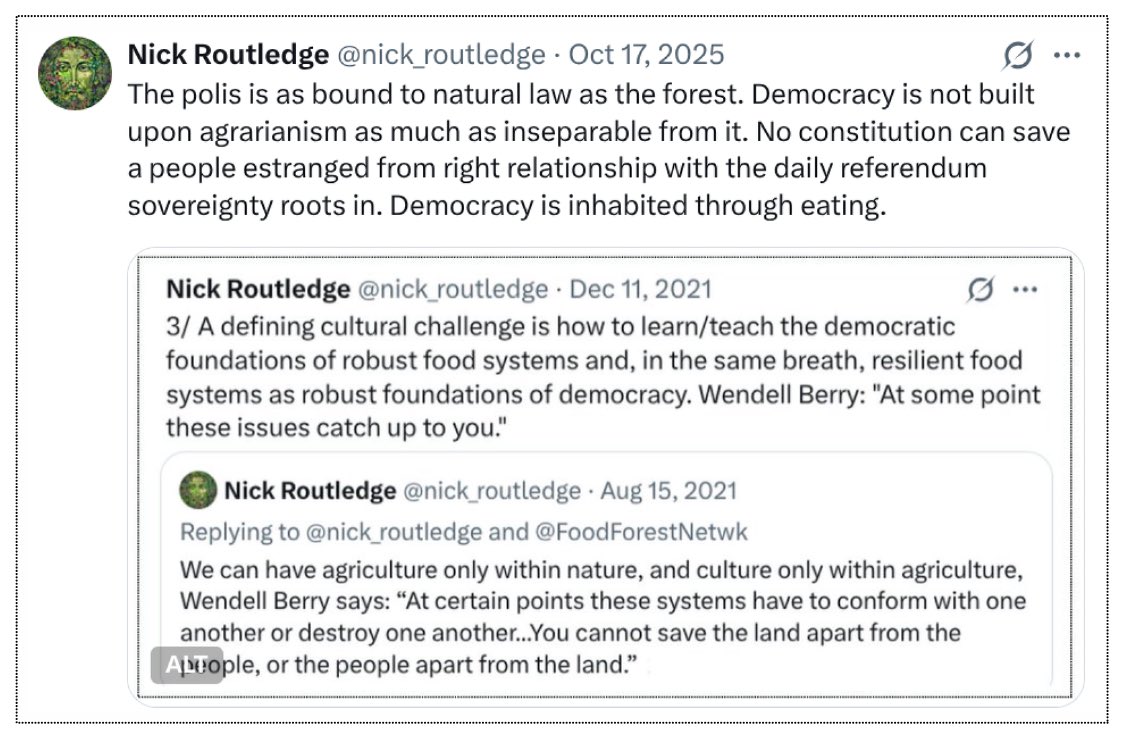
Image description
Original X alt text
The polis is as bound to natural law as the forest. Democracy is not built upon agrarianism as much as inseparable from it. No constitution can save a people estranged from right relationship with the daily referendum sovereignty roots in. Democracy is inhabited through eating. 3/ A defining cultural challenge is how to learn/teach the democratic foundations of robust food systems and, in the same breath, resilient food systems as robust foundations of democracy. Wendell Berry: "At some point these issues catch up to you." We can have agriculture only within nature, and culture only within agriculture, Wendell Berry says: “At certain points these systems have to conform with one another or destroy one another...You cannot save the land apart from the people, or the people apart from the land.”
1/4 The Feast grounds pluriversality materially. Before we meet as competing systems of belief, we meet as creatures who must eat—our lives already passing through one another and through the earth: an intercarnational reality prior to any interpretation of it.
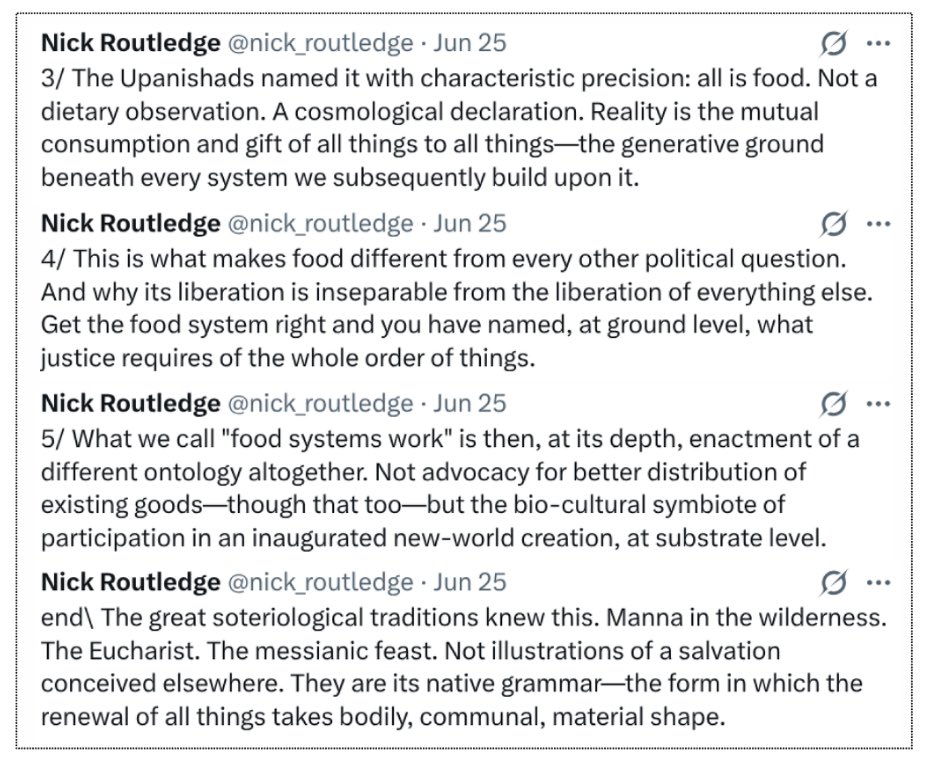
Image description
Extended description
3/ The Upanishads named it with characteristic precision: all is food. Not a dietary observation. A cosmological declaration. Reality is the mutual consumption and gift of all things to all things—the generative ground beneath every system we subsequently build upon it. 4/ This is what makes food different from every other political question. And why its liberation is inseparable from the liberation of everything else. Get the food system right and you have named, at ground level, what justice requires of the whole order of things. 5/ What we call "food systems work" is then, at its depth, enactment of a different ontology altogether. Not advocacy for better distribution of existing goods—though that too—but the bio-cultural symbiote of participation in an inaugurated new-world creation, at substrate level. end\ The great soteriological traditions knew this. Manna in the wilderness. The Eucharist. The messianic feast. Not illustrations of a salvation conceived elsewhere. They are its native grammar—the form in which the renewal of all things takes bodily, communal, material shape.
Open original document