
@jasonwblakely 2/ Every organism, every culture, every civilization is constituted by what it eats and what eats it—by the vast reciprocity of transformation that precedes every distinction we draw between nature and culture, economics and ecology, the human and the more-than-human.
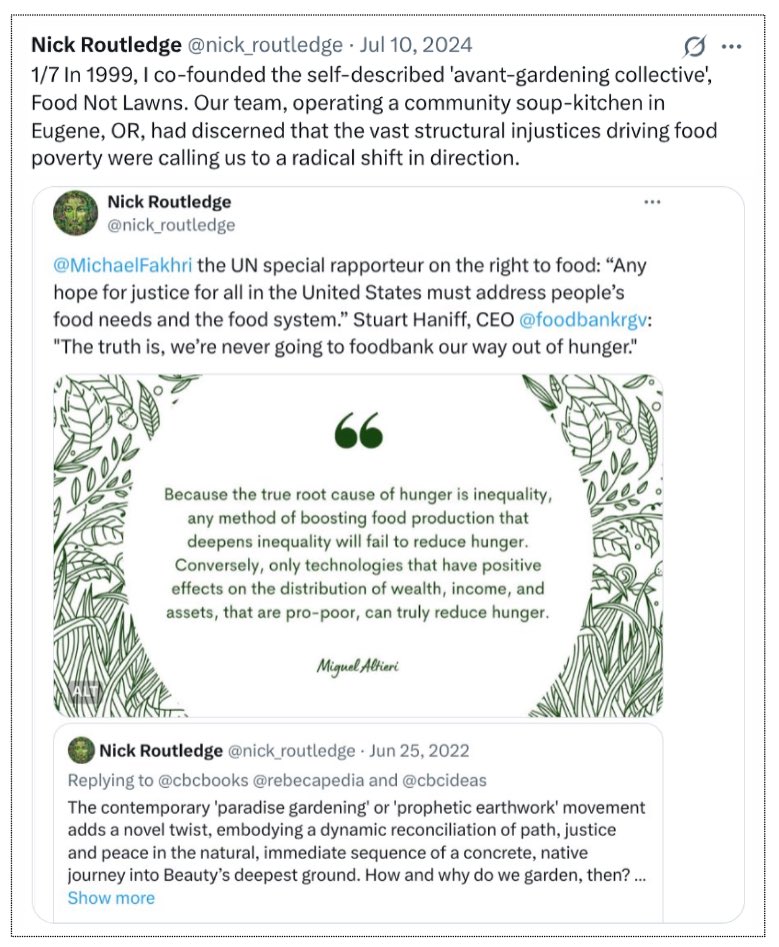
Image description
Extended description
1/7 In 1999, I co-founded the self-described 'avant-gardening collective', Food Not Lawns. Our team, operating a community soup-kitchen in Eugene, OR, had discerned that the vast structural injustices driving food poverty were calling us to a radical shift in direction. @MichaelFakhri the UN special rapporteur on the right to food: “Any hope for justice for all in the United States must address people’s food needs and the food system.” Stuart Haniff, CEO @foodbankrgv: "The truth is, we’re never going to foodbank our way out of hunger." Because the root cause of hunger is inequality, any method of boosting food production that deepens inequality will fail to reduce hunger. Conversely, only technologies that have positive effects on the distribution of wealth, income, and assets, that are pro-poor, can truly reduce hunger. -Miguel Altieri The contemporary 'paradise gardening' or 'prophetic earthwork' movement adds a novel twist, embodying a dynamic reconciliation of path, justice and peace in the natural, immediate sequence of a concrete, native journey into Beauty’s deepest ground. How and why do we garden, then? []
Open original document@Plough For prophetic earthworkers, food, farming, eating, and ecological-relations aren’t merely ethical or practical matters—they constitute the crucible where Truth is discerned, inhabited and generatively realized in an immanent covenantal dynamism transfiguring all created reality.
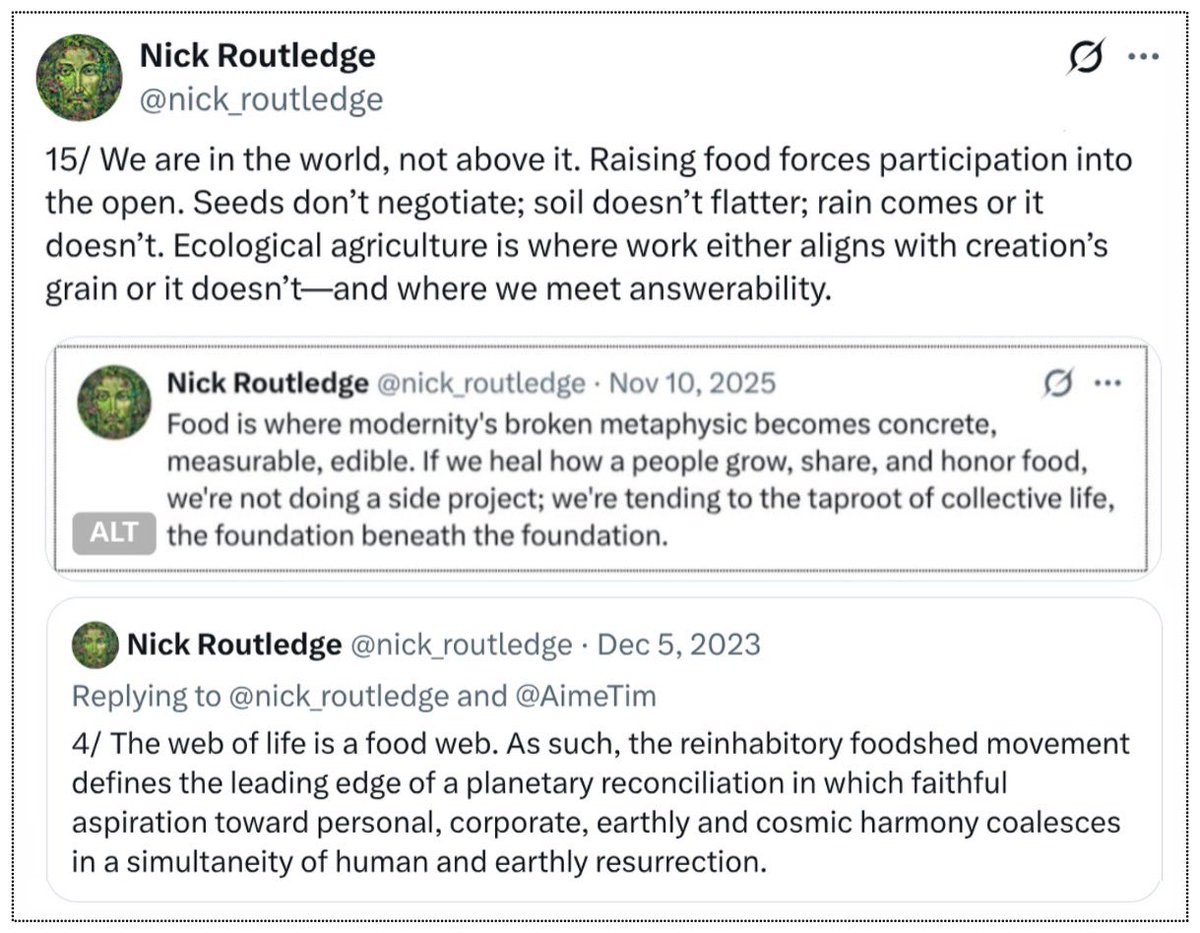
Image description
Original X alt text
Copy of tweet: 15/ We are in the world, not above it. Raising food forces participation into the open. Seeds don’t negotiate; soil doesn’t flatter; rain comes or it doesn’t. Ecological agriculture is where work either aligns with creation’s grain or it doesn’t—and where we meet answerability. Food is where modernity's broken metaphysic becomes concrete, measurable, edible. If we heal how a people grow, share, and honor food, we're not doing a side project; we're tending to the taproot of collective life, the foundation beneath the foundation. 4/ The web of life is a food web. As such, the reinhabitory foodshed movement defines the leading edge of a planetary reconciliation in which faithful aspiration toward personal, corporate, earthly and cosmic harmony coalesces in a simultaneity of human and earthly resurrection.