
@nybooks 3/ Velayat-e faqih—the idea that, in the Imam’s absence, an Islamic jurist should govern society—isn't religious decoration on a secular state. It delineates the foundational logic of Iran’s political system: legitimacy indexed not to representation but to eschatological vacancy.
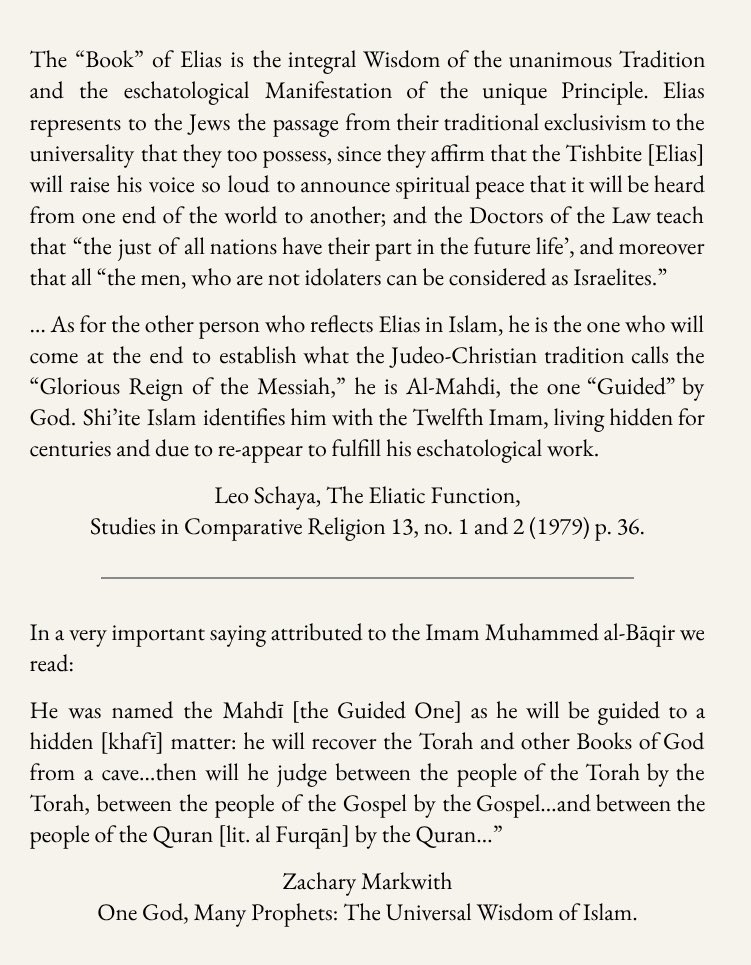
Image description
Extended description
Text of image attached to these tweets: The “Book” of Elias is the integral Wisdom of the unanimous Tradition and the eschatological Manifestation of the unique Principle. Elias represents to the Jews the passage from their traditional exclusivism to the universality that they too possess, since they affirm that the Tishbite [Elias] will raise his voice so loud to announce spiritual peace that it will be heard from one end of the world to another; and the Doctors of the Law teach that “the just of all nations have their part in the future life’, and moreover that all “the men, who are not idolaters can be considered as Israelites.” … As for the other person who reflects Elias in Islam, he is the one who will come at the end to establish what the Judeo-Christian tradition calls the “Glorious Reign of the Messiah,” he is Al-Mahdi, the one “Guided” by God. Shi’ite Islam identifies him with the Twelfth Imam, living hidden for centuries and due to re-appear to fulfill his eschatological work. Leo Schaya, The Eliatic Function, Studies in Comparative Religion 13, no. 1 and 2 (1979) p. 36. ------------------------------------------------------------------------ In a very important saying attributed to the Imam Muhammed al-Bāqir we read: He was named the Mahdī [the Guided One] as he will be guided to a hidden [khafī] matter: he will recover the Torah and other Books of God from a cave…then will he judge between the people of the Torah by the Torah, between the people of the Gospel by the Gospel…and between the people of the Quran [lit. al Furqān] by the Quran…” Zachary Markwith One God, Many Prophets: The Universal Wisdom of Islam. []
Open original document