
@nybooks 2/ Yet Mahdism—in its Twelver Shia form, the doctrine of the Hidden Imam—is almost entirely absent from Western political analysis, which views the Islamic Republic as a misfiring nation-state rather than a regime directly indexed to a messianic futurity.
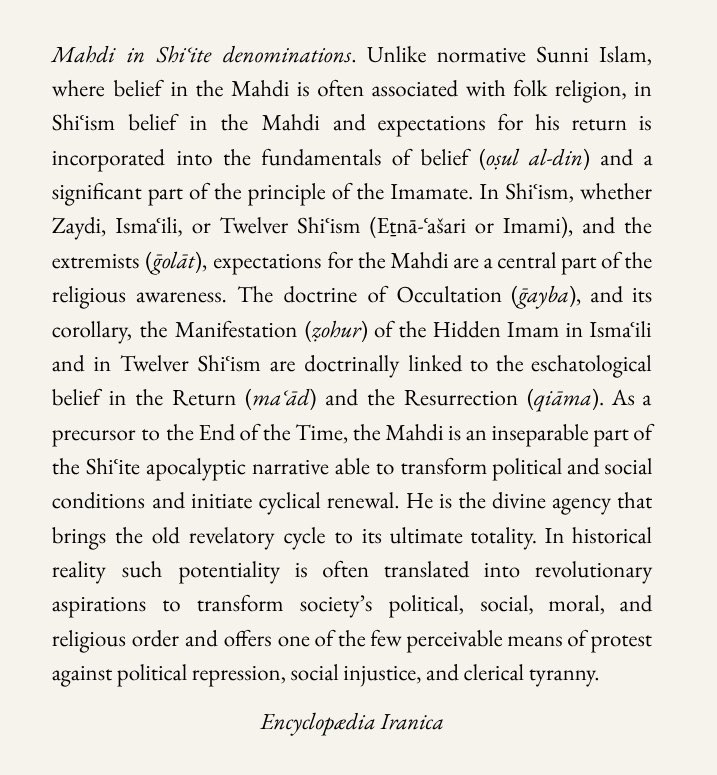
Image description
Extended description
Image text from original tweet here: Mahdi in Shiʿite denominations. Unlike normative Sunni Islam, where belief in the Mahdi is often associated with folk religion, in Shiʿism belief in the Mahdi and expectations for his return is incorporated into the fundamentals of belief (oṣul al-din) and a significant part of the principle of the Imamate. In Shiʿism, whether Zaydi, Ismaʿili, or Twelver Shiʿism (Eṯnā-ʿašari or Imami), and the extremists (ḡolāt), expectations for the Mahdi are a central part of the religious awareness. The doctrine of Occultation (ḡayba), and its corollary, the Manifestation (ẓohur) of the Hidden Imam in Ismaʿili and in Twelver Shiʿism are doctrinally linked to the eschatological belief in the Return (maʿād) and the Resurrection (qiāma). As a precursor to the End of the Time, the Mahdi is an inseparable part of the Shiʿite apocalyptic narrative able to transform political and social conditions and initiate cyclical renewal. He is the divine agency that brings the old revelatory cycle to its ultimate totality. In historical reality such potentiality is often translated into revolutionary aspirations to transform society’s political, social, moral, and religious order and offers one of the few perceivable means of protest against political repression, social injustice, and clerical tyranny. Encyclopædia Iranica []
Open original document