
end\ Consummation isn't a finale but an unveiling—not history's end but its deepening; not the world's end but its becoming real. The living God is met within the grain of ordinary time, life opened from the inside. Eternity isn't ahead, but within. The Kingdom lived aloud.
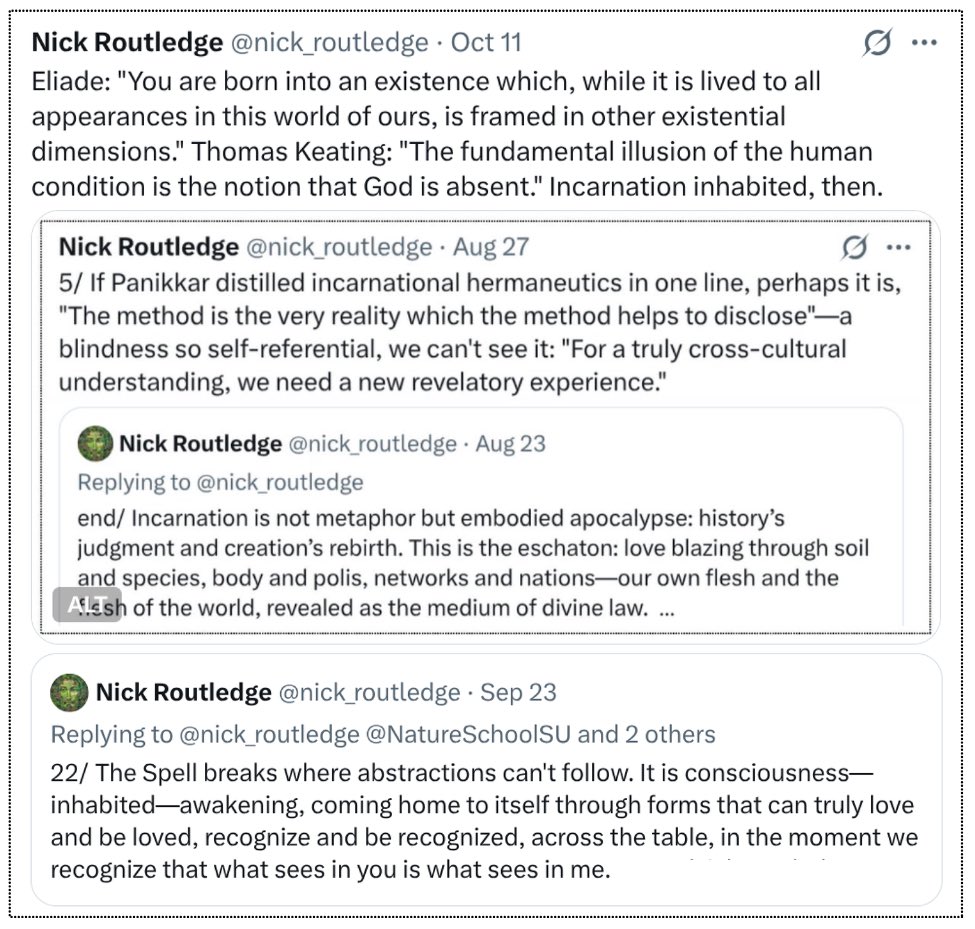
Image description
Extended description
Eliade: "You are born into an existence which, while it is lived to all appearances in this world of ours, is framed in other existential dimensions." Thomas Keating: "The fundamental illusion of the human condition is the notion that God is absent." Incarnation inhabited, then. 5/ If Panikkar distilled incarnational hermaneutics in one line, perhaps it is, "The method is the very reality which the method helps to disclose"—a blindness so self-referential, we can't see it: "For a truly cross-cultural understanding, we need a new revelatory experience." end/ Incarnation is not metaphor but embodied apocalypse: history’s judgment and creation’s rebirth. This is the eschaton: love blazing through soil and species, body and polis, networks and nations—our own flesh and the flesh of the world, revealed as the medium of divine law. Quote tweet: 22/ The Spell breaks where abstractions can't follow. It is consciousness—inhabited—awakening, coming home to itself through forms that can truly love and be loved, recognize and be recognized, across the table, in the moment we recognize that what sees in you is what sees in me
Open original document@Plough This strikes me as extraordinarily profound: sacred and secular are invented labels pasted onto one undivided continuum of lived reality—while our style of inhabiting experience determines whether God is recognized or ignored in ordinary life. Here, time opens upon eternity.
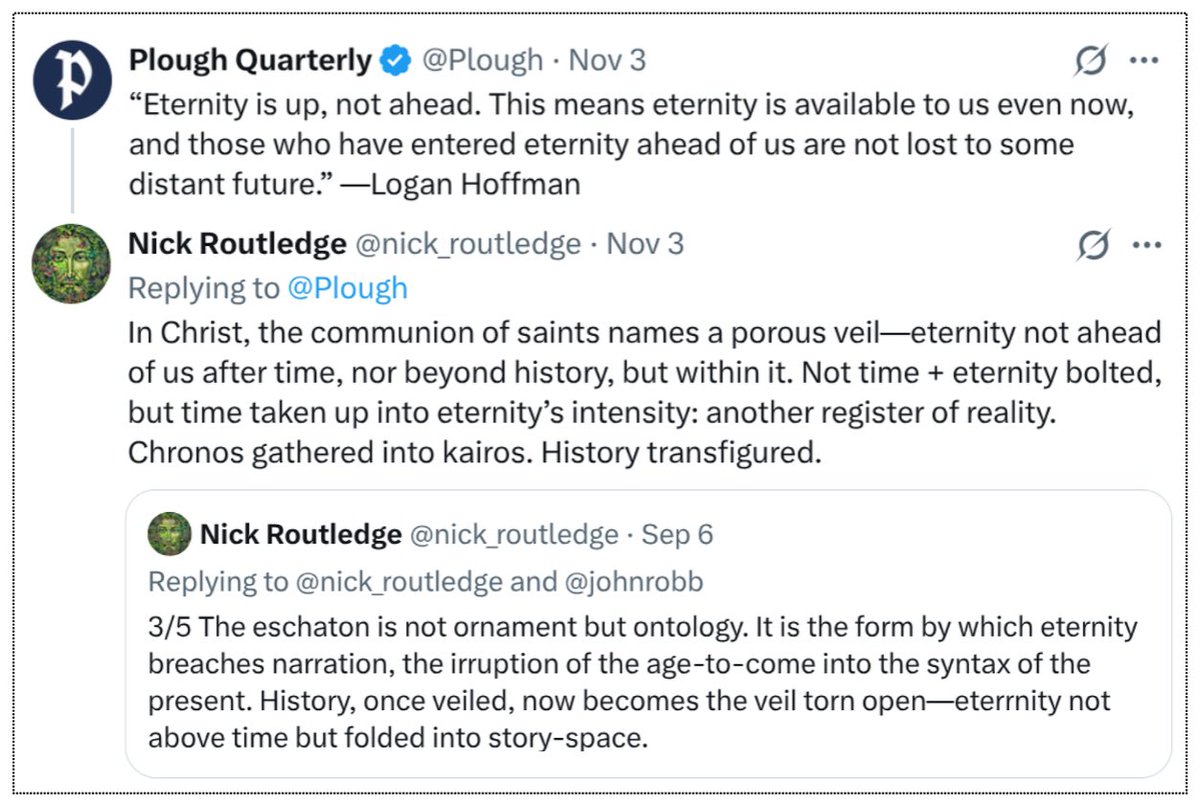
Image description
Original X alt text
Copy of tweet here: “Eternity is up, not ahead. This means eternity is available to us even now, and those who have entered eternity ahead of us are not lost to some distant future.” —Logan Hoffman In Christ, the communion of saints names a porous veil—eternity not ahead of us after time, nor beyond history, but within it. Not time + eternity bolted, but time taken up into eternity’s intensity: another register of reality. Chronos gathered into kairos. History transfigured. 3/5 The eschaton is not ornament but ontology. It is the form by which eternity breaches narration, the irruption of the age-to-come into the syntax of the present. History, once veiled, now becomes the veil torn open—eterrnity not above time but folded into story-space.