
@jasonwblakely 5/ Rorty partly names it: “At the heart of philosophy's quarrel with poetry is the fear that the imagination goes all the way down.” In its dominant high-cultural mode, philosophy becomes a thinned form of knowing: thought made respectable by distance from ordinary depths.
end\ Consummation isn't a finale but an unveiling—not history's end but its deepening; not the world's end but its becoming real. The living God is met within the grain of ordinary time, life opened from the inside. Eternity isn't ahead, but within. The Kingdom lived aloud.
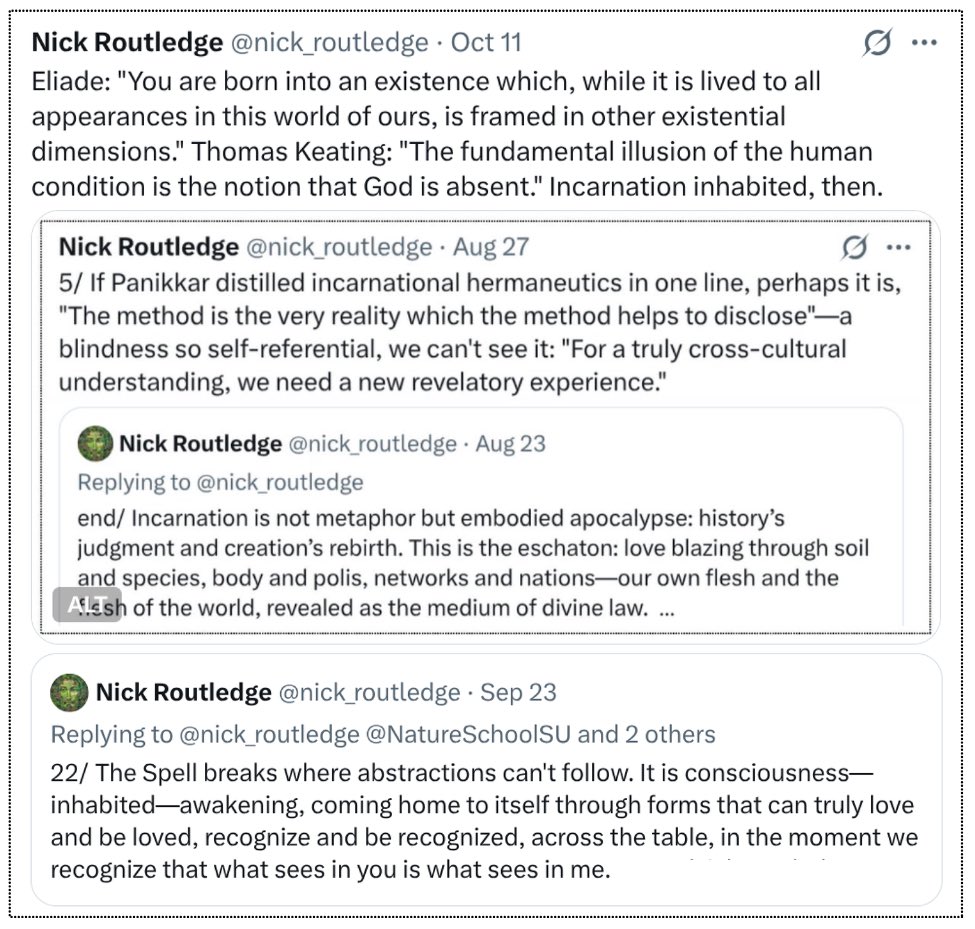
Image description
Extended description
Eliade: "You are born into an existence which, while it is lived to all appearances in this world of ours, is framed in other existential dimensions." Thomas Keating: "The fundamental illusion of the human condition is the notion that God is absent." Incarnation inhabited, then. 5/ If Panikkar distilled incarnational hermaneutics in one line, perhaps it is, "The method is the very reality which the method helps to disclose"—a blindness so self-referential, we can't see it: "For a truly cross-cultural understanding, we need a new revelatory experience." end/ Incarnation is not metaphor but embodied apocalypse: history’s judgment and creation’s rebirth. This is the eschaton: love blazing through soil and species, body and polis, networks and nations—our own flesh and the flesh of the world, revealed as the medium of divine law. Quote tweet: 22/ The Spell breaks where abstractions can't follow. It is consciousness—inhabited—awakening, coming home to itself through forms that can truly love and be loved, recognize and be recognized, across the table, in the moment we recognize that what sees in you is what sees in me
Open original document