
@Plough This strikes me as extraordinarily profound: sacred and secular are invented labels pasted onto one undivided continuum of lived reality—while our style of inhabiting experience determines whether God is recognized or ignored in ordinary life. Here, time opens upon eternity.
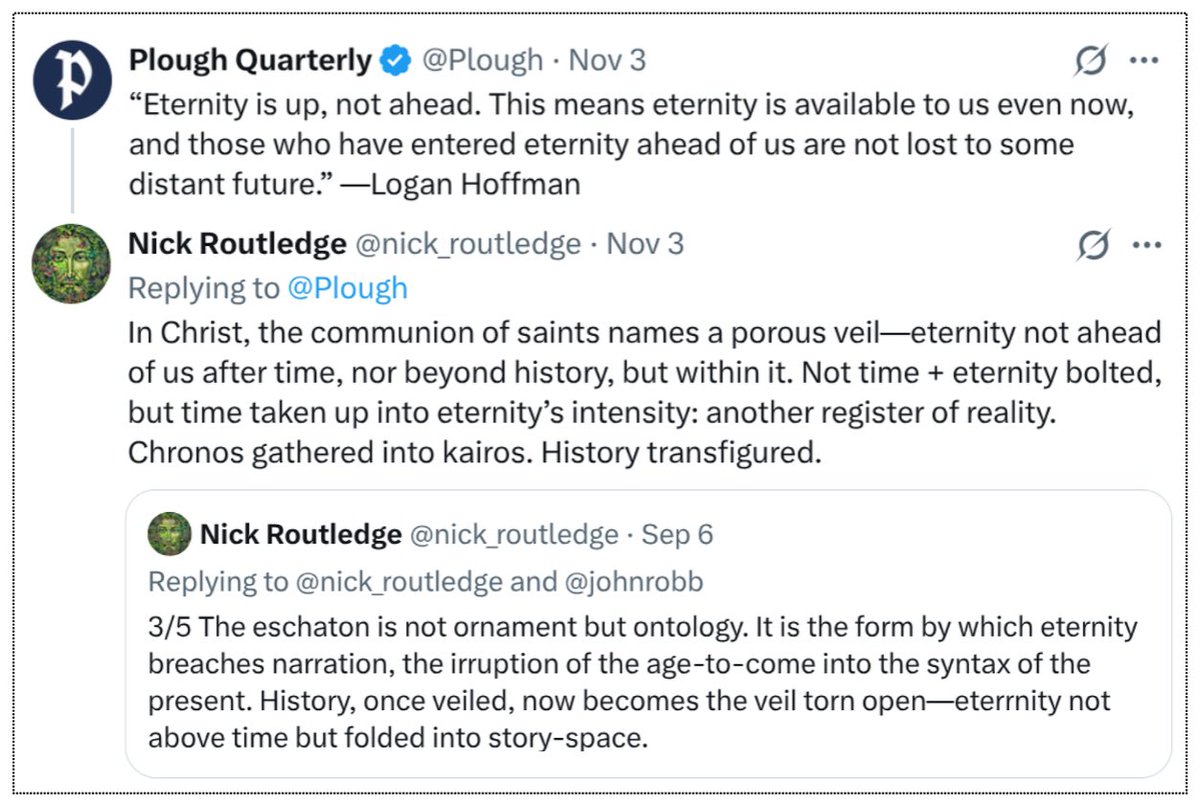
Image description
Original X alt text
Copy of tweet here: “Eternity is up, not ahead. This means eternity is available to us even now, and those who have entered eternity ahead of us are not lost to some distant future.” —Logan Hoffman In Christ, the communion of saints names a porous veil—eternity not ahead of us after time, nor beyond history, but within it. Not time + eternity bolted, but time taken up into eternity’s intensity: another register of reality. Chronos gathered into kairos. History transfigured. 3/5 The eschaton is not ornament but ontology. It is the form by which eternity breaches narration, the irruption of the age-to-come into the syntax of the present. History, once veiled, now becomes the veil torn open—eterrnity not above time but folded into story-space.
@RichardRohrOFM 2/ This, the texture of eschatological fulfillment breaking into ordinary time—not the end of history but its deepening. The convergence of all things in love occurring not beyond time but within it—a present grammar of becoming, here and now.
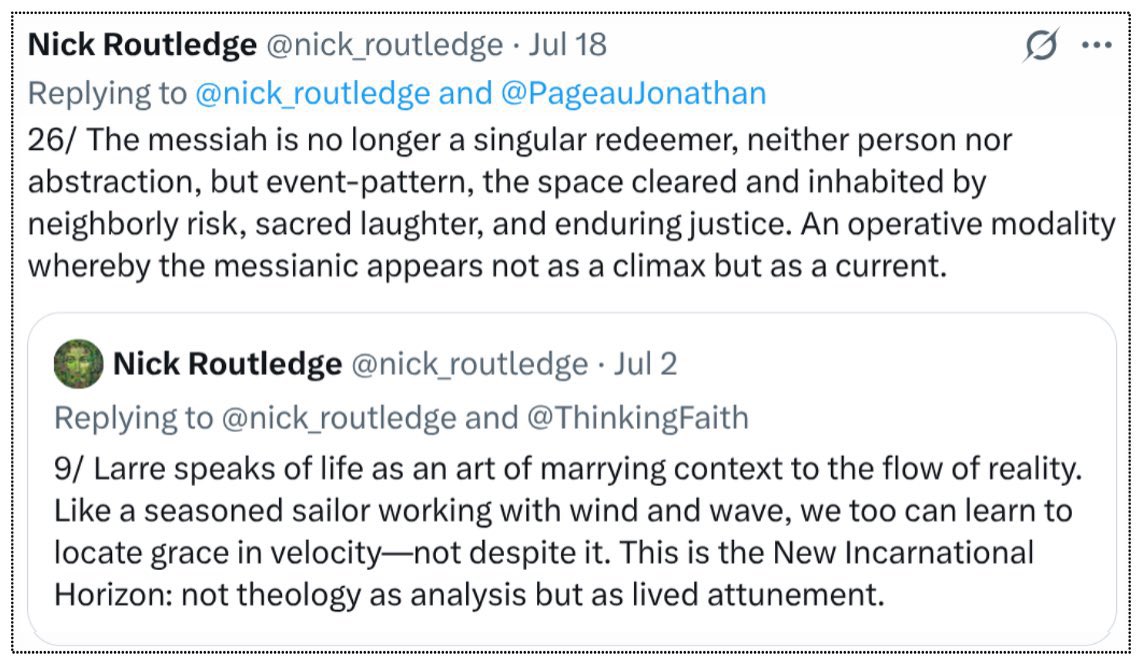
Image description
Original X alt text
Copy of tweet and quote tweet here: @nick_routledge· Jul 18 26/ The messiah is no longer a singular redeemer, neither person nor abstraction, but event-pattern, the space cleared and inhabited by neighborly risk, sacred laughter, and enduring justice. An operative modality whereby the messianic appears not as a climax but as a current. Quote tweet: @nick_routledge Replying to @nick_routledge and @ThinkingFaith 9/ Larre speaks of life as an art of marrying context to the flow of reality. Like a seasoned sailor working with wind and wave, we too can learn to locate grace in velocity—not despite it. This is the New Incarnational Horizon: not theology as analysis but as lived attunement.