
@lukeburgis 6/ This isn’t feel-good spirituality but recognition that consciousness and cosmos co-evolve: moral growth and ontological insight are one. Fracture crystallizes into integrity, wisdom, peace—the very form of reality’s fulfillment, a telos of coherence, integration, wholeness.
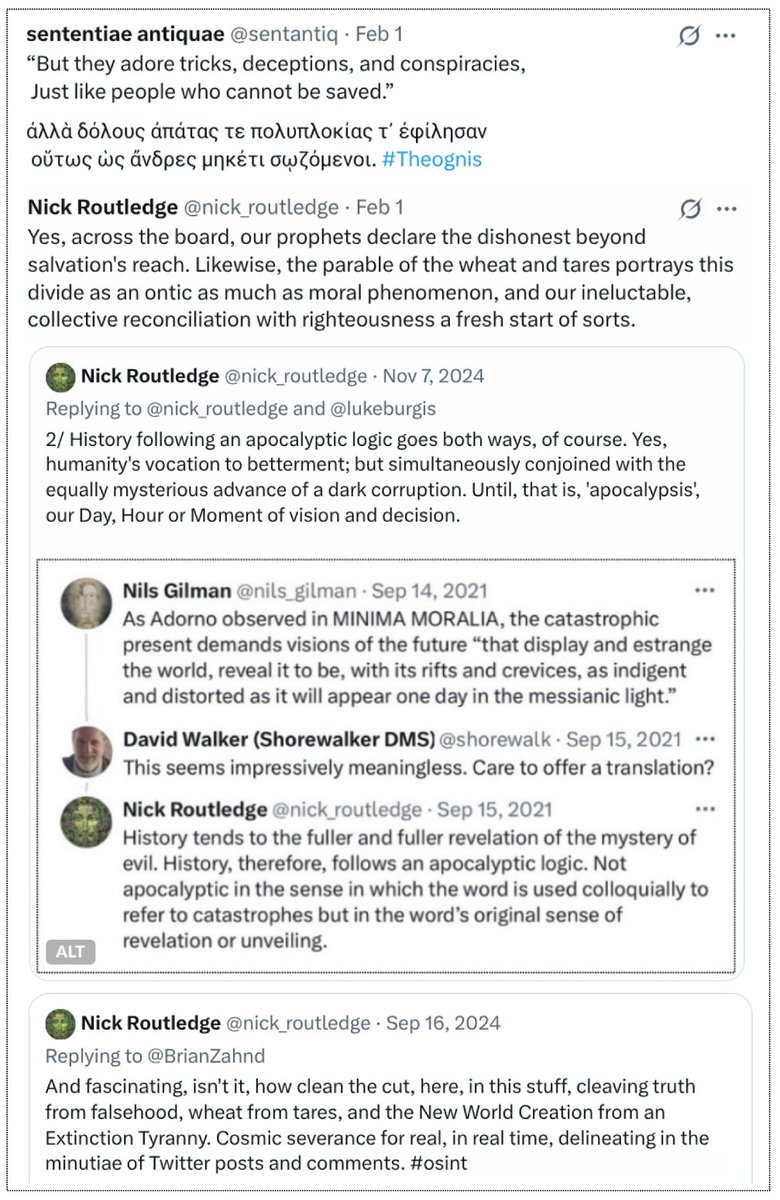
Image description
Original X alt text
Copy of tweet here:
Extended description
Pictured speaker / quoted attribution: sententiae antiquae @sentantiq quoting Theognis Recovered pictured passage; not a claim to the full source. Passage boundary: Pictured English translation only; Greek words separately recovered with uncertainty confined to specified diacritics. Source: archive.nickroutledge.org/post/1962917553006846279 Preserve quoted-author distinctions; the containing tweet does not confer authorship. “But they adore tricks, deceptions, and conspiracies, Just like people who cannot be saved.” Retained uncertainty: [{"passage": "Greek two-line quotation under English Theognis translation", "reason": "Full-resolution checked; words readable, but exact breathing/accent marks in first and second lines are not confidently certified. Manual draft retained separately; no claim English OCR transcribed Greek."}]
Open original documentExtended description
Pictured speaker / quoted attribution: Theognis, posted by @sentantiq Recovered pictured passage; not a claim to the full source. Passage boundary: Greek two lines Source: archive.nickroutledge.org/post/1962917553006846279 Preserve quoted-author distinctions; the containing tweet does not confer authorship. ἀλλὰ δόλους ἀπάτας τε πολυπλοκίας τ’ ἐφίλησαν οὕτως ὡς ἄνδρες μηκέτι σωζόμενοι. #Theognis Retained uncertainty: [{"passage": "Greek two-line quotation under English Theognis translation", "reason": "Full-resolution checked; words readable, but exact breathing/accent marks in first and second lines are not confidently certified. Manual draft retained separately; no claim English OCR transcribed Greek."}]
Open original documentExtended description
Pictured speaker / quoted attribution: Nick Routledge Saved source record associated with pictured writing; full saved record, not an exact pictured excerpt. Passage boundary: Yes across board Source: archive.nickroutledge.org/post/1885733090406064438 Preserve quoted-author distinctions; the containing tweet does not confer authorship. @sentantiq Yes, across the board, our prophets declare the dishonest beyond salvation's reach. Likewise, the parable of the wheat and tares portrays this divide as an ontic as much as moral phenomenon, and our ineluctable, collective reconciliation with righteousness a fresh start of sorts. t.co/hNHUhocWJO Retained uncertainty: [{"passage": "Greek two-line quotation under English Theognis translation", "reason": "Full-resolution checked; words readable, but exact breathing/accent marks in first and second lines are not confidently certified. Manual draft retained separately; no claim English OCR transcribed Greek."}]
Open original documentExtended description
Pictured speaker / quoted attribution: Nick Routledge Saved source record associated with pictured writing; full saved record, not an exact pictured excerpt. Passage boundary: 2/ History Source: archive.nickroutledge.org/post/1854511809036013980 Preserve quoted-author distinctions; the containing tweet does not confer authorship. @lukeburgis 2/ History following an apocalyptic logic goes both ways, of course. Yes, humanity's vocation to betterment; but simultaneously conjoined with the equally mysterious advance of a dark corruption. Until, that is, 'apocalypsis', our Day, Hour or Moment of vision and decision. t.co/K1tkUUTMVC Retained uncertainty: [{"passage": "Greek two-line quotation under English Theognis translation", "reason": "Full-resolution checked; words readable, but exact breathing/accent marks in first and second lines are not confidently certified. Manual draft retained separately; no claim English OCR transcribed Greek."}]
Open original documentExtended description
Pictured speaker / quoted attribution: Nils Gilman quoting Adorno Saved source record associated with pictured writing; full saved record, not an exact pictured excerpt. Passage boundary: As Adorno Source: Preserve quoted-author distinctions; the containing tweet does not confer authorship. Copy of tweet thread: As Adorno observed in MINIMA MORALIA, the catastrophic present demands visions of the future “that display and estrange the world, reveal it to be, with its rifts and crevices, as indigent and distorted as it will appear one day in the messianic light.” This seems impressively meaningless. Care to offer a translation? History tends to the fuller and fuller revelation of the mystery of evil. History, therefore, follows an apocalyptic logic. Not apocalyptic in the sense in which the word is used colloquially to refer to catastrophes but in the word’s original sense of revelation or unveiling. Retained uncertainty: [{"passage": "Greek two-line quotation under English Theognis translation", "reason": "Full-resolution checked; words readable, but exact breathing/accent marks in first and second lines are not confidently certified. Manual draft retained separately; no claim English OCR transcribed Greek."}]
Open original documentExtended description
Pictured speaker / quoted attribution: David Walker @shorewalker1 Saved source record associated with pictured writing; full saved record, not an exact pictured excerpt. Passage boundary: This seems Source: Preserve quoted-author distinctions; the containing tweet does not confer authorship. Copy of tweet thread: As Adorno observed in MINIMA MORALIA, the catastrophic present demands visions of the future “that display and estrange the world, reveal it to be, with its rifts and crevices, as indigent and distorted as it will appear one day in the messianic light.” This seems impressively meaningless. Care to offer a translation? History tends to the fuller and fuller revelation of the mystery of evil. History, therefore, follows an apocalyptic logic. Not apocalyptic in the sense in which the word is used colloquially to refer to catastrophes but in the word’s original sense of revelation or unveiling. Retained uncertainty: [{"passage": "Greek two-line quotation under English Theognis translation", "reason": "Full-resolution checked; words readable, but exact breathing/accent marks in first and second lines are not confidently certified. Manual draft retained separately; no claim English OCR transcribed Greek."}]
Open original documentExtended description
Pictured speaker / quoted attribution: Nick Routledge Saved source record associated with pictured writing; full saved record, not an exact pictured excerpt. Passage boundary: History tends Source: Preserve quoted-author distinctions; the containing tweet does not confer authorship. Copy of tweet thread: As Adorno observed in MINIMA MORALIA, the catastrophic present demands visions of the future “that display and estrange the world, reveal it to be, with its rifts and crevices, as indigent and distorted as it will appear one day in the messianic light.” This seems impressively meaningless. Care to offer a translation? History tends to the fuller and fuller revelation of the mystery of evil. History, therefore, follows an apocalyptic logic. Not apocalyptic in the sense in which the word is used colloquially to refer to catastrophes but in the word’s original sense of revelation or unveiling. Retained uncertainty: [{"passage": "Greek two-line quotation under English Theognis translation", "reason": "Full-resolution checked; words readable, but exact breathing/accent marks in first and second lines are not confidently certified. Manual draft retained separately; no claim English OCR transcribed Greek."}]
Open original documentExtended description
Pictured speaker / quoted attribution: Nick Routledge Saved source record associated with pictured writing; full saved record, not an exact pictured excerpt. Passage boundary: And fascinating Source: archive.nickroutledge.org/post/1962917553006846279 Preserve quoted-author distinctions; the containing tweet does not confer authorship. 5/ The “harvest” of Jesus’ parable is not a divine act imposed from above. The wheat and the tares don’t need to be torn apart. They part naturally—because revelation, when it finally comes, is so piercing that falsehood cannot survive it. Phrased simply, Christian eschatology, correctly grasped, should always constitute a provocation of the powers that prevail within, or the institutions that compose, a social world. The light of this absolute futurity should unsettle every present. —David Bentley Hart The Second Advent, then, as a _planetary_ pedagogical method equal to the gospel transmission of a radical transformation in the meaning of power in the unitive core of the human being, whereby all the heart’s quests are revalued and hierarchies of history reversed. 2/ "We do not preach only one coming of Christ, but the second as well, much more glorious. The first coming was marked by patience; the second brings the crown of a divine kingdom. We look then beyond the first coming to the second.” - Cyril of Jerusalem "The second coming is but a deeper understanding of the first coming." – Moriarty 3/ "The Savior will not come to be judged again, but to judge those by whom he was judged. His first coming was to fulfill his plan of love, to teach men by gentle persuasion. This time, whether men like it or not, they will be subjects of his kingdom by necessity." - Cyril of J. Quote tweet: And fascinating, isn't it, how clean the cut, here, in this stuff, cleaving truth from falsehood, wheat from tares, and the New World Creation from an Extinction Tyranny. Cosmic severance for real, in real time, delineating in the minutiae of Twitter posts and comments. #osint Retained uncertainty: [{"passage": "Greek two-line quotation under English Theognis translation", "reason": "Full-resolution checked; words readable, but exact breathing/accent marks in first and second lines are not confidently certified. Manual draft retained separately; no claim English OCR transcribed Greek."}]
Open original document@krumbbumm As such, the interdependent attitude of the Bodhisattva or Jesus enduring the Cross is the most realistic, locating the meaning of life in whole-hearted, personal identification with the perfection, in this world, of human and earthly solidarity, liberation, salvation and peace.
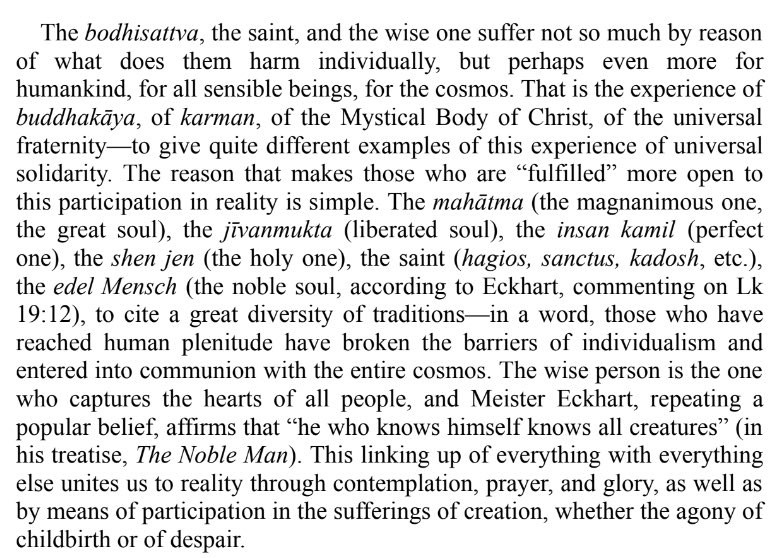
Image description
Original X alt text
The bodhisattva, the saint, and the wise one suffer not so much by reason of what does them harm individually, but perhaps even more for humankind, for all sensible beings, for the cosmos. That is the experience of buddhakaya, of karman, of the Mystical Body of Christ, of the universal fraternity—to give quite different examples of this experience of universal solidarity. The reason that makes those who are “fulfilled” more open to this participation in reality is simple. The mahatma (the magnanimous one, the great soul), the jivanmukta (liberated soul), the insan kamil (perfect one), the shen jen (the holy one), the saint (hagios, sanctus, kadosh, etc.), the edel Mensch (the noble soul, according to Eckhart, commenting on Lk 19:12), to cite a great diversity of traditions—in a word, those who have reached human plenitude have broken the barriers of individualism and entered into communion with the entire cosmos. The wise person is the one who captures the hearts... - Raimon Panikkar