
@lukeburgis 4/ Non-retributive justice does not succeed by tactic. It works because it consents to the mystery at the core of creation: our inescapable entanglement aligned with the hidden architecture of reality through which all life coheres—how things actually are—like it or not.
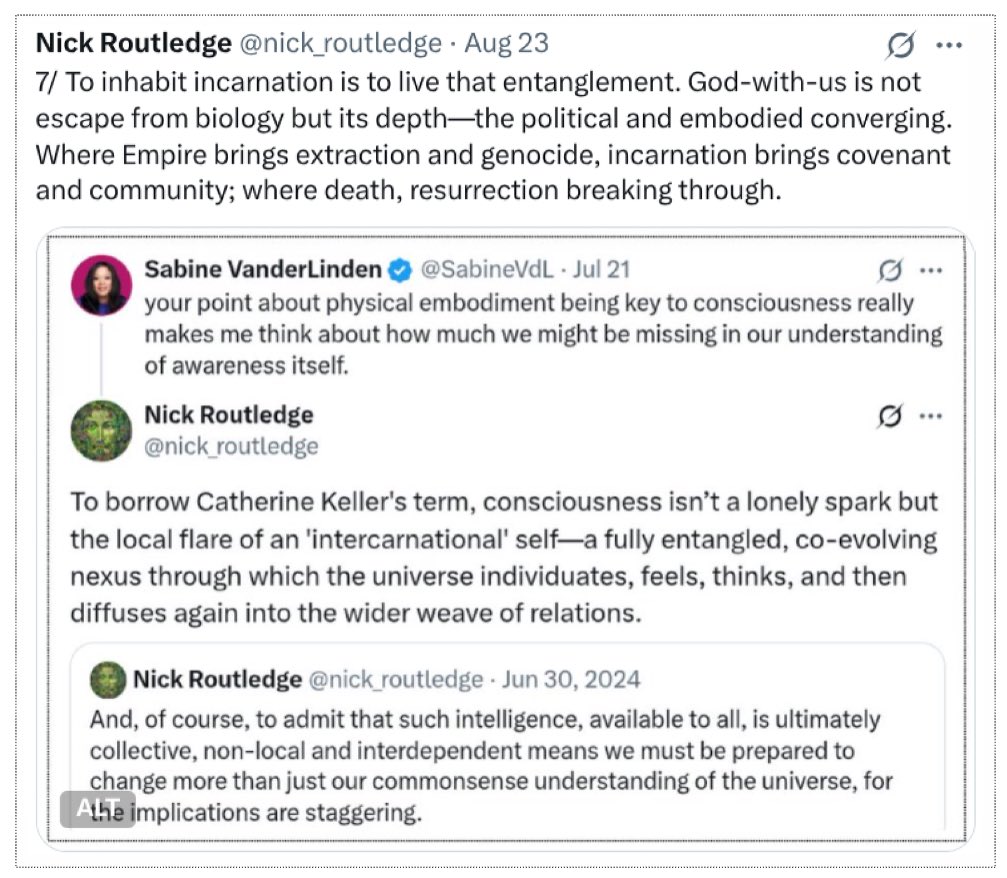
Image description
Original X alt text
Copy of tweet and image here:
Extended description
Pictured speaker / quoted attribution: Nick Saved source record associated with pictured writing; full saved record, not an exact pictured excerpt. Passage boundary: Source: archive.nickroutledge.org/post/1959442597094826408 Preserve quoted-author distinctions; the containing tweet does not confer authorship. 7/ To inhabit incarnation is to live that entanglement. God-with-us is not escape from biology but its depth—the political and embodied converging. Where Empire brings extraction and genocide, incarnation brings covenant and community; where death, resurrection breaking through. t.co/eF0cdoC7Hz
Open original documentExtended description
Pictured speaker / quoted attribution: Sabine VanderLinden Saved source record associated with pictured writing; full saved record, not an exact pictured excerpt. Passage boundary: Source: archive.nickroutledge.org/post/1962916374633971848 Preserve quoted-author distinctions; the containing tweet does not confer authorship. Sabine VanderLinden: your point about physical embodiment being key to consciousness really makes me think about how much we might be missing in our understanding of awareness itself.
Open original documentExtended description
Pictured speaker / quoted attribution: Nick quoting Catherine Keller Saved source record associated with pictured writing; full saved record, not an exact pictured excerpt. Passage boundary: Source: archive.nickroutledge.org/post/1947359631602553151 Preserve quoted-author distinctions; the containing tweet does not confer authorship. @SabineVdL @Plough To borrow Catherine Keller's term, consciousness isn’t a lonely spark but the local flare of an 'intercarnational' self—a fully entangled, co-evolving nexus through which the universe individuates, feels, thinks, and then diffuses again into the wider weave of relations. t.co/VhQx1Al2hd
Open original documentExtended description
Pictured speaker / quoted attribution: Nick Saved source record associated with pictured writing; full saved record, not an exact pictured excerpt. Passage boundary: Source: archive.nickroutledge.org/post/1807433914258182310 Preserve quoted-author distinctions; the containing tweet does not confer authorship. @SherPoint And, of course, to admit that such intelligence, available to all, is ultimately collective, non-local and interdependent means we must be prepared to change more than just our commonsense understanding of the universe, for the implications are staggering.
Open original document6/ Every collapse unveils the alternative. Incarnation is apocalypse—love unveiled as the law of reality. Empire is unmasked, solidarity revealed, and history itself bent toward liberation. Entanglement is exposed as the condition of being itself.
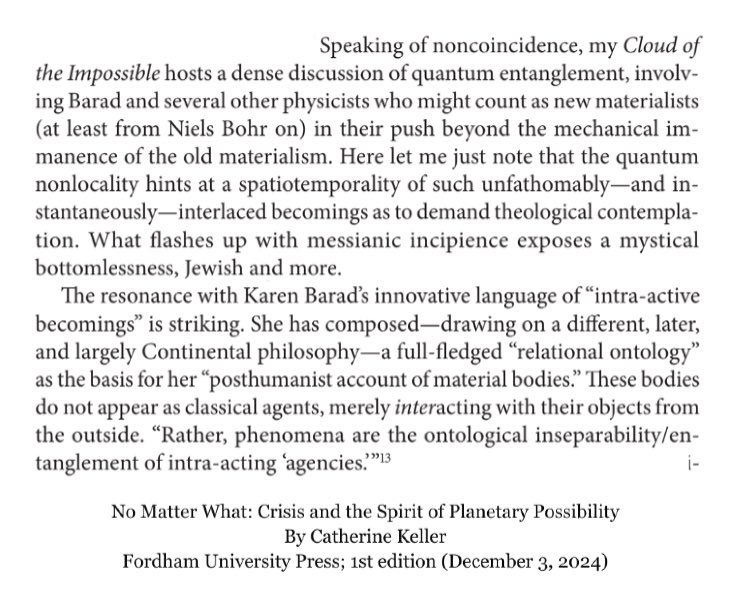
Image description
Original X alt text
Speaking of noncoincidence, my Cloud of the Impossible hosts a dense discussion of quantum entanglement, involving Barad and several other physicists who might count as new materialists in their push beyond the mechanical immanence of the old materialism. Here let me just note that the quantum nonlocality hints at a spatiotemporality of such unfathomably—and instantaneously—interlaced becomings as to demand theological contemplation. What flashes up with messianic incipience exposes a mysticalbottomlessness, Jewish and more. The resonance with Karen Barad’s innovative language of “intra-active becomings” is striking. She has composed—drawing on a later, and largely Continental philosophy—a full-fledged “relational ontology” as the basis for her “posthumanist account of material bodies.” These bodies do not appear as classical agents, merely interacting with their objects from the outside. “Rather, phenomena are the ontological inseparability/entanglement of intra-acting ‘agencies.
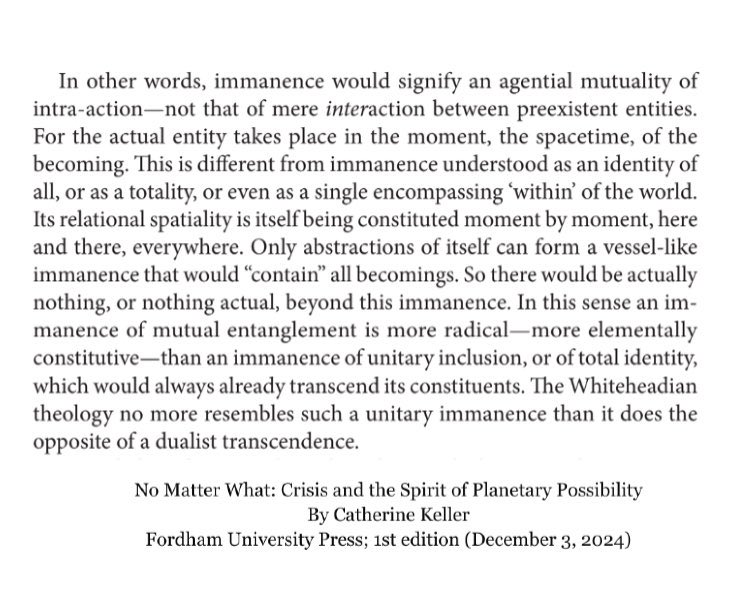
Image description
Original X alt text
In other words, immanence would signify an agential mutuality of intra-action—not that of mere interaction between preexistent entities. For the actual entity takes place in the moment, the spacetime, of the becoming. This is different from immanence understood as an identity of all, or as a totality, or even as a single encompassing ‘within’ of the world. Its relational spatiality is itself being constituted moment by moment, here and there, everywhere. Only abstractions of itself can form a vessel-like immanence that would “contain” all becomings. So there would be actually nothing, or nothing actual, beyond this immanence. In this sense an immanence of mutual entanglement is more radical —more elementally constitutive—than an immanence of unitary inclusion, or of total identity, which would always already transcend its constituents. The Whiteheadian theology no more resembles such a unitary immanence than it does the opposite of a dualist transcendence.