
Nick Routledge@nick_routledge
Reply to @nick_routledge

18/ Sahaja, Nund Rishi said, required 'rebirth.' Incarnation wasn’t a doctrine—it was a location. It meant the divine could only appear through the neighbor, the landscape, the wound. It’s not what we believe—it’s how we breathe reality in relationship. Right here. Now.
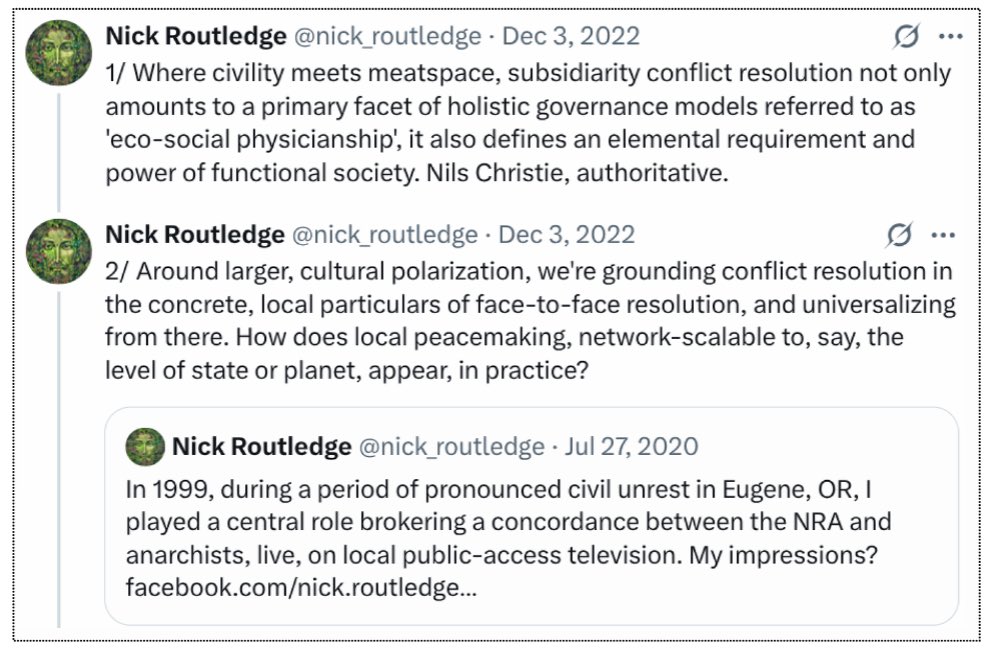
Copy of thread here:

1/ Where civility meets meatspace, subsidiarity conflict resolution not only amounts to a primary facet of holistic governance models referred to as 'eco-social physicianship', it also defines an elemental requirement and power of functional society. Nils Christie, authoritative.

·
2/ Around larger, cultural polarization, we're grounding conflict resolution in the concrete, local particulars of face-to-face resolution, and universalizing from there. How does local peacemaking, network-scalable to, say, the level of state or planet, appear, in practice?

In 1999, during a period of pronounced civil unrest in Eugene, OR, I played a central role brokering a concordance between the NRA and anarchists, live, on local public-access television. My impressions?
Image description

Original X alt text

Copy of thread here: 1/ Where civility meets meatspace, subsidiarity conflict resolution not only amounts to a primary facet of holistic governance models referred to as 'eco-social physicianship', it also defines an elemental requirement and power of functional society. Nils Christie, authoritative. · 2/ Around larger, cultural polarization, we're grounding conflict resolution in the concrete, local particulars of face-to-face resolution, and universalizing from there. How does local peacemaking, network-scalable to, say, the level of state or planet, appear, in practice? In 1999, during a period of pronounced civil unrest in Eugene, OR, I played a central role brokering a concordance between the NRA and anarchists, live, on local public-access television. My impressions?

Quoted or linked post

Nick Routledge@nick_routledge · 11 Apr 2025

@Machine_Civ @Naifalbidh @RichardRohrOFM: "You do not think yourself into a new way of living, you live yourself into a new way of thinking." Hakuin: "Zen practice pursued within activity is a million times superior to that pursued in tranquility." Faith itself, if not accompanied by action, is dead.
Francis didn’t bother questioning Church doctrines and dogmas. He just took the imitation of Christ seriously and tried to live the way that Jesus lived. In The Legend of Perugia, one of the earliest accounts about Francis, he reminds the first friars that they only know as much as they do. His emphasis on action, practice, and lifestyle was foundational and revolutionary for its time and is at the root of Franciscan alternative orthodoxy. Francis and Clare fell in love with the humanity and humility of Jesus. For them, Jesus was someone actually to imitate and not just to worship as divine.
- Richard Rohr
Image description

Original X alt text

Francis didn’t bother questioning Church doctrines and dogmas. He just took the imitation of Christ seriously and tried to live the way that Jesus lived. In The Legend of Perugia, one of the earliest accounts about Francis, he reminds the first friars that they only know as much as they do. His emphasis on action, practice, and lifestyle was foundational and revolutionary for its time and is at the root of Franciscan alternative orthodoxy. Francis and Clare fell in love with the humanity and humility of Jesus. For them, Jesus was someone actually to imitate and not just to worship as divine. - Richard Rohr
The early Franciscan friars and Poor Clares wanted to be gospel practitioners instead of merely “word police,” “inspectors,” or “museum curators” as Pope Francis calls some clergy. Both Francis and Clare offered their rules as a forma vitae, or form of life. They saw orthopraxy (correct practice) as a necessary parallel, and maybe even precedent, to verbal orthodoxy (correct teaching). History has shown that many Christians never get to the practical implications of their beliefs. “Why aren’t you doing what you say you believe?” the prophet invariably asks.
- Richard Rohr
Image description

Original X alt text

The early Franciscan friars and Poor Clares wanted to be gospel practitioners instead of merely “word police,” “inspectors,” or “museum curators” as Pope Francis calls some clergy. Both Francis and Clare offered their rules as a forma vitae, or form of life. They saw orthopraxy (correct practice) as a necessary parallel, and maybe even precedent, to verbal orthodoxy (correct teaching). History has shown that many Christians never get to the practical implications of their beliefs. “Why aren’t you doing what you say you believe?” the prophet invariably asks. - Richard Rohr
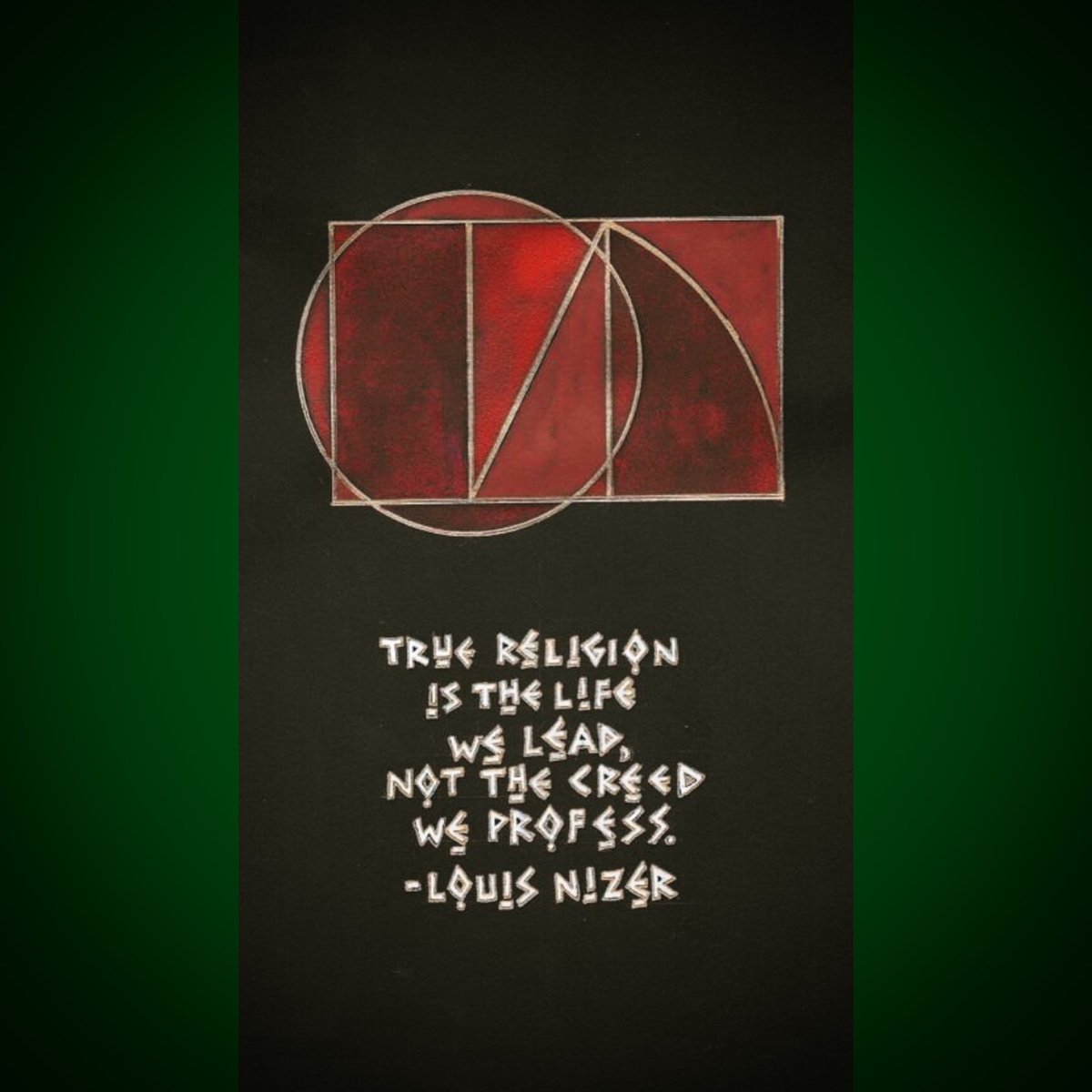
True religion is the life we lead, not the creed we profess.
- Louis Nizer
Image description

Original X alt text

True religion is the life we lead, not the creed we profess. - Louis Nizer

View this post’s context →

Context in the archive

Quoted by@PageauJonathan 28/ Offstage, then, the herald nurtures the quiet grammar of mustard‑seed hope—readying the Kingdom for Empire's ruin, erecting the scaffolding of New World Creation ahead of doomsday theatrics, and flipping the dreaded Apocalypse into an overture of redeemed ecology and polity.Quoted by@ThinkingFaith end/ Neighborliness is not a metaphor. It is the shape of incarnational reality—immediate, relational, mutual. We are already held. What saves us is not ascent but immersion in the river, the rhythm, the Real. The Kingdom is not far. It's what we step into when we inhabit love.