
@PageauJonathan 28/ Offstage, then, the herald nurtures the quiet grammar of mustard‑seed hope—readying the Kingdom for Empire's ruin, erecting the scaffolding of New World Creation ahead of doomsday theatrics, and flipping the dreaded Apocalypse into an overture of redeemed ecology and polity.
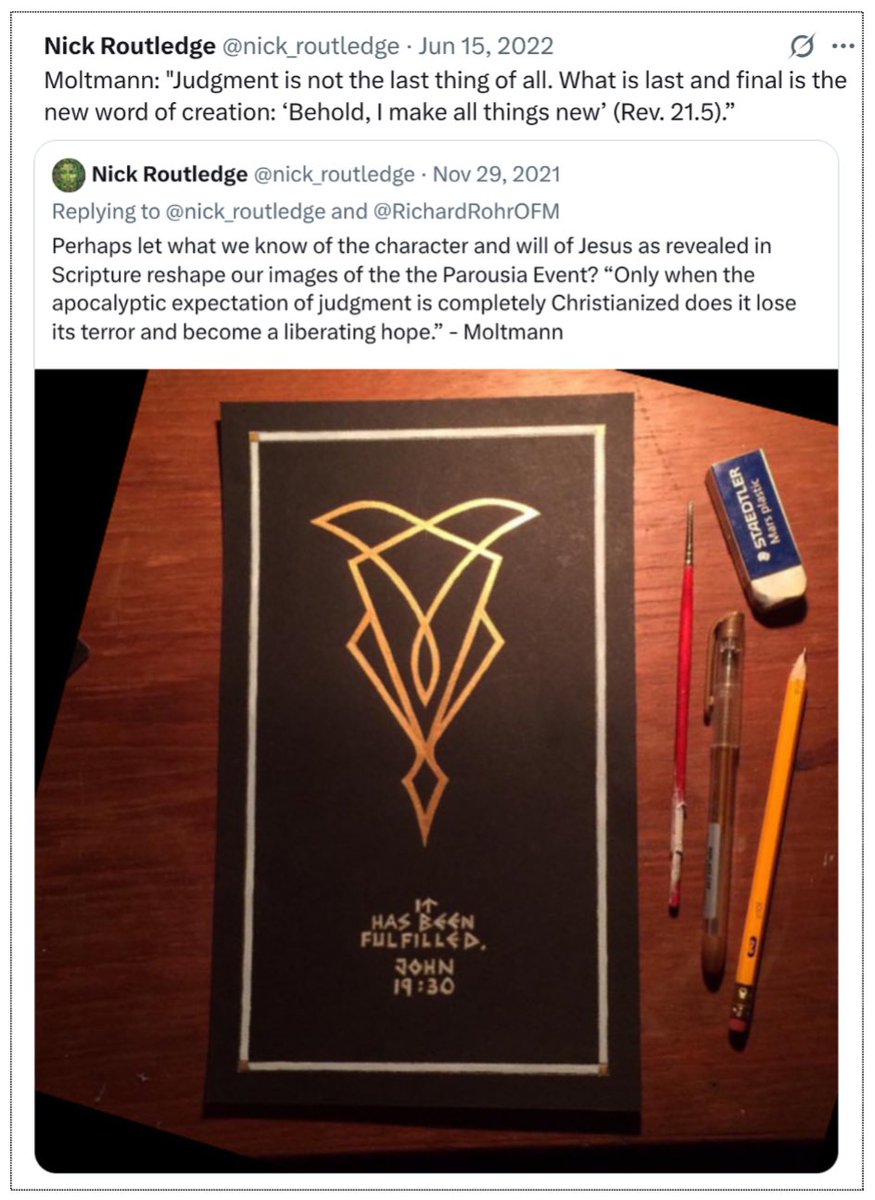
Image description
Original X alt text
Copy of tweet here: Moltmann: "Judgment is not the last thing of all. What is last and final is the new word of creation: ‘Behold, I make all things new’ (Rev. 21.5).” Perhaps let what we know of the character and will of Jesus as revealed in Scripture reshape our images of the the Parousia Event? “Only when the apocalyptic expectation of judgment is completely Christianized does it lose its terror and become a liberating hope.” - Moltmann Art: It has been fulfilled. - John 19:30
18/ Sahaja, Nund Rishi said, required 'rebirth.' Incarnation wasn’t a doctrine—it was a location. It meant the divine could only appear through the neighbor, the landscape, the wound. It’s not what we believe—it’s how we breathe reality in relationship. Right here. Now.
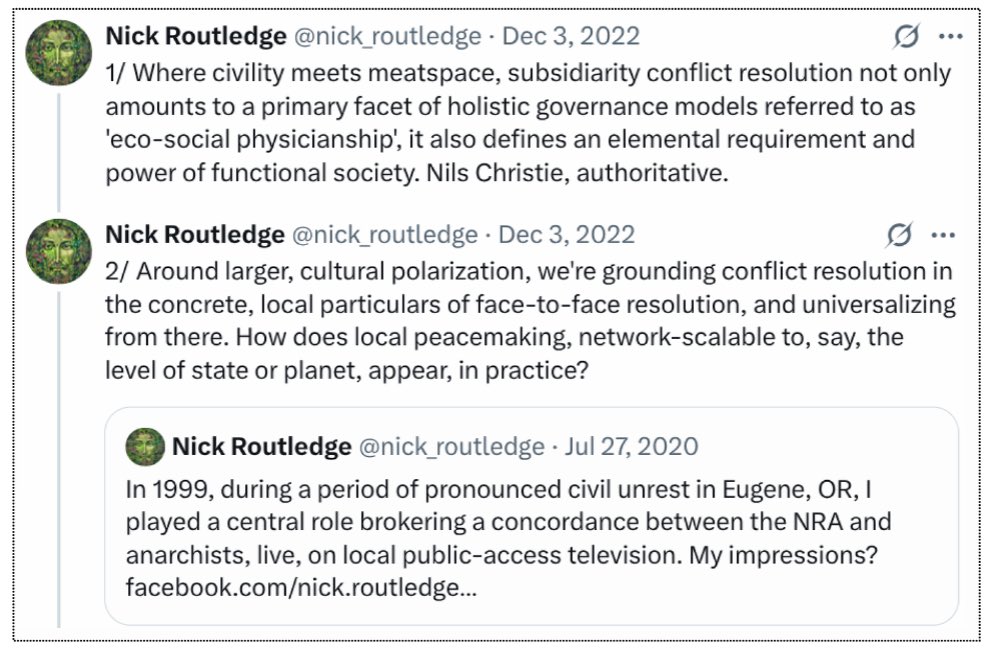
Image description
Original X alt text
Copy of thread here: 1/ Where civility meets meatspace, subsidiarity conflict resolution not only amounts to a primary facet of holistic governance models referred to as 'eco-social physicianship', it also defines an elemental requirement and power of functional society. Nils Christie, authoritative. · 2/ Around larger, cultural polarization, we're grounding conflict resolution in the concrete, local particulars of face-to-face resolution, and universalizing from there. How does local peacemaking, network-scalable to, say, the level of state or planet, appear, in practice? In 1999, during a period of pronounced civil unrest in Eugene, OR, I played a central role brokering a concordance between the NRA and anarchists, live, on local public-access television. My impressions?