
@Machine_Civ @Naifalbidh @RichardRohrOFM: "You do not think yourself into a new way of living, you live yourself into a new way of thinking." Hakuin: "Zen practice pursued within activity is a million times superior to that pursued in tranquility." Faith itself, if not accompanied by action, is dead.
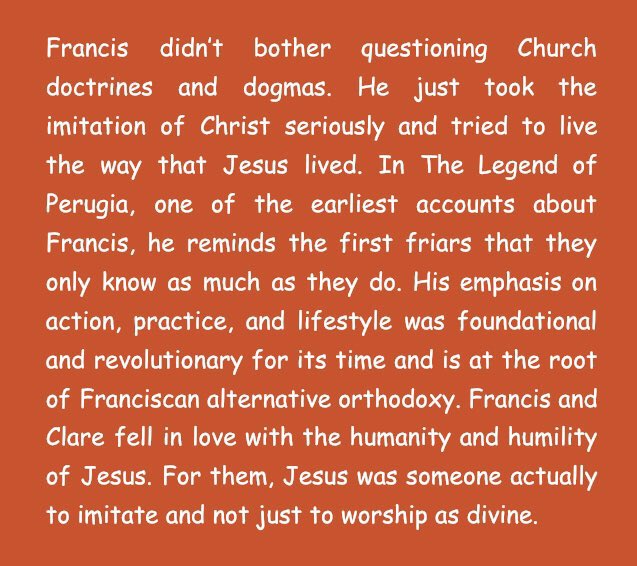
Image description
Original X alt text
Francis didn’t bother questioning Church doctrines and dogmas. He just took the imitation of Christ seriously and tried to live the way that Jesus lived. In The Legend of Perugia, one of the earliest accounts about Francis, he reminds the first friars that they only know as much as they do. His emphasis on action, practice, and lifestyle was foundational and revolutionary for its time and is at the root of Franciscan alternative orthodoxy. Francis and Clare fell in love with the humanity and humility of Jesus. For them, Jesus was someone actually to imitate and not just to worship as divine. - Richard Rohr
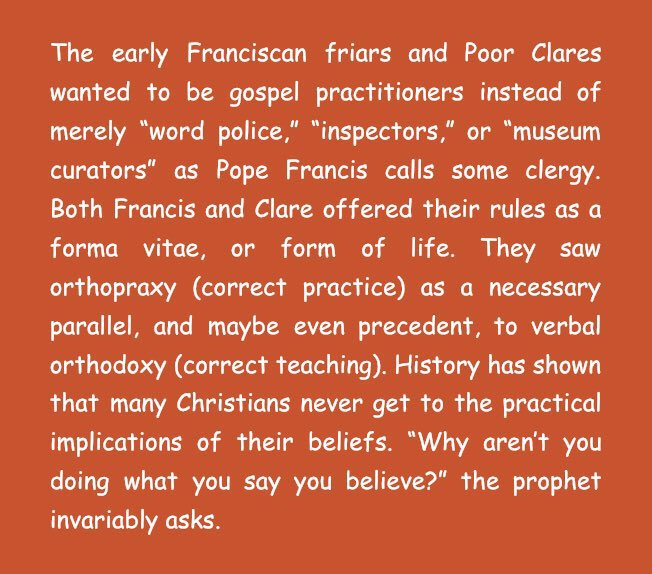
Image description
Original X alt text
The early Franciscan friars and Poor Clares wanted to be gospel practitioners instead of merely “word police,” “inspectors,” or “museum curators” as Pope Francis calls some clergy. Both Francis and Clare offered their rules as a forma vitae, or form of life. They saw orthopraxy (correct practice) as a necessary parallel, and maybe even precedent, to verbal orthodoxy (correct teaching). History has shown that many Christians never get to the practical implications of their beliefs. “Why aren’t you doing what you say you believe?” the prophet invariably asks. - Richard Rohr
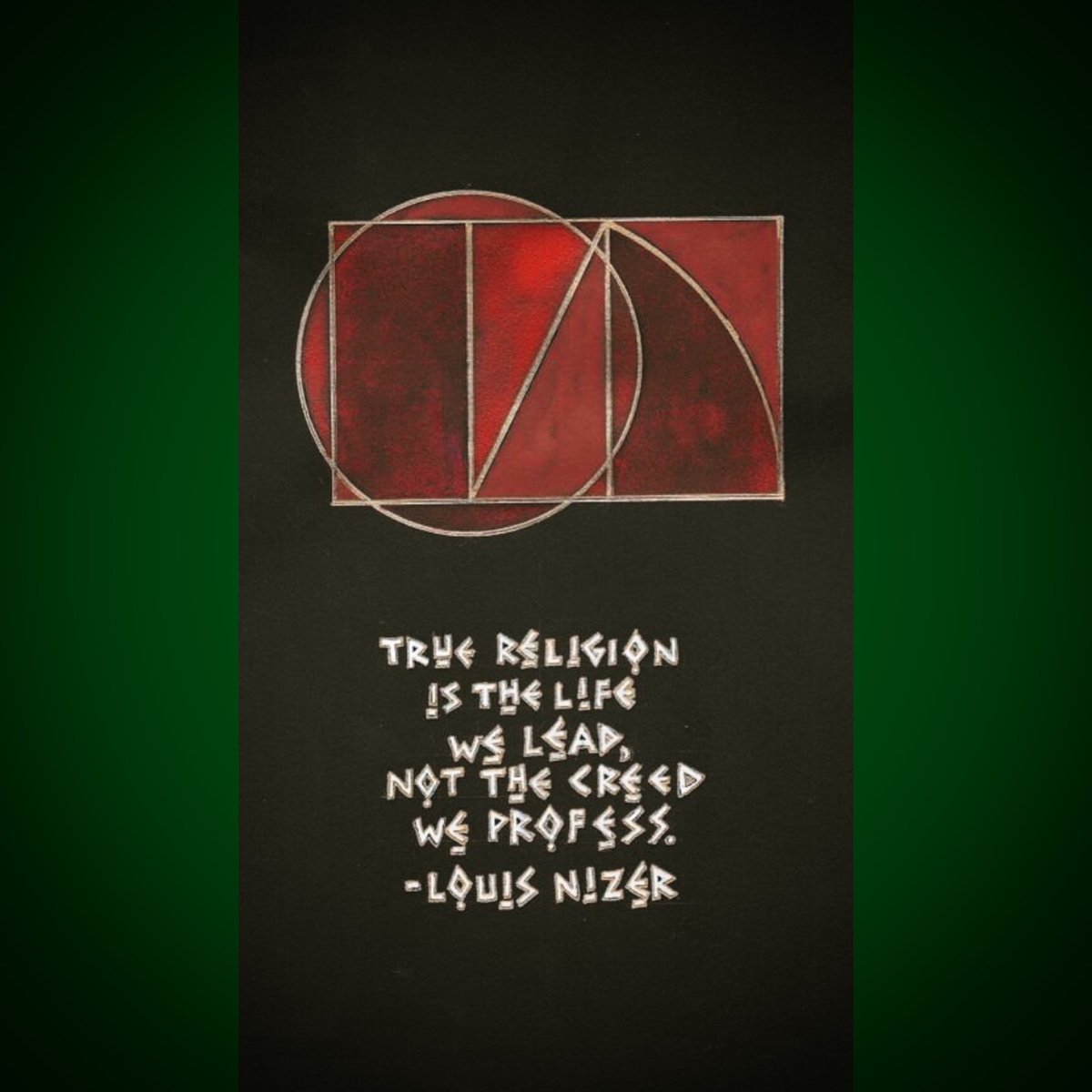
Image description
Original X alt text
True religion is the life we lead, not the creed we profess. - Louis Nizer
@trippfuller 10/ Where both men saw each moment ripe with messianic potential and vitality, Shari'ati also conceived this "strait gate" as an immediacy opening upon and stoking dynamic, participatory, revolutionary messianic activity - a liberation from the status quo of "negative longing."
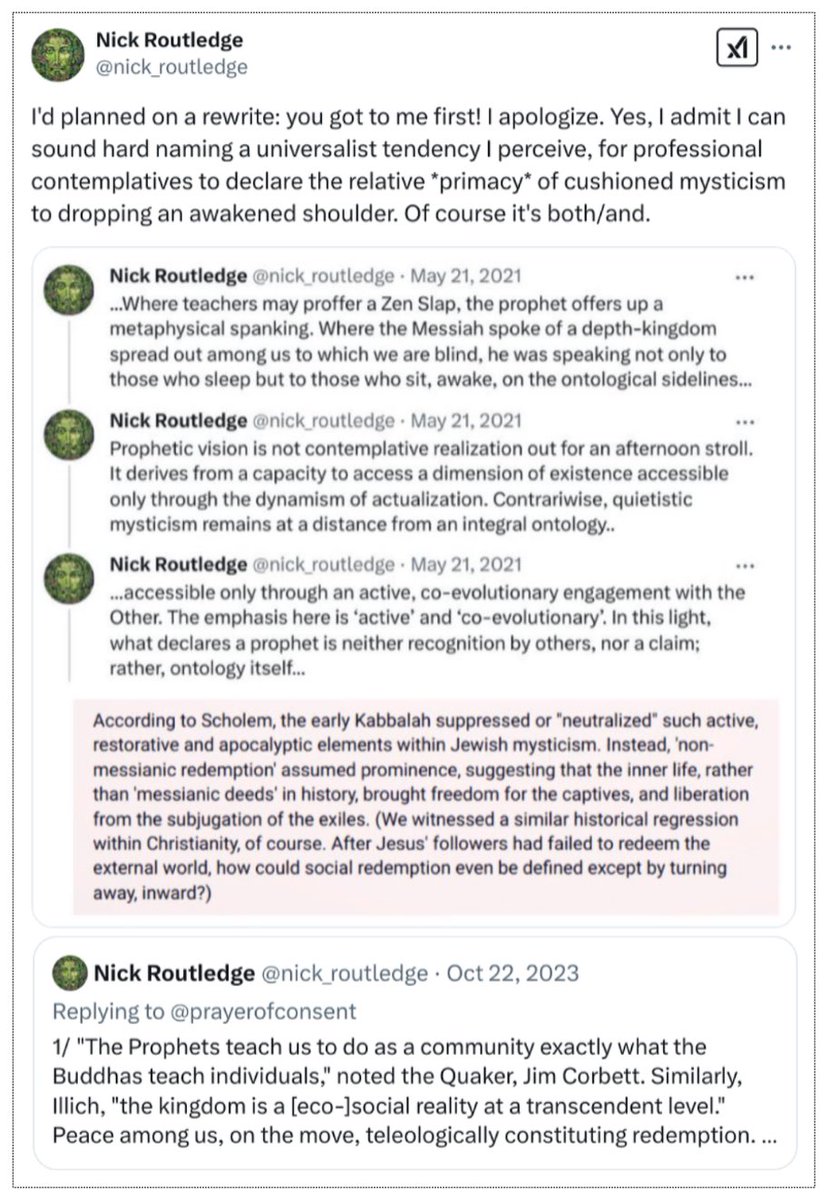
Image description
Original X alt text
Copy of tweet, image and quote tweet here:
Extended description
Pictured speaker / quoted attribution: Nick Saved source record associated with pictured writing; full saved record, not an exact pictured excerpt. Passage boundary: Source: archive.nickroutledge.org/post/1730036568046628951 Preserve quoted-author distinctions; the containing tweet does not confer authorship. @SophiaCycles I'd planned on a rewrite: you got to me first! I apologize. Yes, I admit I can sound hard naming a universalist tendency I perceive, for professional contemplatives to declare the relative *primacy* of cushioned mysticism to dropping an awakened shoulder. Of course it's both/and. t.co/eifJgWBeu3
Open original documentExtended description
Pictured speaker / quoted attribution: Nick, three May21 connected bodies Saved source record associated with pictured writing; full saved record, not an exact pictured excerpt. Passage boundary: Source: archive.nickroutledge.org/post/1395787272868405250 Preserve quoted-author distinctions; the containing tweet does not confer authorship. @poetinbabylon ...Where teachers may proffer a Zen Slap, the prophet offers up a metaphysical spanking. Where the Messiah spoke of a depth-kingdom spread out among us to which we are blind, he was speaking not only to those who sleep but to those who sit, awake, on the ontological sidelines...
Open original documentExtended description
Pictured speaker / quoted attribution: Nick, three May21 connected bodies Saved source record associated with pictured writing; full saved record, not an exact pictured excerpt. Passage boundary: Source: archive.nickroutledge.org/post/1395787598761582595 Preserve quoted-author distinctions; the containing tweet does not confer authorship. @poetinbabylon Prophetic vision is not contemplative realization out for an afternoon stroll. It derives from a capacity to access a dimension of existence accessible only through the dynamism of actualization. Contrariwise, quietistic mysticism remains at a distance from an integral ontology..
Open original documentExtended description
Pictured speaker / quoted attribution: Nick, three May21 connected bodies Saved source record associated with pictured writing; full saved record, not an exact pictured excerpt. Passage boundary: Source: archive.nickroutledge.org/post/1395787763434201088 Preserve quoted-author distinctions; the containing tweet does not confer authorship. @poetinbabylon ...accessible only through an active, co-evolutionary engagement with the Other. The emphasis here is ‘active’ and ‘co-evolutionary’. In this light, what declares a prophet is neither recognition by others, nor a claim; rather, ontology itself...
Open original documentExtended description
Pictured speaker / quoted attribution: Nick discussing Scholem Saved source record associated with pictured writing; full saved record, not an exact pictured excerpt. Passage boundary: Source: Preserve quoted-author distinctions; the containing tweet does not confer authorship. Copy of text linked to here: According to Scholem, the early Kabbalah suppressed or "neutralized" such active, restorative and apocalyptic elements within Jewish mysticism. Instead, 'non-messianic redemption' assumed prominence, suggesting that the inner life, rather than 'messianic deeds' in history, brought freedom for the captives, and liberation from the subjugation of the exiles. (We witnessed a similar historical regression within Christianity, of course. After Jesus' followers had failed to redeem the external world, how could social redemption even be defined except by turning away, inward?)
Open original documentExtended description
Pictured speaker / quoted attribution: Nick quoting Jim Corbett and Illich Saved source record associated with pictured writing; full saved record, not an exact pictured excerpt. Passage boundary: Source: archive.nickroutledge.org/post/1716117941249511610 Preserve quoted-author distinctions; the containing tweet does not confer authorship. @CenteringPrayer 1/ "The Prophets teach us to do as a community exactly what the Buddhas teach individuals," noted the Quaker, Jim Corbett. Similarly, Illich, "the kingdom is a [eco-]social reality at a transcendent level." Peace among us, on the move, teleologically constituting redemption.
Open original document