
11/ We didn't come into this world: we came out of it. #DeepIncarnation doesn't lead us away from materiality but straight into and through it. Not escape then, but homecoming to a wholeness perfecting itself in the Paradisal unicity of human and earthly #Resurrection. #Parousia
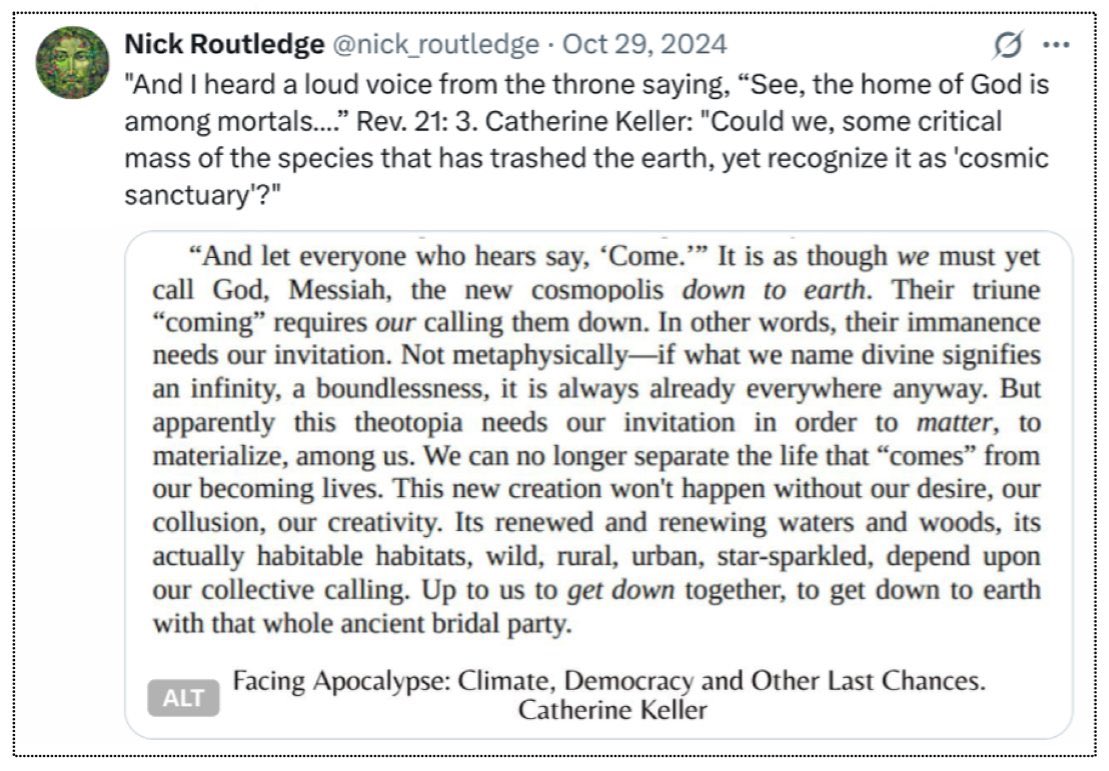
Image description
Original X alt text
Copy of tweet including complete alt-text of the Keller excerpt, here: "And I heard a loud voice from the throne saying, “See, the home of God is among mortals….” Rev. 21: 3. Catherine Keller: "Could we, some critical mass of the species that has trashed the earth, yet recognize it as 'cosmic sanctuary'?" “And let everyone who hears say, ‘Come.’” It is as though we must yet call God, Messiah, the new cosmopolis down to earth. Their triune "coming” requires our calling them down. In other words, their immanence needs our invitation. Not metaphysically—if what we name divine signifies an infinity, a boundlessness, it is always already everywhere anyway. But apparently this theotopia needs our invitation in order to matter, to materialize, among us. We can no longer separate the life that “comes” from our becoming lives. This new creation won't happen without our desire, our collusion, our...
@johnmilbank3 As such, concrete reality is the covenantal realm in which the simultaneity of human and earthly resurrection, the solidarity of social and planetary renewal, lands. Planetary Parousia is a co-evolutionary helix; the heaven of earth, one realm; the Kingdom, the Soul's homecoming.
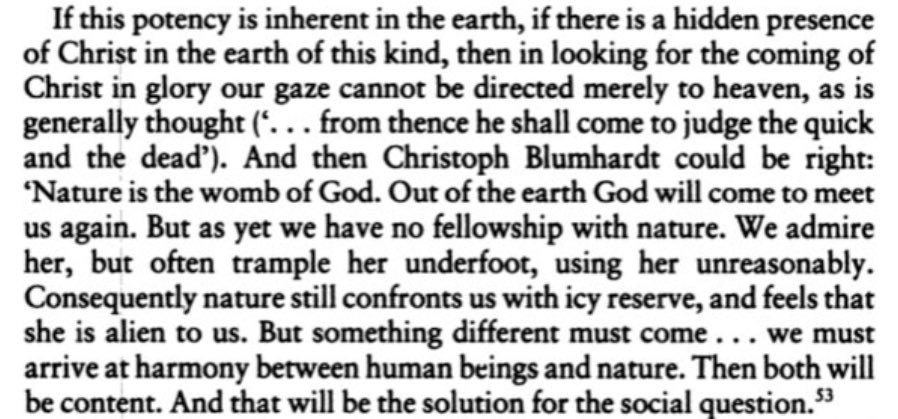
Image description
Original X alt text
Juergen Moltmann, The Coming of God If this potency is inherent in the earth, if there is a hidden presence of Christ in the earth of this kind, then in looking for the coming of Christ in glory our gaze cannot be directed merely to heaven, as is generally thought (“. . . from thence he shall come to judge the quick and the dead’). And then Christoph Blumhardt could be right: "Nature is the womb of God. Out of the earth God will come to meet us again. But as yet we have no fellowship with nature. We admire her, but often trample her underfoot, using her unreasonably. Consequently nature still confronts us with icy reserve, and feels that she is alien to us. But something different must come . . . we must arrive at harmony between human beings and nature. Then both will be content. And that will be the solution for the social question.
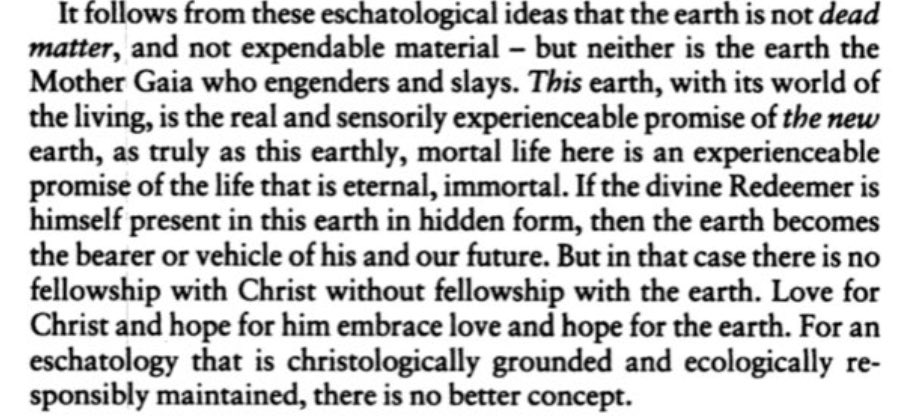
Image description
Original X alt text
It follows from these eschatological ideas that the earth is not dead matter, and not expendable material — but neither is the earth the Mother Gaia who engenders and slays. This earth, with its world of the living, is the real and sensorily experienceable promise of the new earth, as truly as this earthly, mortal life here is an experienceable promise of the life that is eternal, immortal. If the divine Redeemer is himself present in this earth in hidden form, then the earth becomes the bearer or vehicle of his and our future. But in that case there is no fellowship with Christ without fellowship with the earth. Love for Christ and hope for him embrace love and hope for the earth. For an eschatology that is christologically grounded and ecologically responsibly maintained, there is no better concept.