
@SophiaCycles I'd planned on a rewrite: you got to me first! I apologize. Yes, I admit I can sound hard naming a universalist tendency I perceive, for professional contemplatives to declare the relative *primacy* of cushioned mysticism to dropping an awakened shoulder. Of course it's both/and.
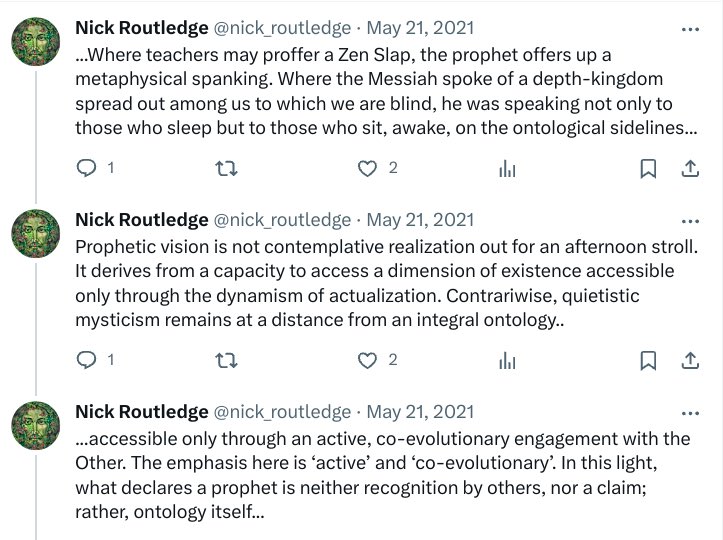
Image description
Original X alt text
Copy of tweet thread here: ...Where teachers may proffer a Zen Slap, the prophet offers up a metaphysical spanking. Where the Messiah spoke of a depth-kingdom spread out among us to which we are blind, he was speaking not only to those who sleep but to those who sit, awake, on the ontological sidelines... Prophetic vision is not contemplative realization out for an afternoon stroll. It derives from a capacity to access a dimension of existence accessible only through the dynamism of actualization. Contrariwise, quietistic mysticism remains at a distance from an integral ontology ...accessible only through an active, co-evolutionary engagement with the Other. The emphasis here is ‘active’ and ‘co-evolutionary’. In this light, what declares a prophet is neither recognition by others, nor a claim; rather, ontology itself...
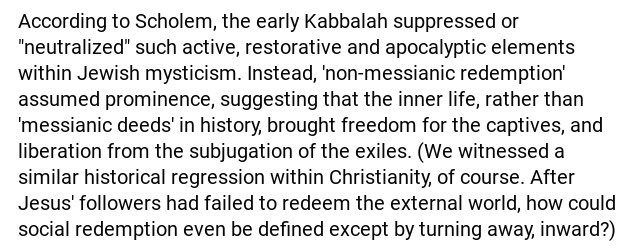
Image description
Original X alt text
Copy of text linked to here: According to Scholem, the early Kabbalah suppressed or "neutralized" such active, restorative and apocalyptic elements within Jewish mysticism. Instead, 'non-messianic redemption' assumed prominence, suggesting that the inner life, rather than 'messianic deeds' in history, brought freedom for the captives, and liberation from the subjugation of the exiles. (We witnessed a similar historical regression within Christianity, of course. After Jesus' followers had failed to redeem the external world, how could social redemption even be defined except by turning away, inward?)
@CenteringPrayer 1/ "The Prophets teach us to do as a community exactly what the Buddhas teach individuals," noted the Quaker, Jim Corbett. Similarly, Illich, "the kingdom is a [eco-]social reality at a transcendent level." Peace among us, on the move, teleologically constituting redemption.
View this post’s context →