
@SherPoint 4/ Yes, sitting in solitude with the Absolute is well and good. But for the rest of us, everyday experience lands differently, as do the concrete, particularized effects and requirements of immense social and cultural differences and loyalties resolutely at odds with one another.
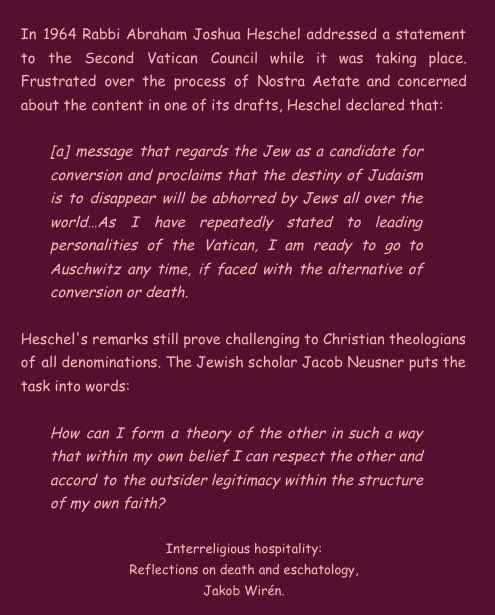
Image description
Original X alt text
In 1964 Rabbi Abraham Joshua Heschel addressed a statement to the Second Vatican Council while it was taking place. Frustrated over the process of Nostra Aetate and concerned about the content in one of its drafts, Heschel declared that: [a] message that regards the Jew as a candidate for conversion and proclaims that the destiny of Judaism is to disappear will be abhorred by Jews all over the world…As I have repeatedly stated to leading personalities of the Vatican, I am ready to go to Auschwitz any time, if faced with the alternative of conversion or death. Heschel's remarks still prove challenging to Christian theologians of all denominations. The Jewish scholar Jacob Neusner puts the task into words: How can I form a theory of the other in such a way that within my own belief I can respect the other and accord to the outsider legitimacy within the structure of my own faith? Interreligious hospitality: Reflections on death and eschatology, Jakob Wirén
@lukeburgis end/ A pattern of desire unaware of its own hostility? No finer camouflage than a theological blind, nor logic of religious antagonism more unifying and self-justified than the false sacred cloaked as true. The mimetic escalation of a deeper, genuine Wholeness transcends it all.
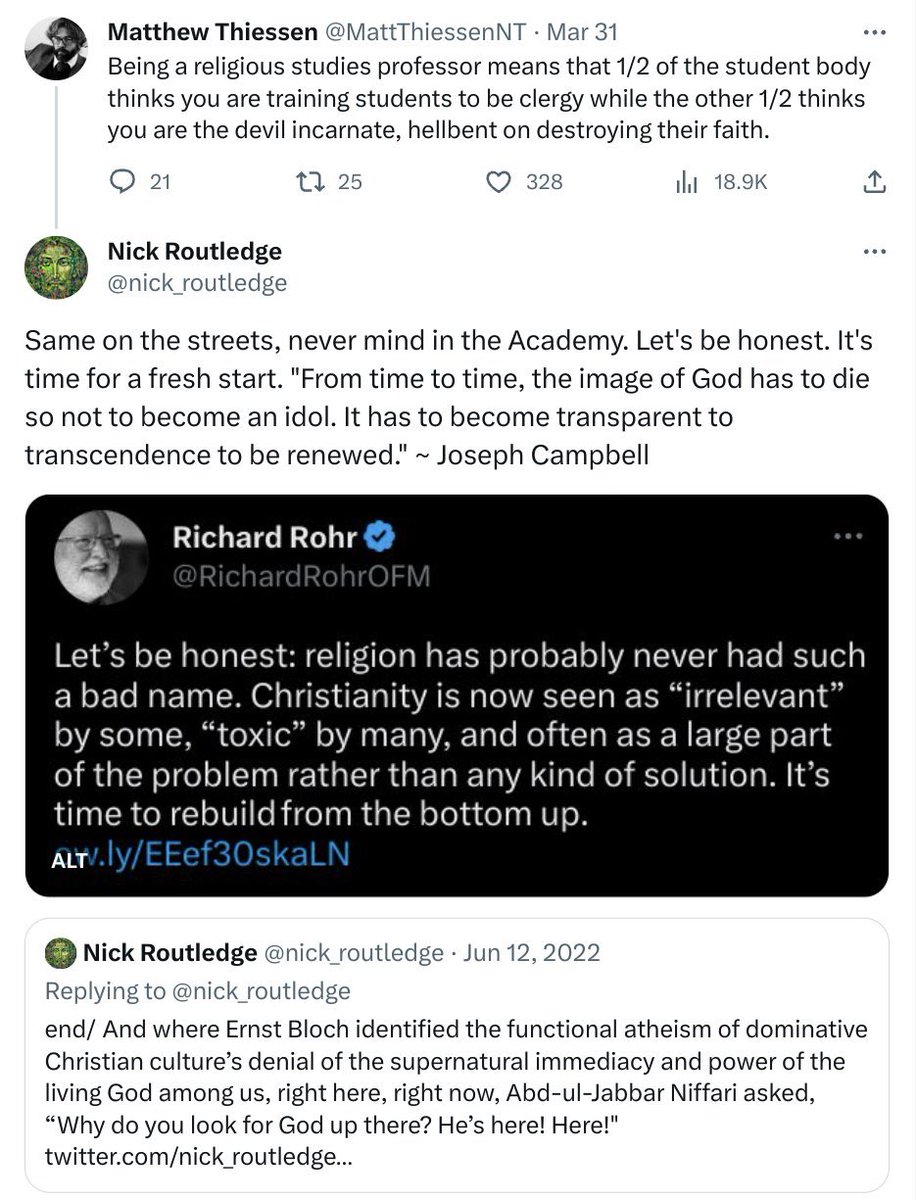
Image description
Original X alt text
Copy of tweet and QT here: Same on the streets, never mind in the Academy. Let's be honest. It's time for a fresh start. "From time to time, the image of God has to die so not to become an idol. It has to become transparent to transcendence to be renewed." ~ Joseph Campbell Let’s be honest: religion has probably never had such a bad name. Christianity is now seen as “irrelevant” by some, “toxic” by many, and often as a large part of the problem rather than any kind of solution. It’s time to rebuild from the bottom up. end/ And where Ernst Bloch identified the functional atheism of dominative Christian culture’s denial of the supernatural immediacy and power of the living God among us, right here, right now, Abd-ul-Jabbar Niffari asked, “Why do you look for God up there? He’s here! Here!"