
Nick Routledge@nick_routledge
Reply to @RDGStout

@RDGStout Then again, few theologians, anywhere, understand all authentic religion as ultimately a necessarily planetary, i.e. _universally_hospitable_ project, as does Jakob Wirén, Reader in Systematic Theology at Lund University and research fellow at the Church of Sweden Research Unit.
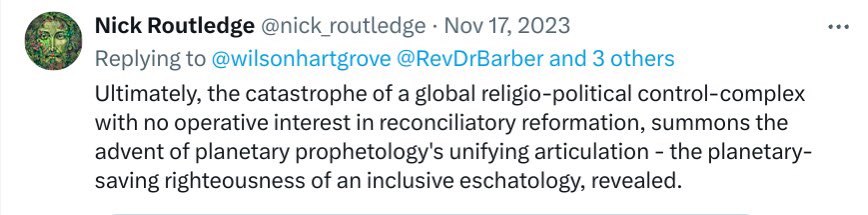
Copy of tweet:

Ultimately, the catastrophe of a global religio-political control-complex with no operative interest in reconciliatory reformation, summons the advent of planetary prophetology's unifying articulation - the planetary-saving righteousness of an inclusive eschatology, revealed.
Image description

Original X alt text

Copy of tweet: Ultimately, the catastrophe of a global religio-political control-complex with no operative interest in reconciliatory reformation, summons the advent of planetary prophetology's unifying articulation - the planetary-saving righteousness of an inclusive eschatology, revealed.

Quoted or linked post

Nick Routledge@nick_routledge · 13 Jan 2024

@SherPoint 4/ Yes, sitting in solitude with the Absolute is well and good. But for the rest of us, everyday experience lands differently, as do the concrete, particularized effects and requirements of immense social and cultural differences and loyalties resolutely at odds with one another.
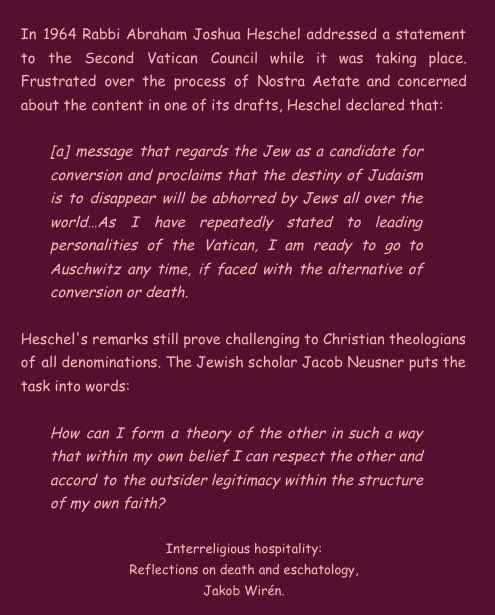
In  1964 Rabbi Abraham Joshua Heschel addressed a statement to the Second Vatican Council while it was taking place. Frustrated over the process of Nostra Aetate and concerned about the content in one of its drafts, Heschel declared that:

[a] message that regards the Jew as a candidate for conversion and proclaims that the destiny of Judaism is to disappear will be abhorred by Jews all over the world…As I have repeatedly stated to leading personalities of the Vatican, I am ready to go to Auschwitz any time, if faced with the alternative of conversion or death.

Heschel's remarks still prove challenging to Christian theologians of all denominations. The Jewish scholar Jacob Neusner puts the task into words:

How can I form a theory of the other in such a way that within my own belief I can respect the other and accord to the outsider legitimacy within the structure of my own faith?

Interreligious hospitality:
Reflections on death and eschatology,
Jakob Wirén
Image description

Original X alt text

In 1964 Rabbi Abraham Joshua Heschel addressed a statement to the Second Vatican Council while it was taking place. Frustrated over the process of Nostra Aetate and concerned about the content in one of its drafts, Heschel declared that: [a] message that regards the Jew as a candidate for conversion and proclaims that the destiny of Judaism is to disappear will be abhorred by Jews all over the world…As I have repeatedly stated to leading personalities of the Vatican, I am ready to go to Auschwitz any time, if faced with the alternative of conversion or death. Heschel's remarks still prove challenging to Christian theologians of all denominations. The Jewish scholar Jacob Neusner puts the task into words: How can I form a theory of the other in such a way that within my own belief I can respect the other and accord to the outsider legitimacy within the structure of my own faith? Interreligious hospitality: Reflections on death and eschatology, Jakob Wirén

View this post’s context →

Context in the archive

Quoted byRT @nick_routledge: @GabrielSaidR 'Surprise!' as they say. Our 'Day' of liberation in which an Extinction Tyranny defined by maniacal, interlocking, global structures of secular and religious consciousness and power, is espistemically demolished by the planetary-saving righteousness of the force of truth itself.Quoted by@GabrielSaidR 'Surprise!' as they say. Our 'Day' of liberation in which an Extinction Tyranny defined by maniacal, interlocking, global structures of secular and religious consciousness and power, is espistemically demolished by the planetary-saving righteousness of the force of truth itself.