
4/ Naturally, First Nations eschatology anticipates world resurrection healing the Earth and us, as one - our fully incarnational calling to a fully relational life: "Not to turn from the world to God but to turn to God in the world" as Teilhard de Chardin describes it.
Image description
Original X alt text
About the nature of the now in the ‘here and now’ – its teleology included - we are awash in counsel. About the nature of the here, a good deal less so. The oversight is not at all surprising. Hardly anyone seems to understand Marshall McLuhan’s point that a medium is not a neutral conduit of transmission that has little or no impact on the content of communication. One glance at the global reach of all major schools of thought devoted to making sense of the pulse of existence – whether scientific, religious or otherwise – clearly reveals a style of thinking that is inherently portable, a medium available to communities of recognition everywhere. This is the point. What of that part of the sum of psychological and material reality which simply isn’t portable? What, for example, of gnosis utterly inseparable from a slow, sustained experience of a particularized habitat?
Image description
Original X alt text
When earth-attentive cultures assert that ‘wisdom sits in places’, they are claiming that an experience of the world and existence as we may fully participate in it, is not only sustained by an attunement to a particularized locale, but is specific to that place, too. Root and branch are in dynamic interplay in a single helix of presence. This begs the question: if wisdom indeed sits in places, are ‘wisdom traditions’ estranged from a sense-of-place but half-wise? Putting flesh on the word, if the supreme personal destiny which awaits us balances the path inwards with the path outwards, may we not safely deduce that where we are called to live the illuminated life matters wholeheartedly? What implications arise from enlarging our understanding of individual and communal experience in this light? And what, potentially, is the shape of a Covenant in which the human community embraces a dynamic, reciprocal relationship with the habitat of which we are an integral part?

Image description
Original X alt text
Painting with text fragment 'Redcoat'.
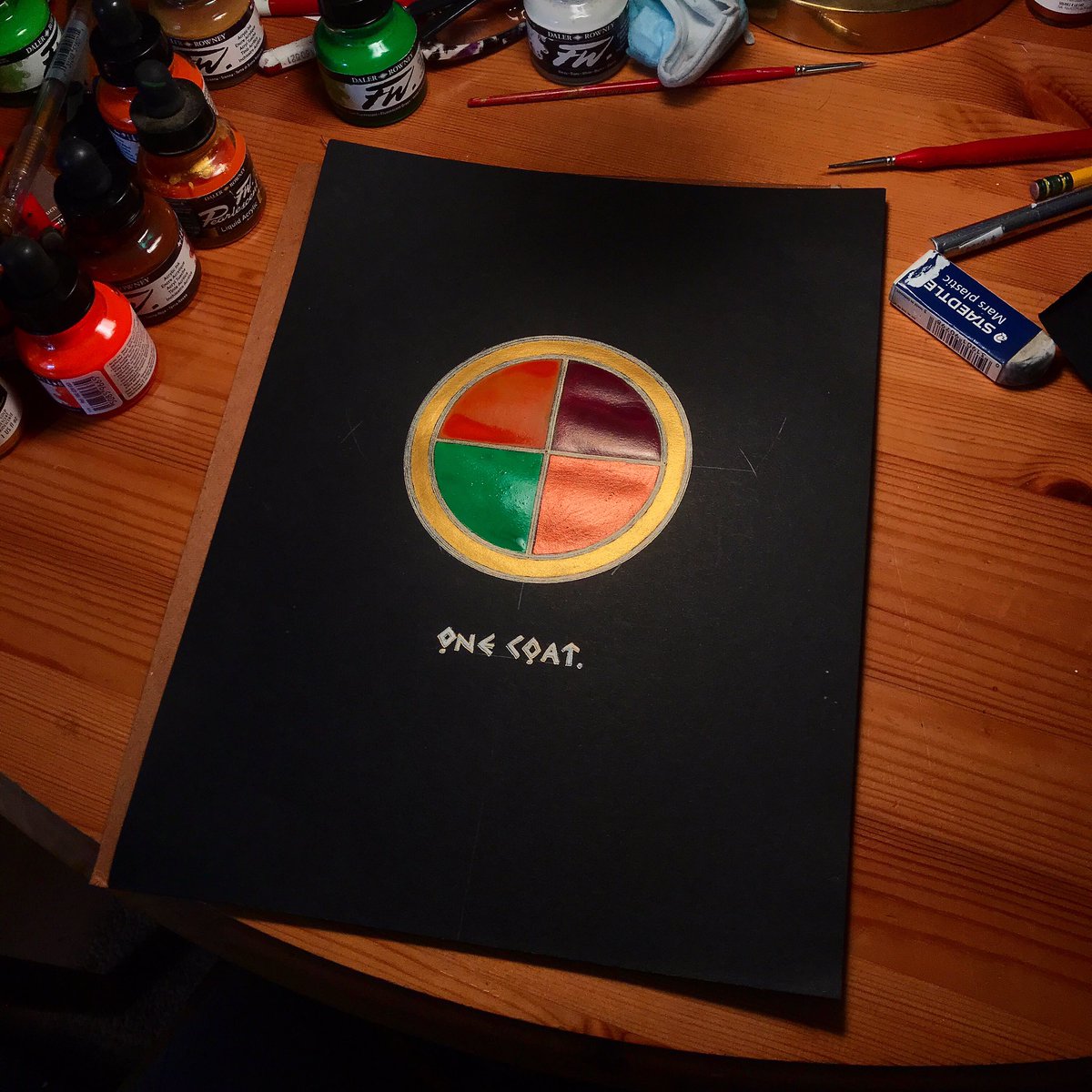
Image description
Original X alt text
Painting with text fragment 'One Coat'.
@noonessleep Simply put? Every resurrection requires a home address. Indeed, we only come home to concrete reality in so far as we and the world complete one another - the simultaneity of de Chardin's spiritualization of the material and materialization of the spiritual. Here, Moltmann:
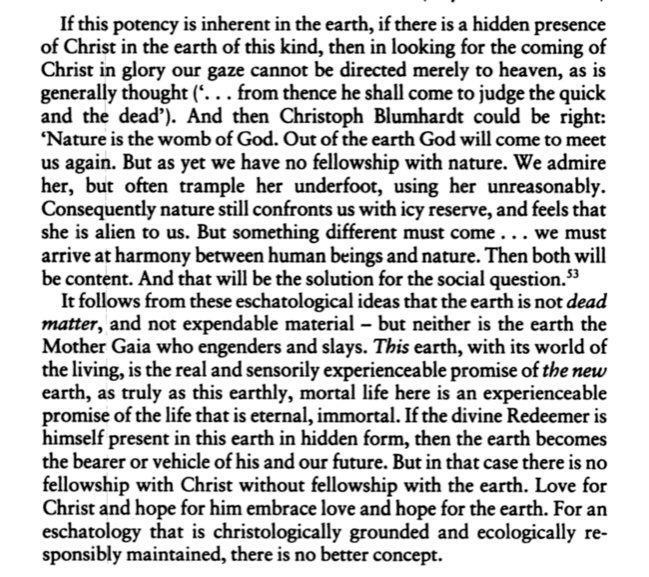
Image description
Original X alt text
Edited down by 640 characters... If this potency is inherent in the earth, if there is a hidden presence ofChrist in the earth of this kind, then in looking for the coming of Christ in glory our gaze cannot be directed merely to heaven, as is generally thought And then Christoph Blumhardt could be right: 'Nature is the womb of God. Out of the earth God will come to meet us again....we must arrive at harmony between human beings and nature. Then both will be content. And that will be the solution for the social question. It follows from these eschatological ideas that the earth is not dead matter, and not expendable material...lf the divine Redeemer is himself present in this earth in hidden form, then the earth becomes the bearer or vehicle of his and our future. But in that case there is no fellowship with Christ without fellowship with the earth. Love for Christ and hope for him embrace love and hope for the earth.