
Nick Routledge@nick_routledge
Reply to @nick_routledge

5/ In eschatological terms, an extinction tyranny of materialist and religious fetishism urges a summons beyond all cultural or religious containment. Time, then, for a fresh start transcending the co-evolutionary limits of the world's secular and religious imaginaries.
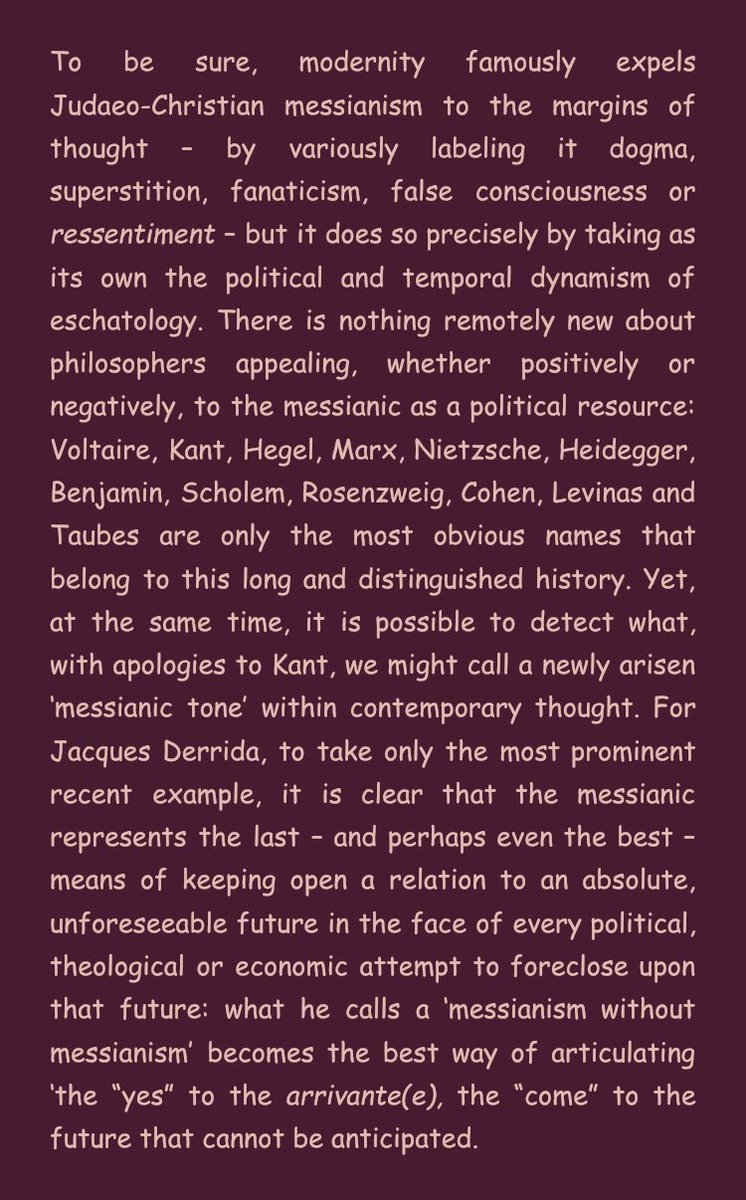
To be sure, modernity famously expels Judaeo-Christian messianism to the margins of thought – by variously labeling it dogma, superstition, fanaticism, false consciousness or ressentiment – but it does so precisely by taking as its own the political and temporal dynamism of eschatology... Yet, at the same time, it is possible to detect what, with apologies to Kant, we might call a newly arisen ‘messianic tone’ within contemporary thought. For Jacques Derrida, to take only the most prominent recent example, it is clear that the messianic represents the last – and perhaps even the best – means of keeping open a relation to an absolute, unforeseeable future in the face of every political, theological or economic attempt to foreclose upon that future: what he calls a ‘messianism without messianism’ becomes the best way of articulating ‘the “yes” to the arrivante(e), the “come” to the future that cannot be anticipated.
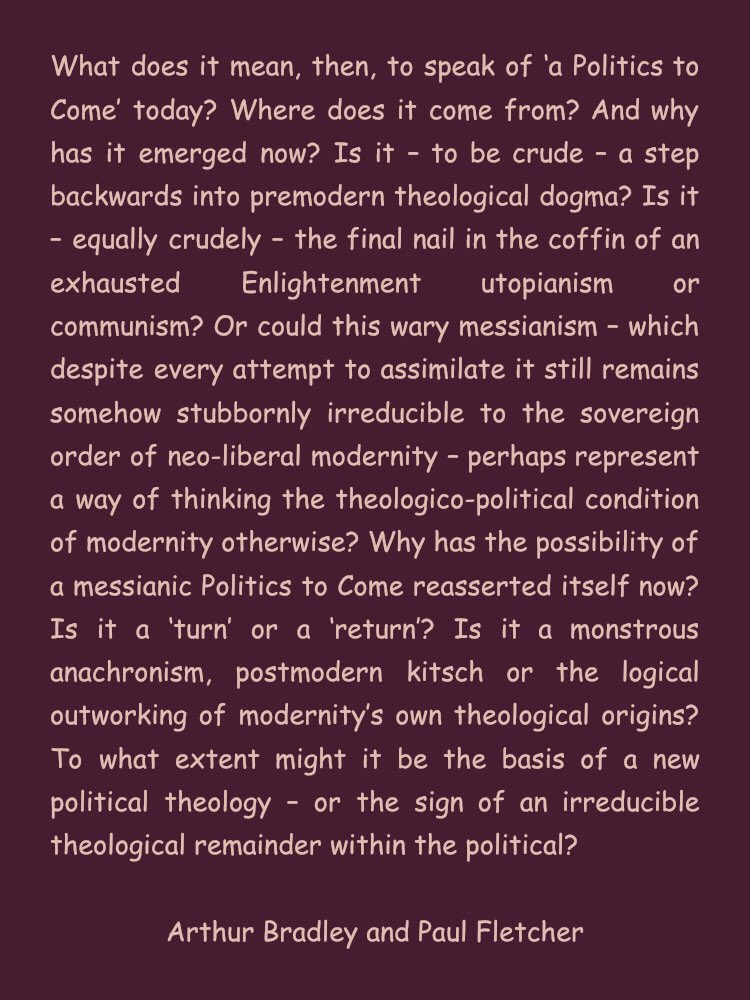
Image description

Original X alt text

To be sure, modernity famously expels Judaeo-Christian messianism to the margins of thought – by variously labeling it dogma, superstition, fanaticism, false consciousness or ressentiment – but it does so precisely by taking as its own the political and temporal dynamism of eschatology... Yet, at the same time, it is possible to detect what, with apologies to Kant, we might call a newly arisen ‘messianic tone’ within contemporary thought. For Jacques Derrida, to take only the most prominent recent example, it is clear that the messianic represents the last – and perhaps even the best – means of keeping open a relation to an absolute, unforeseeable future in the face of every political, theological or economic attempt to foreclose upon that future: what he calls a ‘messianism without messianism’ becomes the best way of articulating ‘the “yes” to the arrivante(e), the “come” to the future that cannot be anticipated.

What does it mean, then, to speak of ‘a Politics to Come’ today? Where does it come from? And why has it emerged now? Is it – to be crude – a step backwards into premodern theological dogma? Is it – equally crudely – the final nail in the coffin of an exhausted Enlightenment utopianism or communism? Or could this wary messianism – which despite every attempt to assimilate it still remains somehow stubbornly irreducible to the sovereign order of neo-liberal modernity – perhaps represent a way of thinking the theologico-political condition of modernity otherwise? Why has the possibility of a messianic Politics to Come reasserted itself now? Is it a ‘turn’ or a ‘return’? Is it a monstrous anachronism, postmodern kitsch or the logical outworking of modernity’s own theological origins? To what extent might it be the basis of a new political theology – or the sign of an irreducible theological remainder within the political?

Arthur Bradley and Paul Fletcher
Image description

Original X alt text

What does it mean, then, to speak of ‘a Politics to Come’ today? Where does it come from? And why has it emerged now? Is it – to be crude – a step backwards into premodern theological dogma? Is it – equally crudely – the final nail in the coffin of an exhausted Enlightenment utopianism or communism? Or could this wary messianism – which despite every attempt to assimilate it still remains somehow stubbornly irreducible to the sovereign order of neo-liberal modernity – perhaps represent a way of thinking the theologico-political condition of modernity otherwise? Why has the possibility of a messianic Politics to Come reasserted itself now? Is it a ‘turn’ or a ‘return’? Is it a monstrous anachronism, postmodern kitsch or the logical outworking of modernity’s own theological origins? To what extent might it be the basis of a new political theology – or the sign of an irreducible theological remainder within the political? Arthur Bradley and Paul Fletcher

Quoted or linked post

Nick Routledge@nick_routledge · 20 Aug 2022

@nils_gilman Not slow-motion for vast sections of the planet; nor is there anything unintentional about a militarized island of greed, denial and malevolence effecting a planetary cataclysm upon which the whole "big lie that economic logic is the only model that will work," (Zuboff) depends.
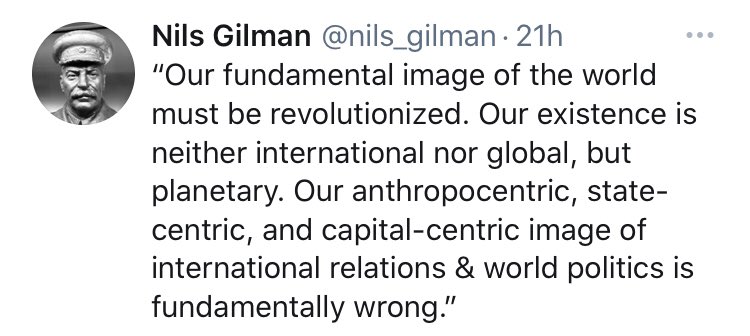
Tweet from @nils_gilman

“Our fundamental image of the world must be revolutionized. Our existence is neither international nor global, but planetary. Our anthropocentric, state-centric, and capital-centric image of international relations & world politics is fundamentally wrong.”
Image description

Original X alt text

Tweet from @nils_gilman “Our fundamental image of the world must be revolutionized. Our existence is neither international nor global, but planetary. Our anthropocentric, state-centric, and capital-centric image of international relations & world politics is fundamentally wrong.”

View this post’s context →

Context in the archive

Quoted byRT @nick_routledge: @davidrieff @nils_gilman David, hi. Surprised to stumble upon a fundamentally secular community of interest and vernacular addressing "the political and temporal dynamism of eschatology" as it relates to "the possibility of a messianic Politics to Come." Nils' "radical philosophical event" comes to mind.Quoted by@davidrieff @nils_gilman David, hi. Surprised to stumble upon a fundamentally secular community of interest and vernacular addressing "the political and temporal dynamism of eschatology" as it relates to "the possibility of a messianic Politics to Come." Nils' "radical philosophical event" comes to mind.