
@NWirzba @ChristianCent 3/ Beneath that, ultimately, lies a metaphysic of inhabitation: the universal arrives through the ontic grain of each place, rather than as abstract order from above. Incarnation itself becomes the form of universality, and refusal of a universal imposed from nowhere.
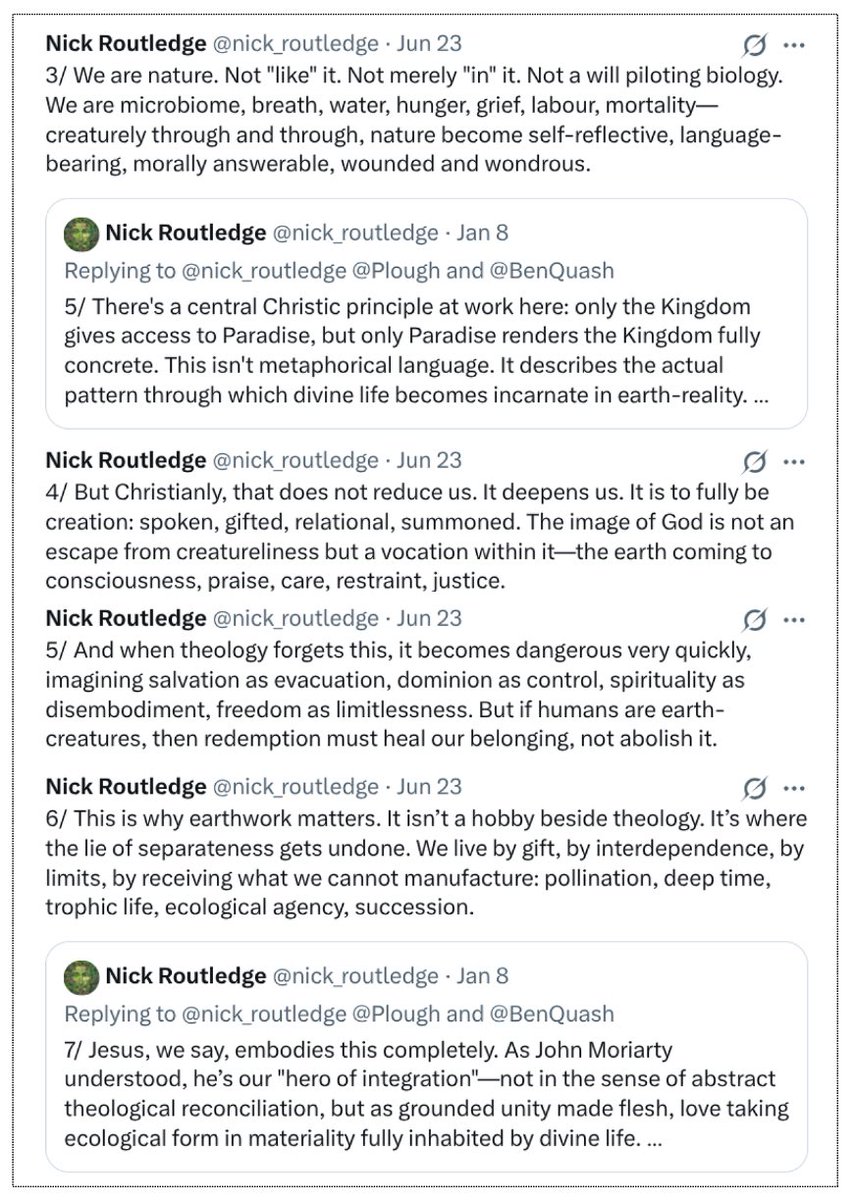
Image description
Extended description
3/ We are nature. Not "like" it. Not merely "in" it. Not a will piloting biology. We are microbiome, breath, water, hunger, grief, labour, mortality—creaturely through and through, nature become self-reflective, language-bearing, morally answerable, wounded and wondrous. 5/ There's a central Christic principle at work here: only the Kingdom gives access to Paradise, but only Paradise renders the Kingdom fully concrete. This isn't metaphorical language. It describes the actual pattern through which divine life becomes incarnate in earth-reality. 4/ But Christianly, that does not reduce us. It deepens us. It is to fully be creation: spoken, gifted, relational, summoned. The image of God is not an escape from creatureliness but a vocation within it—the earth coming to consciousness, praise, care, restraint, justice. 5/ And when theology forgets this, it becomes dangerous very quickly, imagining salvation as evacuation, dominion as control, spirituality as disembodiment, freedom as limitlessness. But if humans are earth-creatures, then redemption must heal our belonging, not abolish it. 6/ This is why earthwork matters. It isn’t a hobby beside theology. It’s where the lie of separateness gets undone. We live by gift, by interdependence, by limits, by receiving what we cannot manufacture: pollination, deep time, trophic life, ecological agency, succession. 7/ Jesus, we say, embodies this completely. As John Moriarty understood, he’s our "hero of integration"—not in the sense of abstract theological reconciliation, but as grounded unity made flesh, love taking ecological form in materiality fully inhabited by divine life.
Open original document@seenunseenmag @profntwright 7/ We are not outside creation looking in. We _are_ creation. Not all of creation, of course. Not its source. Not creation’s lord in any absolute sense. But we are matter called into relation, earth enlivened by breath, dust-bearing image summoned into praise and responsibility.
View this post’s context →