
@commentmag Perhaps James’s practices may be more than techniques for living with ambiguity. Uncertainty is not meaning’s absence, but exposure to meaning already arriving and not yet complete; contemplation and art become eschatological disciplines for inhabiting the luminous unfinished.
@CTmagazine If "knowledge has no light but that shed on the world by redemption" (Adorno), then we confront not merely an academic puzzle but a core paradox of existence: how do we live, know and act when reality's very intelligibility hinges upon an event that has not yet occurred? 🧵1/11
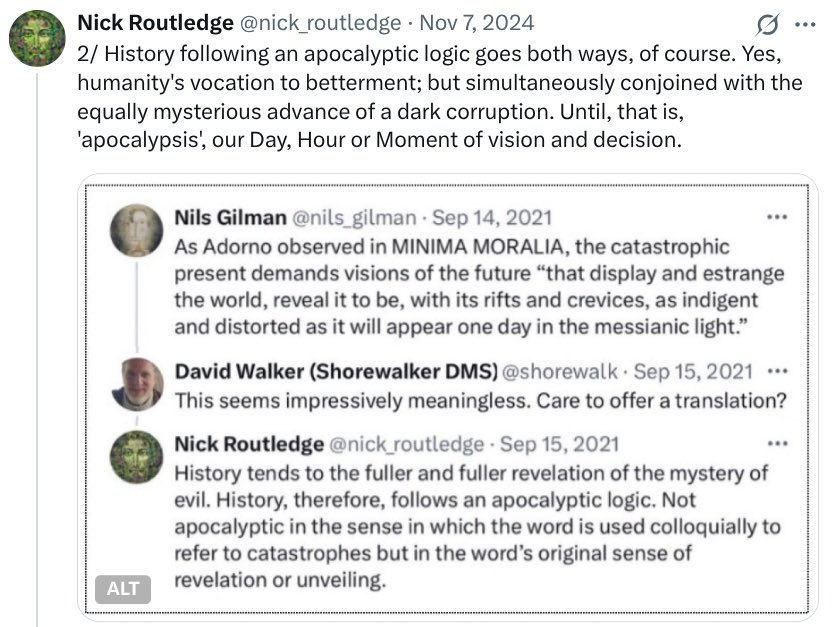
Image description
Original X alt text
Copy of tweet here: 2/ History following an apocalyptic logic goes both ways, of course. Yes, humanity's vocation to betterment; but simultaneously conjoined with the equally mysterious advance of a dark corruption. Until, that is, 'apocalypsis', our Day, Hour or Moment of vision and decision. As Adorno observed in MINIMA MORALIA, the catastrophic present demands visions of the future “that display and estrange the world, reveal it to be, with its rifts and crevices, as indigent and distorted as it will appear one day in the messianic light.” This seems impressively meaningless. Care to offer a translation? History tends to the fuller and fuller revelation of the mystery of evil. History, therefore, follows an apocalyptic logic. Not apocalyptic in the sense in which the word is used colloquially to refer to catastrophes but in the word’s original sense of revelation or unveiling.