Nick Routledge@nick_routledge
Reply to @CTmagazine

@CTmagazine If "knowledge has no light but that shed on the world by redemption" (Adorno), then we confront not merely an academic puzzle but a core paradox of existence: how do we live, know and act when reality's very intelligibility hinges upon an event that has not yet occurred? đŸ§”1/11

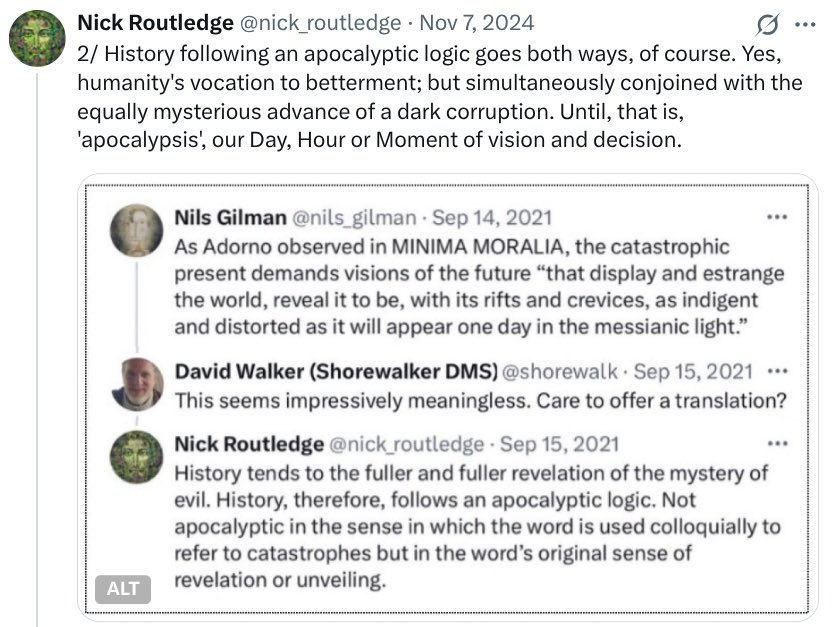
Copy of tweet here:

2/ History following an apocalyptic logic goes both ways, of course. Yes, humanity's vocation to betterment; but simultaneously conjoined with the equally mysterious advance of a dark corruption. Until, that is, 'apocalypsis', our Day, Hour or Moment of vision and decision.

As Adorno observed in MINIMA MORALIA, the catastrophic present demands visions of the future “that display and estrange the world, reveal it to be, with its rifts and crevices, as indigent and distorted as it will appear one day in the messianic light.”

This seems impressively meaningless. Care to offer a translation?

History tends to the fuller and fuller revelation of the mystery of evil. History, therefore, follows an apocalyptic logic. Not apocalyptic in the sense in which the word is used colloquially to refer to catastrophes but in the word’s original sense of revelation or unveiling.
Image description

Original X alt text

Copy of tweet here: 2/ History following an apocalyptic logic goes both ways, of course. Yes, humanity's vocation to betterment; but simultaneously conjoined with the equally mysterious advance of a dark corruption. Until, that is, 'apocalypsis', our Day, Hour or Moment of vision and decision. As Adorno observed in MINIMA MORALIA, the catastrophic present demands visions of the future “that display and estrange the world, reveal it to be, with its rifts and crevices, as indigent and distorted as it will appear one day in the messianic light.” This seems impressively meaningless. Care to offer a translation? History tends to the fuller and fuller revelation of the mystery of evil. History, therefore, follows an apocalyptic logic. Not apocalyptic in the sense in which the word is used colloquially to refer to catastrophes but in the word’s original sense of revelation or unveiling.

Quoted or linked post

Nick Routledge@nick_routledge · 19 Jun 2025

3/ The prophets insist: history is not a blind alley. Beneath its surface runs a hidden trajectory—not toward despair, but disclosure. A truth so stark that no evasion remains. The collapse of illusion under the weight of the Real. A script must end.
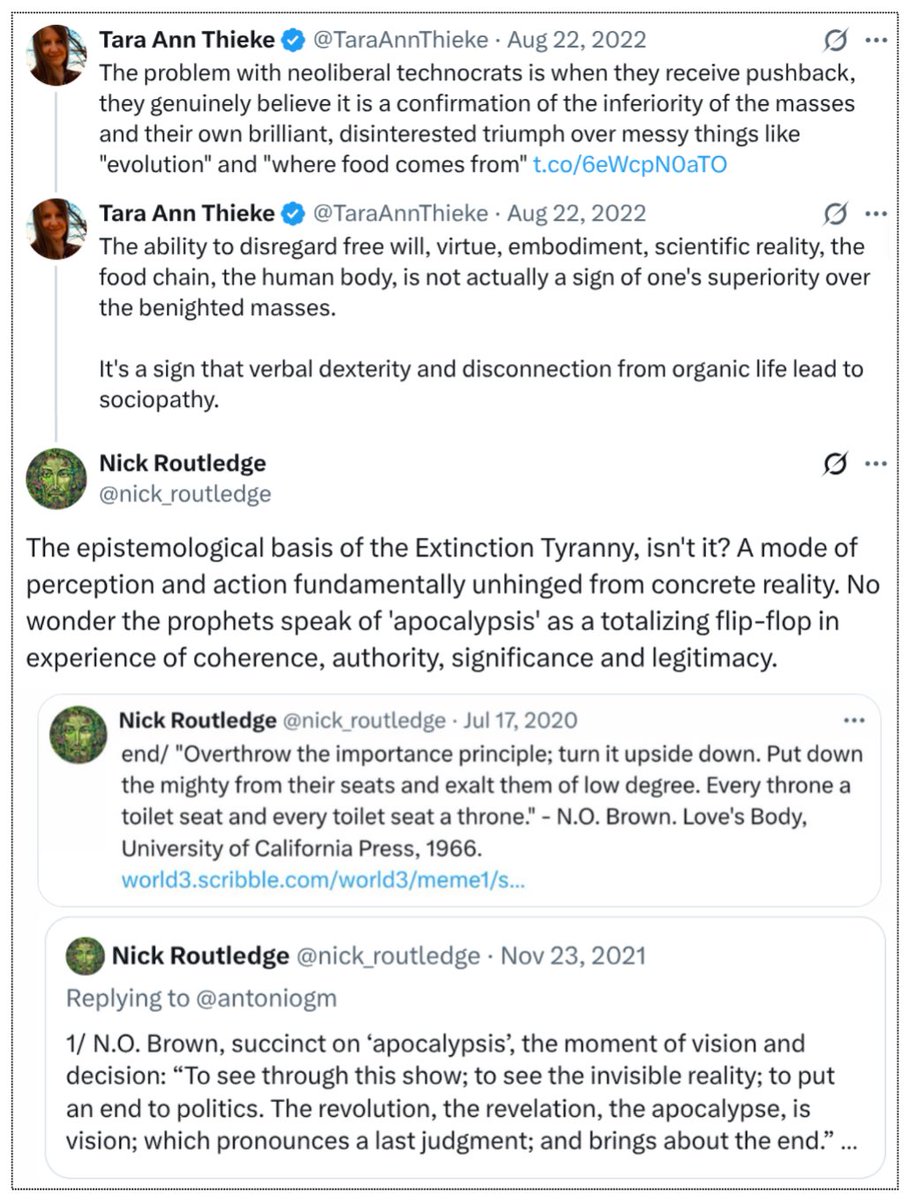
Copy of tweet here:

The epistemological basis of the Extinction Tyranny, isn't it? A mode of perception and action fundamentally unhinged from concrete reality. No wonder the prophets speak of 'apocalypsis' as a totalizing flip-flop in experience of coherence, authority, significance and legitimacy.

end/ "Overthrow the importance principle; turn it upside down. Put down the mighty from their seats and exalt them of low degree. Every throne a toilet seat and every toilet seat a throne." - N.O. Brown. Love's Body, University of California Press, 1966. https://world3.scribble.com/world3/meme1/space2/frstlst.html

1/ N.O. Brown, succinct on ‘apocalypsis’, the moment of vision and decision: “To see through this show; to see the invisible reality; to put an end to politics. The revolution, the revelation, the apocalypse, is vision; which pronounces a last judgment; and brings about the end.”
Image description

Original X alt text

Copy of tweet here: The epistemological basis of the Extinction Tyranny, isn't it? A mode of perception and action fundamentally unhinged from concrete reality. No wonder the prophets speak of 'apocalypsis' as a totalizing flip-flop in experience of coherence, authority, significance and legitimacy. end/ "Overthrow the importance principle; turn it upside down. Put down the mighty from their seats and exalt them of low degree. Every throne a toilet seat and every toilet seat a throne." - N.O. Brown. Love's Body, University of California Press, 1966. world3.scribble.com/world3/meme1/space2/frstlst.html 1/ N.O. Brown, succinct on ‘apocalypsis’, the moment of vision and decision: “To see through this show; to see the invisible reality; to put an end to politics. The revolution, the revelation, the apocalypse, is vision; which pronounces a last judgment; and brings about the end.”

View this post’s context →

Context in the archive

Quoted by@commentmag Perhaps James’s practices may be more than techniques for living with ambiguity. Uncertainty is not meaning’s absence, but exposure to meaning already arriving and not yet complete; contemplation and art become eschatological disciplines for inhabiting the luminous unfinished.Quoted by@profntwright 3/ Across the world, classical theology typically functions as a restraint upon apocalypticism. “Of that day and hour no one knows” is not merely an eschatological claim, but a discipline of interpretation, resisting the slide from hope into chilliastic escalation.Quoted by@being_on_line @bratton @NoemaMag 6/ Moreover, sophisticated analysis doesn’t imply 4th-wall perspective. Media ecology reminds us that that 'neutral description' often encodes a ground-state metaphysics leaving upstream conditions of perception—ontology, sense-making, world-modeling—entirely uninterrogated.