
@CTmagazine @jeff_bilbro end\ Perhaps the deeper question is not whether we remain a People of the Book in the age of AI, but whether ways of life still exist capable of bearing reality incarnationally—conditions under which revelation is again encountered as meaningful, participatory and alive.
@Plough 2/ Earth is the commons the messianic moves through. Not a religion scaled up—the planet itself in messianic process; Spirit as living breath and bond that fills and coheres. Covenantal orcharding, eschatonic arboriculture, resurrection forestry. Incarnation with a home address.
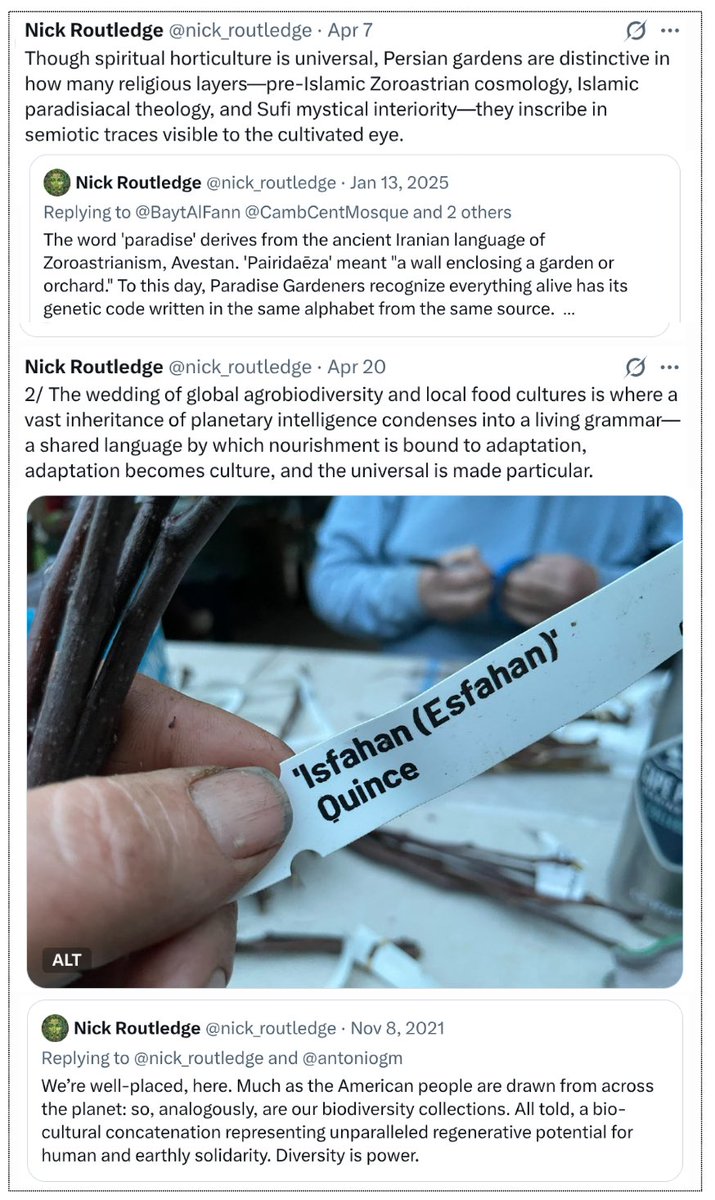
Image description
Extended description
Though spiritual horticulture is universal, Persian gardens are distinctive in how many religious layers—pre-Islamic Zoroastrian cosmology, Islamic paradisiacal theology, and Sufi mystical interiority—they inscribe in semiotic traces visible to the cultivated eye. Subtweet: The word 'paradise' derives from the ancient Iranian language of Zoroastrianism, Avestan. 'Pairidaēza' meant "a wall enclosing a garden or orchard." To this day, Paradise Gardeners recognize everything alive has its genetic code written in the same alphabet from the same source. 2/ The wedding of global agrobiodiversity and local food cultures is where a vast inheritance of planetary intelligence condenses into a living grammar—a shared language by which nourishment is bound to adaptation, adaptation becomes culture, and the universal is made particular. [Photograph of a hand holding a label identifying Isfahan quince scion, at @agrariansharing's grafting party April 19.] Subtweet: We’re well-placed, here. Much as the American people are drawn from across the planet: so, analogously, are our biodiversity collections. All told, a bio-cultural concatenation representing unparalleled regenerative potential for human and earthly solidarity. Diversity is power.
Open original document