
@Plough 2/ Earth is the commons the messianic moves through. Not a religion scaled up—the planet itself in messianic process; Spirit as living breath and bond that fills and coheres. Covenantal orcharding, eschatonic arboriculture, resurrection forestry. Incarnation with a home address.
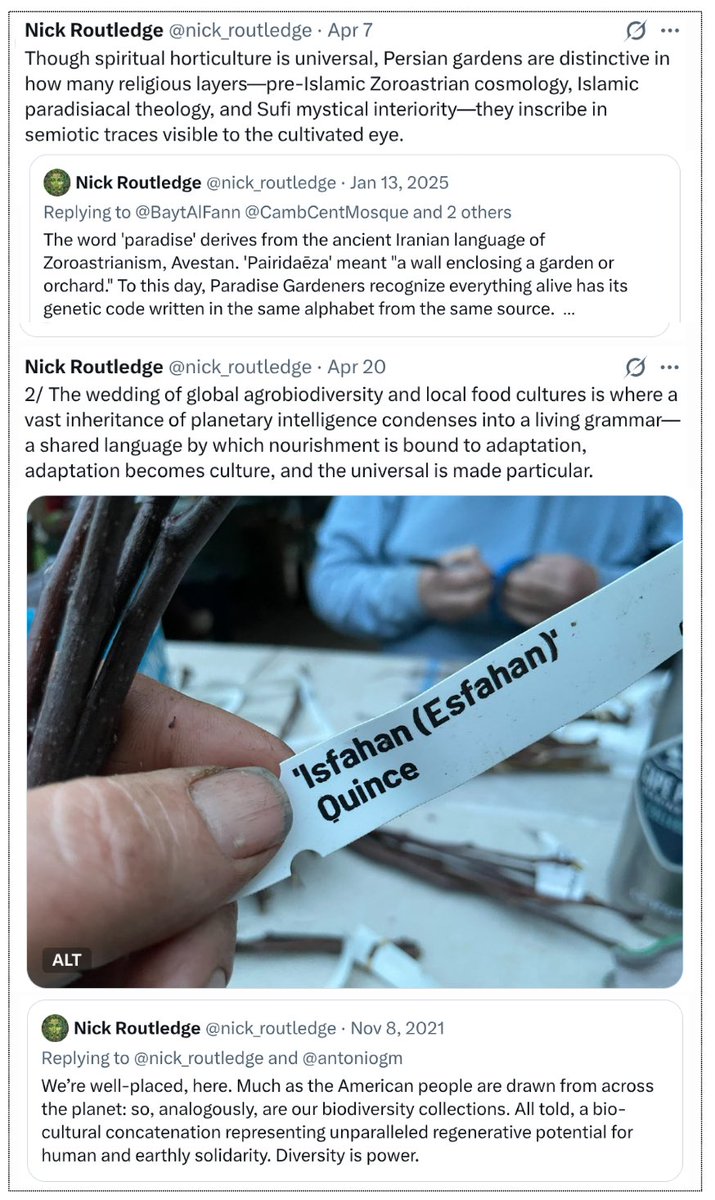
Image description
Extended description
Though spiritual horticulture is universal, Persian gardens are distinctive in how many religious layers—pre-Islamic Zoroastrian cosmology, Islamic paradisiacal theology, and Sufi mystical interiority—they inscribe in semiotic traces visible to the cultivated eye. Subtweet: The word 'paradise' derives from the ancient Iranian language of Zoroastrianism, Avestan. 'Pairidaēza' meant "a wall enclosing a garden or orchard." To this day, Paradise Gardeners recognize everything alive has its genetic code written in the same alphabet from the same source. 2/ The wedding of global agrobiodiversity and local food cultures is where a vast inheritance of planetary intelligence condenses into a living grammar—a shared language by which nourishment is bound to adaptation, adaptation becomes culture, and the universal is made particular. [Photograph of a hand holding a label identifying Isfahan quince scion, at @agrariansharing's grafting party April 19.] Subtweet: We’re well-placed, here. Much as the American people are drawn from across the planet: so, analogously, are our biodiversity collections. All told, a bio-cultural concatenation representing unparalleled regenerative potential for human and earthly solidarity. Diversity is power.
Open original document@Awurabena2 @NorannV It's love's eternal pattern drawing all creation into the Paradise of Kingdom belonging, how the divine life arrives as both our home and our journey home to God, and where the distance from isolation to intimacy is bridged through creation’s love for us, as much as ours for it.
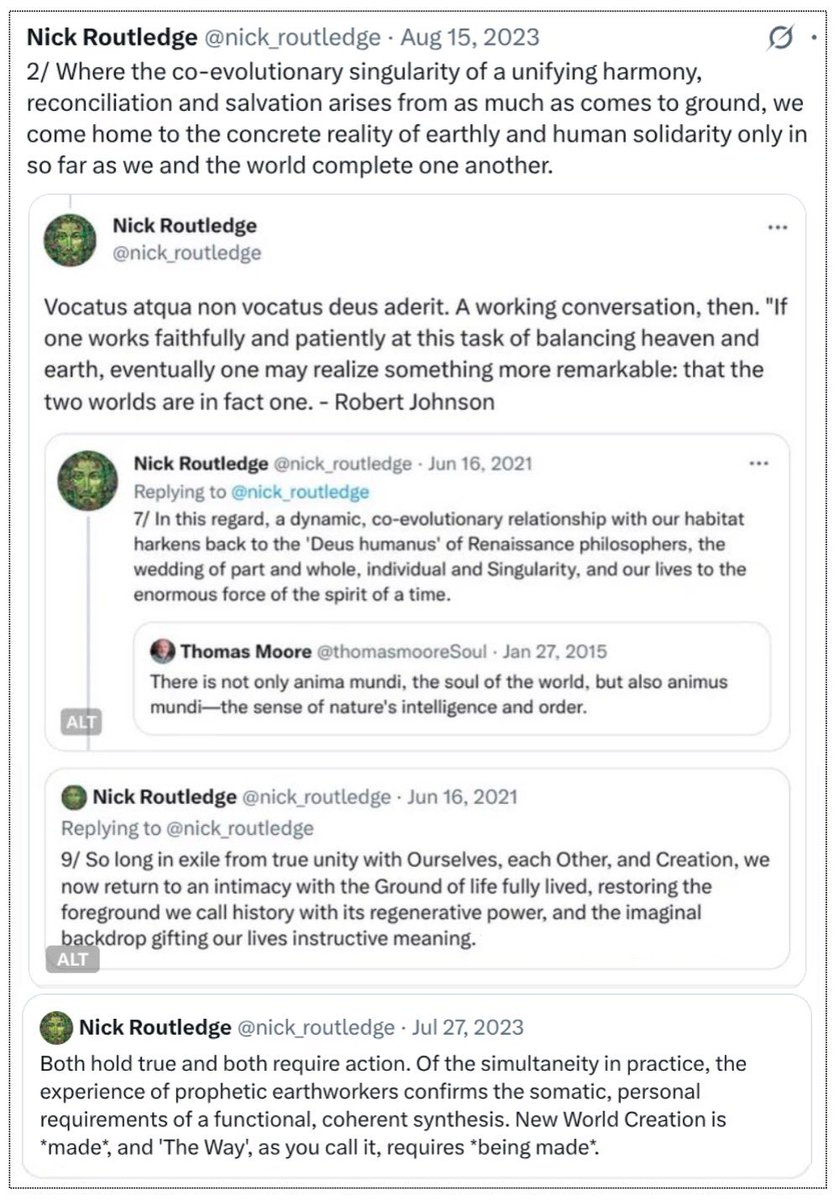
Image description
Extended description
2/ Where the co-evolutionary singularity of a unifying harmony, reconciliation and salvation arises from as much as comes to ground, we come home to the concrete reality of earthly and human solidarity only in so far as we and the world complete one another. Vocatus atqua non vocatus deus aderit. A working conversation, then. "If one works faithfully and patiently at this task of balancing heaven and earth, eventually one may realize something more remarkable: that the two worlds are in fact one. - Robert Johnson 7/ In this regard, a dynamic, co-evolutionary relationship with our habitat harkens back to the 'Deus humanus' of Renaissance philosophers, the wedding of part and whole, individual and Singularity, and our lives to the enormous force of the spirit of a time. Thomas Moore There is not only anima mundi, the soul of the world, but also animus mundi—the sense of nature's intelligence and order. 9/ So long in exile from true unity with Ourselves, each Other, and Creation, we now return to an intimacy with the Ground of life fully lived, restoring the foreground we call history with its regenerative power, and the imaginal backdrop gifting our lives instructive meaning. Subtweet: Both hold true and both require action. Of the simultaneity in practice, the experience of prophetic earthworkers confirms the somatic, personal requirements of a functional, coherent synthesis. New World Creation is *made*, and 'The Way', as you call it, requires *being made*. []
Open original document