
@NewYorker Yes, the essay's intellectually sophisticated, rhetorically agile and historically literate. But not especially Pauline in atmosphere. It never really breathes the air of the altered reality-structure and transformed temporality defining Paul’s experience and ultimate horizon.
25/ Panikkar names it. Not a higher idea, but a deeper world, a new way of inhabiting matter, time, and relationship wherein nothing less than reality itself becomes its own method. What’s unveiled in apocalypse isn't a hidden doctrine but a previously inaccessible depth realm.
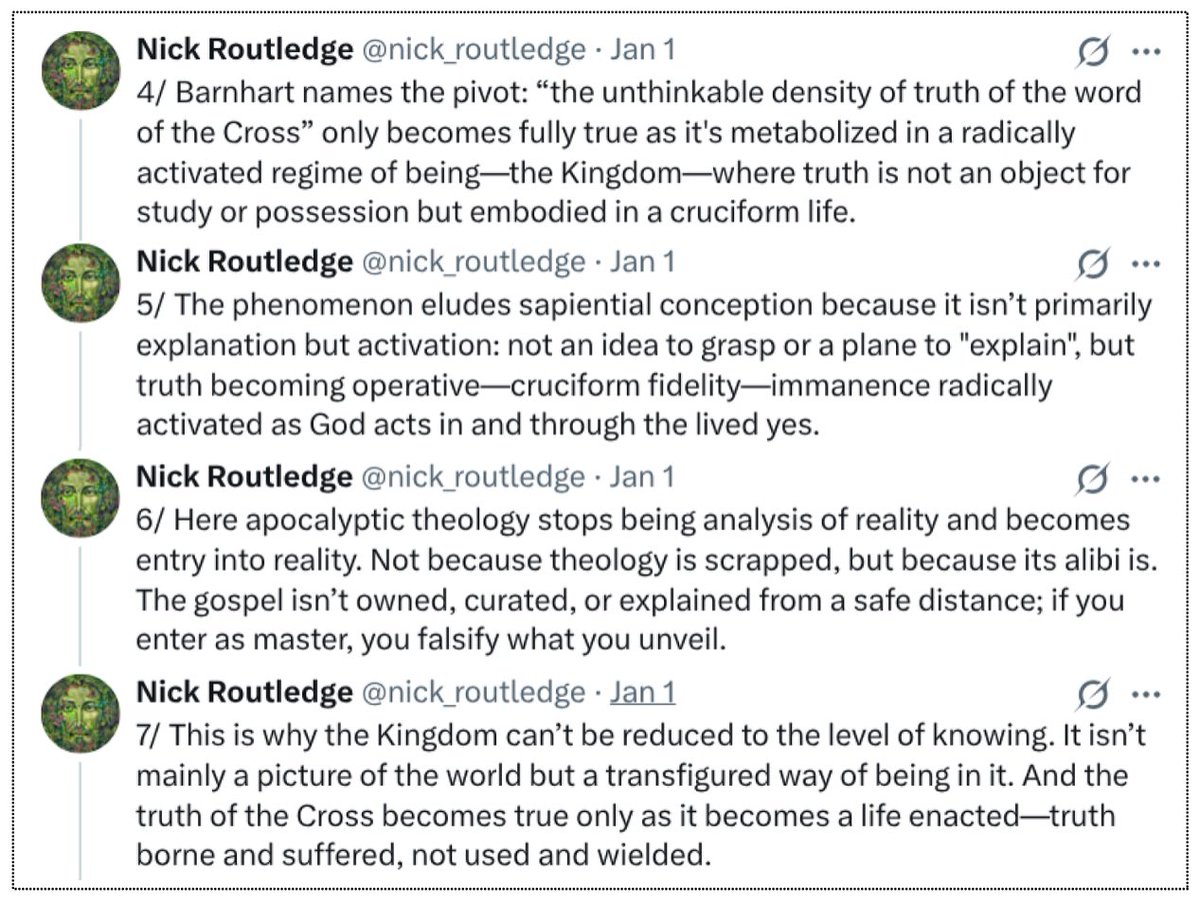
Image description
Extended description
4/ Barnhart names the pivot: “the unthinkable density of truth of the word of the Cross” only becomes fully true as it's metabolized in a radically activated regime of being—the Kingdom—where truth is not an object for study or possession but embodied in a cruciform life. 5/ The phenomenon eludes sapiential conception because it isn’t primarily explanation but activation: not an idea to grasp or a plane to "explain", but truth becoming operative—cruciform fidelity—immanence radically activated as God acts in and through the lived yes. 6/ Here apocalyptic theology stops being analysis of reality and becomes entry into reality. Not because theology is scrapped, but because its alibi is. The gospel isn’t owned, curated, or explained from a safe distance; if you enter as master, you falsify what you unveil. 7/ This is why the Kingdom can’t be reduced to the level of knowing. It isn’t mainly a picture of the world but a transfigured way of being in it. And the truth of the Cross becomes true only as it becomes a life enacted—truth borne and suffered, not used and wielded.
Open original document