
25/ Panikkar names it. Not a higher idea, but a deeper world, a new way of inhabiting matter, time, and relationship wherein nothing less than reality itself becomes its own method. What’s unveiled in apocalypse isn't a hidden doctrine but a previously inaccessible depth realm.
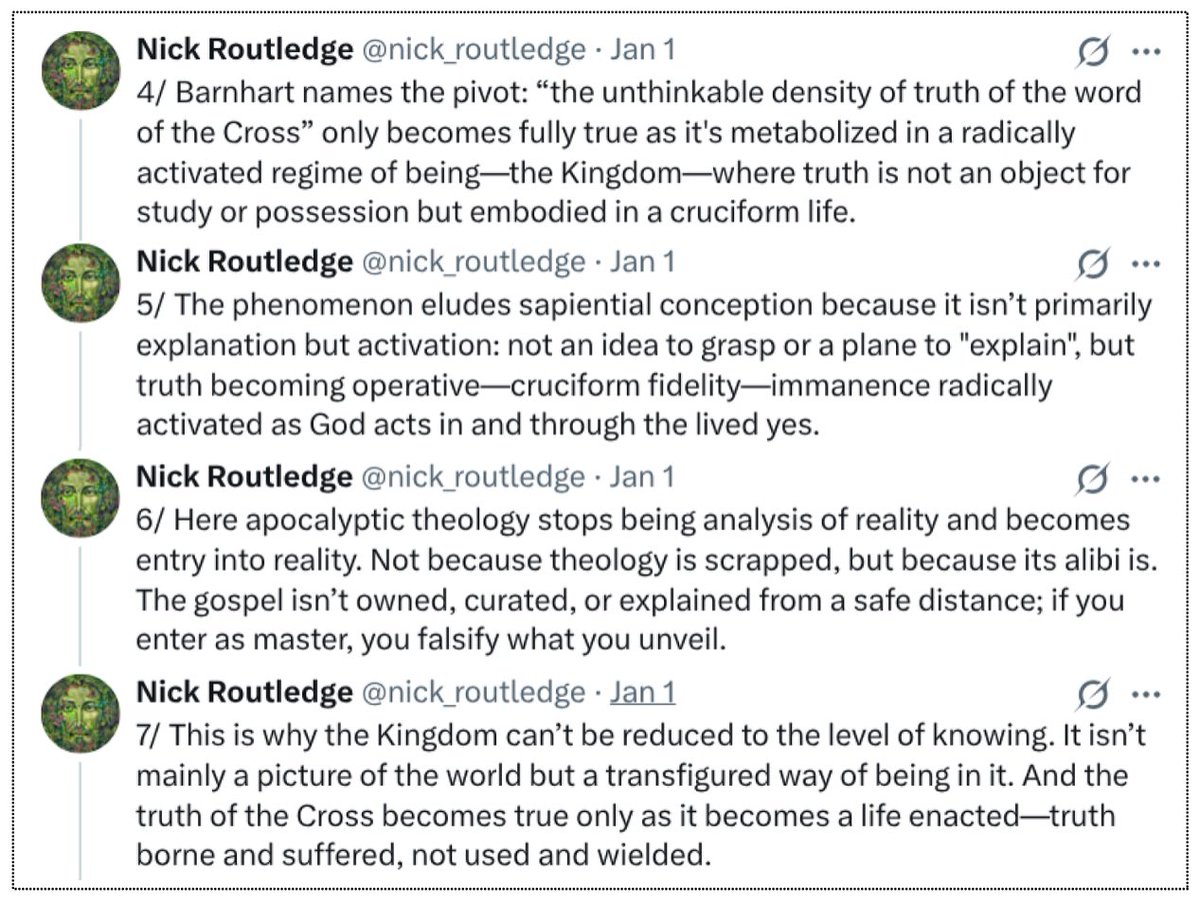
Image description
Extended description
4/ Barnhart names the pivot: “the unthinkable density of truth of the word of the Cross” only becomes fully true as it's metabolized in a radically activated regime of being—the Kingdom—where truth is not an object for study or possession but embodied in a cruciform life. 5/ The phenomenon eludes sapiential conception because it isn’t primarily explanation but activation: not an idea to grasp or a plane to "explain", but truth becoming operative—cruciform fidelity—immanence radically activated as God acts in and through the lived yes. 6/ Here apocalyptic theology stops being analysis of reality and becomes entry into reality. Not because theology is scrapped, but because its alibi is. The gospel isn’t owned, curated, or explained from a safe distance; if you enter as master, you falsify what you unveil. 7/ This is why the Kingdom can’t be reduced to the level of knowing. It isn’t mainly a picture of the world but a transfigured way of being in it. And the truth of the Cross becomes true only as it becomes a life enacted—truth borne and suffered, not used and wielded.
Open original document@RobertEllsberg @OrbisBooks 5/ If Panikkar distilled incarnational hermaneutics in one line, perhaps it is, "The method is the very reality which the method helps to disclose"—a blindness so self-referential, we can't see it: "For a truly cross-cultural understanding, we need a new revelatory experience."
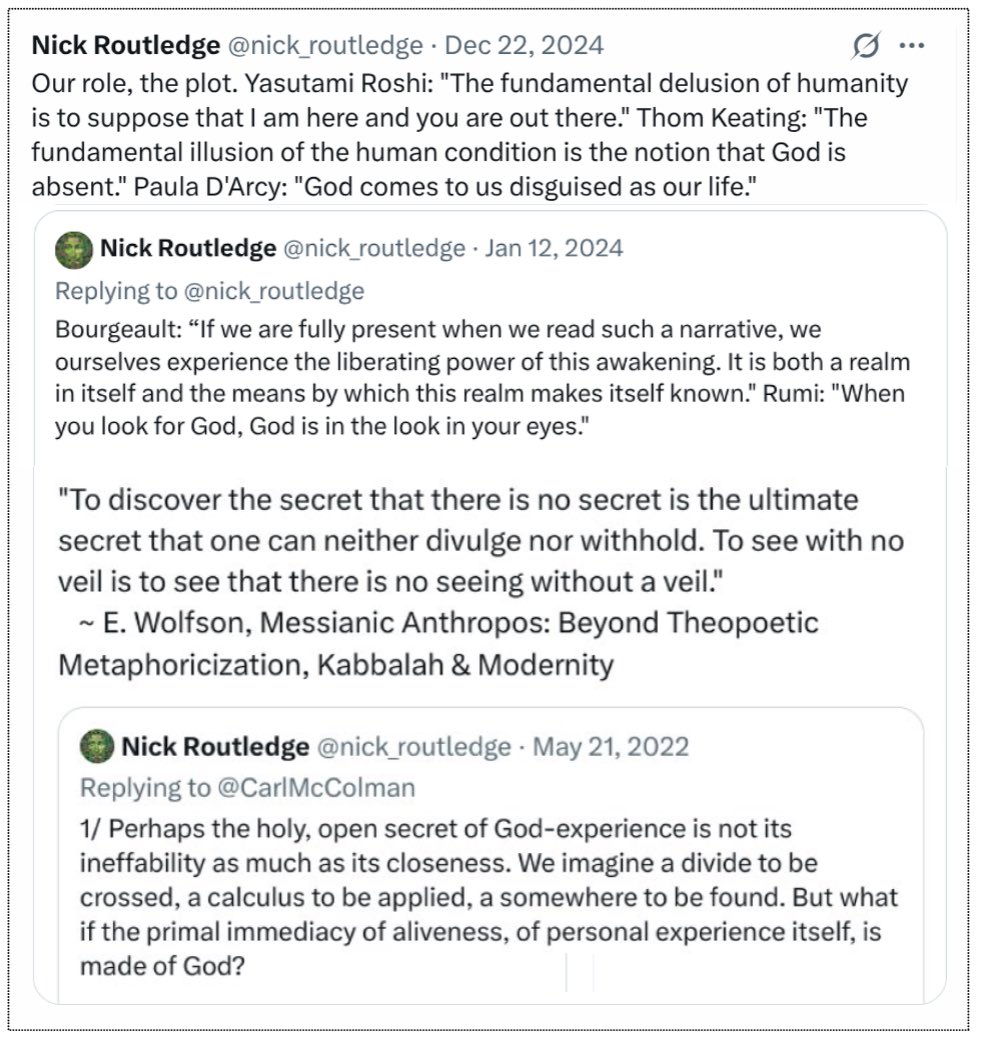
Image description
Original X alt text
Copy of tweet, and quote tweet with image, here:
Extended description
Pictured speaker / quoted attribution: Nick quoting Yasutami Roshi, Thomas Keating and Paula D’Arcy Saved source record associated with pictured writing; full saved record, not an exact pictured excerpt. Passage boundary: Source: archive.nickroutledge.org/post/1870801535359488337 Preserve quoted-author distinctions; the containing tweet does not confer authorship. Our role, the plot. Yasutami Roshi: "The fundamental delusion of humanity is to suppose that I am here and you are out there." Thom Keating: "The fundamental illusion of the human condition is the notion that God is absent." Paula D'Arcy: "God comes to us disguised as our life." t.co/xFl1jG8DC1
Open original documentExtended description
Pictured speaker / quoted attribution: Nick quoting Cynthia Bourgeault and Rumi Saved source record associated with pictured writing; full saved record, not an exact pictured excerpt. Passage boundary: Source: Preserve quoted-author distinctions; the containing tweet does not confer authorship. Bourgeault: “If we are fully present when we read such a narrative, we ourselves experience the liberating power of this awakening. It is both a realm in itself and the means by which this realm makes itself known." Rumi: "When you look for God, God is in the look in your eyes." Copy of tweet here: 1/ Perhaps the holy, open secret of God-experience is not its ineffability as much as its closeness. We imagine a divide to be crossed, a calculus to be applied, a somewhere to be found. But what if the primal immediacy of aliveness, of personal experience itself, is made of God?
Open original documentExtended description
Pictured speaker / quoted attribution: Elliot Wolfson Saved source record associated with pictured writing; full saved record, not an exact pictured excerpt. Passage boundary: Source: Preserve quoted-author distinctions; the containing tweet does not confer authorship. @aliner "To discover the secret that there is no secret is the ultimate secret that one can neither divulge nor withhold. To see with no veil is to see that there is no seeing without a veil." - E. Wolfson, Messianic Anthropos: Beyond Theopoetic Metaphoricization, Kabbalah & Modernity t.co/dA0gwONAWx
Open original documentExtended description
Pictured speaker / quoted attribution: Nick Saved source record associated with pictured writing; full saved record, not an exact pictured excerpt. Passage boundary: Source: archive.nickroutledge.org/post/1528094710203830272 Preserve quoted-author distinctions; the containing tweet does not confer authorship. @CarlMcColman 1/ Perhaps the holy, open secret of God-experience is not its ineffability as much as its closeness. We imagine a divide to be crossed, a calculus to be applied, a somewhere to be found. But what if the primal immediacy of aliveness, of personal experience itself, is made of God? t.co/u7fiVplGoT
Open original document