
@johnehrett @Plough 1/4 Ehrett identifies a real trap. But the essay remains inside it, unfolding almost entirely in abstraction—theology, biology, technology, politics—while the living world never enters the frame. Once creation drops from view, politics has only one substrate left: the human body.
@gilduran76 @WIRED 2/ Clearly, for Thiel, theology is just one organ: the whole body is control. First as 'metaphysics' (deny death with techno-immortality), then as politics (conjure a katechon to “hold back” chaos), then as infrastructure (surveillance, predictive policing, platform capture).
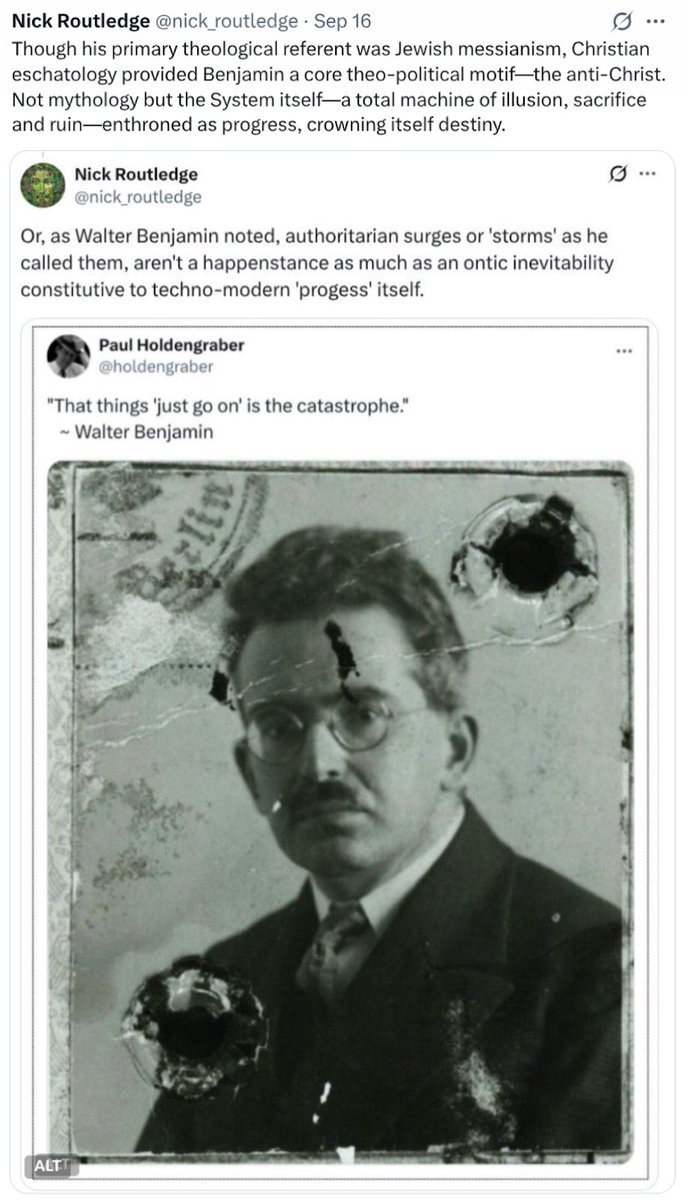
Image description
Extended description
Tweet: Though his primary theological referent was Jewish messianism, Christian eschatology provided Benjamin a core theo-political motif—the anti-Christ. Not mythology but the System itself—a total machine of illusion, sacrifice and ruin—enthroned as progress, crowning itself destiny. Or, as Walter Benjamin noted, authoritarian surges or 'storms' as he called them, aren't a happenstance as much as an ontic inevitability constitutive to techno-modern 'progress' itself. Image of tweet here: "That things 'just go on' is the catastrophe." ~ Walter Benjamin thanks to [Photograph of Walter Benjamin]
Open original document