
@Agent888488 Underhill is naming an access problem: without stretching the epistemic faculty, we get analysis without acquaintance—maps of a country we can't enter. The limit isn’t intelligence, it’s initiation. And the interpretive key is participatory. Without it, deep wisdom stays inert.
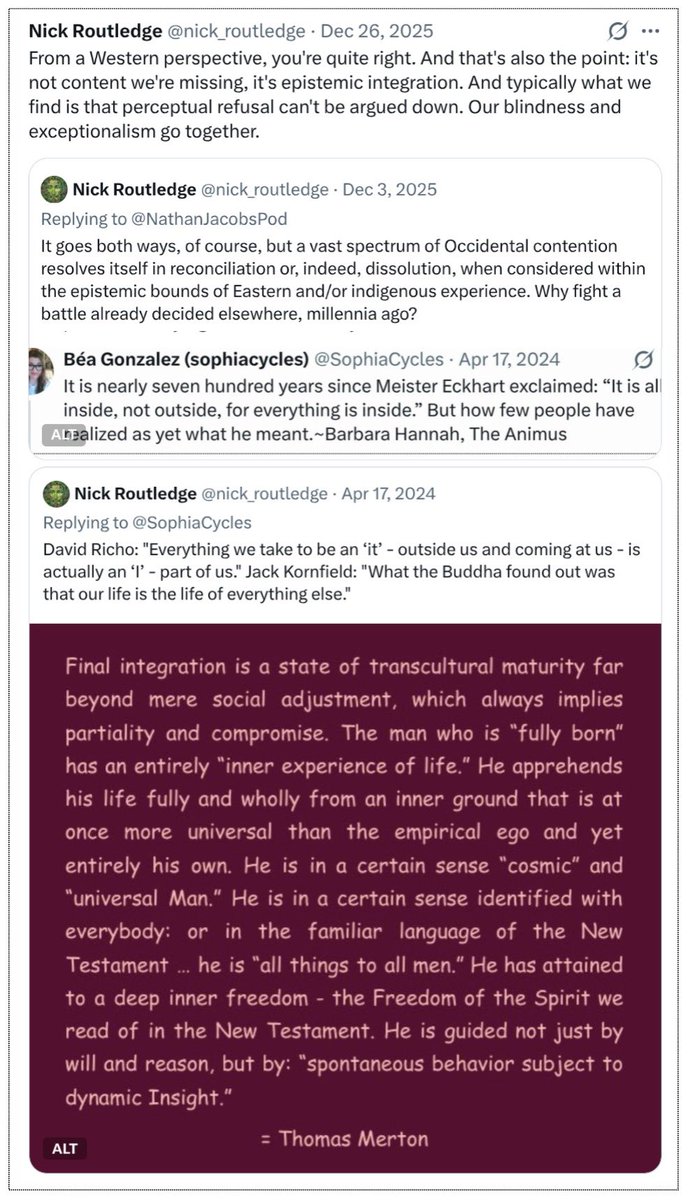
Image description
Extended description
and From a Western perspective, you're quite right. And that's also the point: it's not content we're missing, it's epistemic integration. And typically what we find is that perceptual refusal can't be argued down. Our blindness and exceptionalism go together. It goes both ways, of course, but a vast spectrum of Occidental contention resolves itself in reconciliation or, indeed, dissolution, when considered within the epistemic bounds of Eastern and/or indigenous experience. Why fight a battle already decided elsewhere, millennia ago? SophiaCycles It is nearly seven hundred years since Meister Eckhart exclaimed: “It is all inside, not outside, for everything is inside.” But how few people have realized as yet what he meant.~Barbara Hannah, The Animus Subtweet: David Richo: "Everything we take to be an ‘it’ - outside us and coming at us - is actually an ‘I’ - part of us." Jack Kornfield: "What the Buddha found out was that our life is the life of everything else. Final integration is a state of transcultural maturity far beyond mere social adjustment, which always implies partiality and compromise. The man who is “fully born” has an entirely “inner experience of life.” He apprehends his life fully and wholly from an inner ground that is at once more universal than the empirical ego and yet entirely his own. He is in a certain sense “cosmic” and “universal Man.” He is in a certain sense identified with everybody: or in the familiar language of the New Testament … he is “all things to all men.” He has attained to a deep inner freedom - the Freedom of the Spirit we read of in the New Testament. He is guided not just by will and reason, but by: “spontaneous behavior subject to dynamic Insight.” - Thomas Merton
Open original document@RDGStout end/ Fwiw, despite translation fuzzies, correspondences of the Gospel of Thomas to Asian 'sudden enlightenment texts' aren't a stretch: visible to the eye, they're common as muck. As such, inter-spiritual exegesis can be a key essential to awakening the text's meaning and telos.
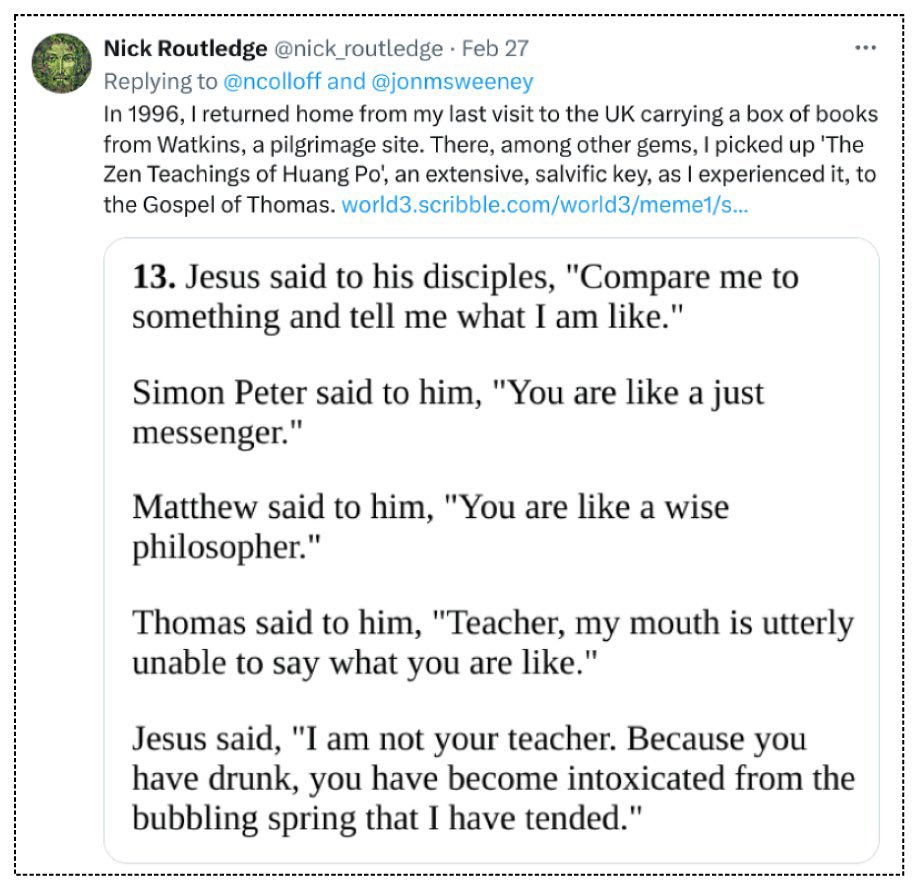
Image description
Original X alt text
Copy of tweet: and In 1996, I returned home from my last visit to the UK carrying a box of books from Watkins, a pilgrimage site. There, among other gems, I picked up 'The Zen Teachings of Huang Po', an extensive, salvific key, as I experienced it, to the Gospel of Thomas. 13. Jesus said to his disciples, "Compare me to something and tell me what I am like." Simon Peter said to him, "You are like a just messenger." Matthew said to him, "You are like a wise philosopher." Thomas said to him, "Teacher, my mouth is utterly unable to say what you are like." Jesus said, "I am not your teacher. Because you have drunk, you have become intoxicated from the bubbling spring that I have tended."