
@RDGStout end/ Fwiw, despite translation fuzzies, correspondences of the Gospel of Thomas to Asian 'sudden enlightenment texts' aren't a stretch: visible to the eye, they're common as muck. As such, inter-spiritual exegesis can be a key essential to awakening the text's meaning and telos.
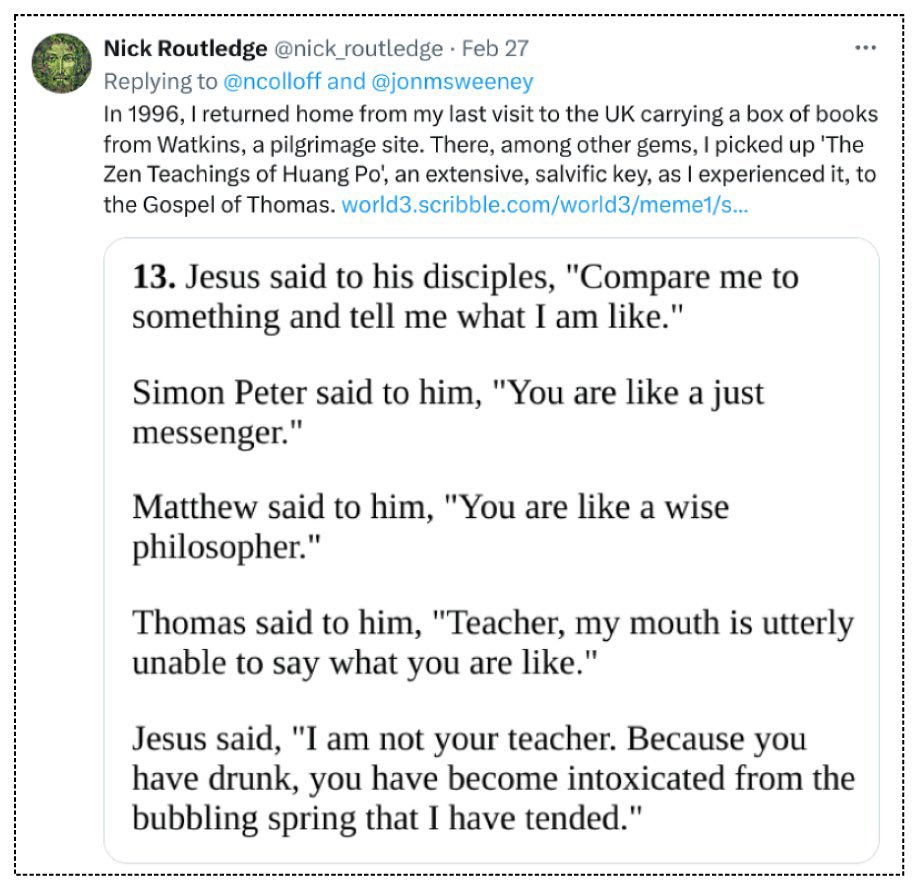
Image description
Original X alt text
Copy of tweet: and In 1996, I returned home from my last visit to the UK carrying a box of books from Watkins, a pilgrimage site. There, among other gems, I picked up 'The Zen Teachings of Huang Po', an extensive, salvific key, as I experienced it, to the Gospel of Thomas. 13. Jesus said to his disciples, "Compare me to something and tell me what I am like." Simon Peter said to him, "You are like a just messenger." Matthew said to him, "You are like a wise philosopher." Thomas said to him, "Teacher, my mouth is utterly unable to say what you are like." Jesus said, "I am not your teacher. Because you have drunk, you have become intoxicated from the bubbling spring that I have tended."
@MecDikmen @joegoodkin @sentantiq @apistone You might check out the trinitarian correlative of Plato’s ‘The Sophist’, Jesus’ ‘Gospel of Thomas’, and Sengstan’s ‘Verses on the Faith Mind’. Woke universal, innit?
View this post’s context →