
@holdengraber @Samantharhill What does it mean to think, speak, or act in a present answerable to the victims of genocide—now? For Benjamin, the Messianic is a fresh beginning at the level of meaning—shattering the victors’ regime of sense, breaking the “logic” that narrates catastrophe as inevitability—now.
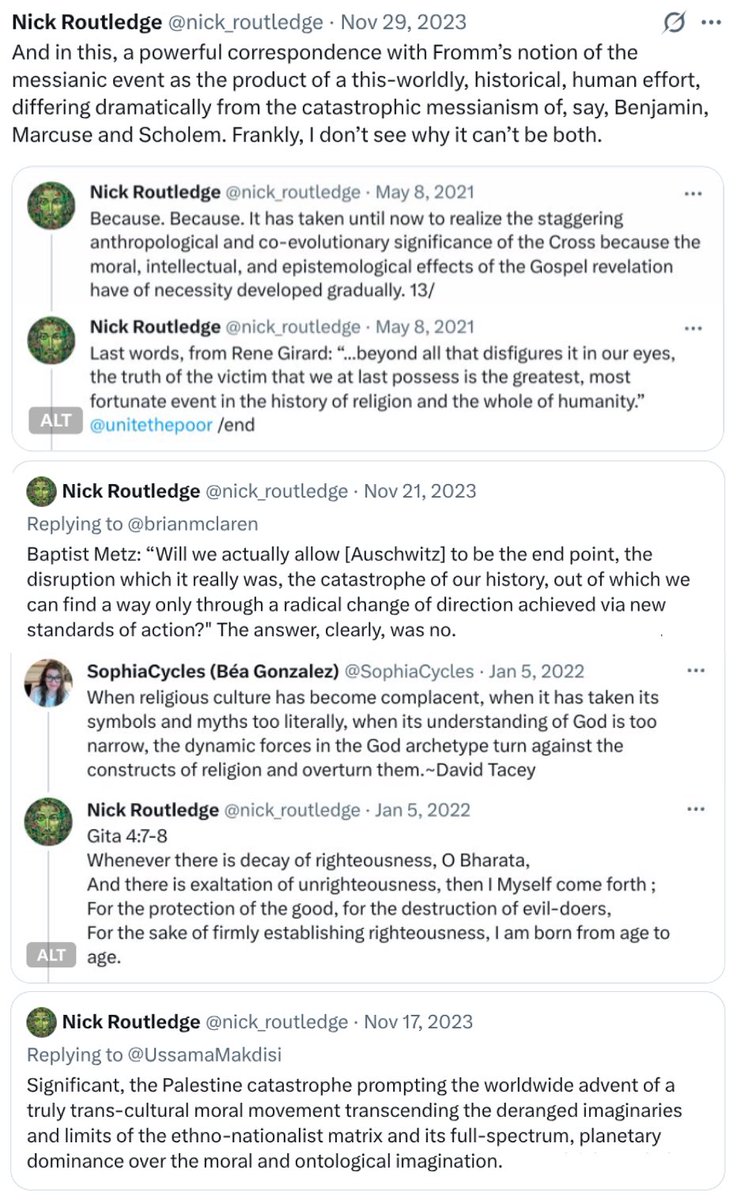
Image description
Extended description
And in this, a powerful correspondence with Fromm’s notion of the messianic event as the product of a this-worldly, historical, human effort, differing dramatically from the catastrophic messianism of, say, Benjamin, Marcuse and Scholem. Frankly, I don’t see why it can’t be both. Because. Because. It has taken until now to realize the staggering anthropological and co-evolutionary significance of the Cross because the moral, intellectual, and epistemological effects of the Gospel revelation have of necessity developed gradually. 13/ Nick Routledge · Last words, from Rene Girard: “...beyond all that disfigures it in our eyes, the truth of the victim that we at last possess is the greatest, most fortunate event in the history of religion and the whole of humanity.” /end Quote tweet: Baptist Metz: “Will we actually allow [Auschwitz] to be the end point, the disruption which it really was, the catastrophe of our history, out of which we can find a way only through a radical change of direction achieved via new standards of action?" The answer, clearly, was no. When religious culture has become complacent, when it has taken its symbols and myths too literally, when its understanding of God is too narrow, the dynamic forces in the God archetype turn against the constructs of religion and overturn them.~David Tacey Gita 4:7-8 Whenever there is decay of righteousness, O Bharata, And there is exaltation of unrighteousness, then I Myself come forth ; For the protection of the good, for the destruction of evil-doers, For the sake of firmly establishing righteousness, I am born from age to age. Quote tweet: Significant, the Palestine catastrophe prompting the worldwide advent of a truly trans-cultural moral movement transcending the deranged imaginaries and limits of the ethno-nationalist matrix and its full-spectrum, planetary dominance over the moral and ontological imagination
Open original document@riyeff @BremenBod @MassimoFaggioli Ultimately, the arc ripens into a messianic claim—judgment, mercy, liberation—that gathers up and surpasses Abrahamic registers, reaching beyond “religion” altogether. Benjamin remains our patron saint in that regard, even as the image is now planetary, the text not yet in print.
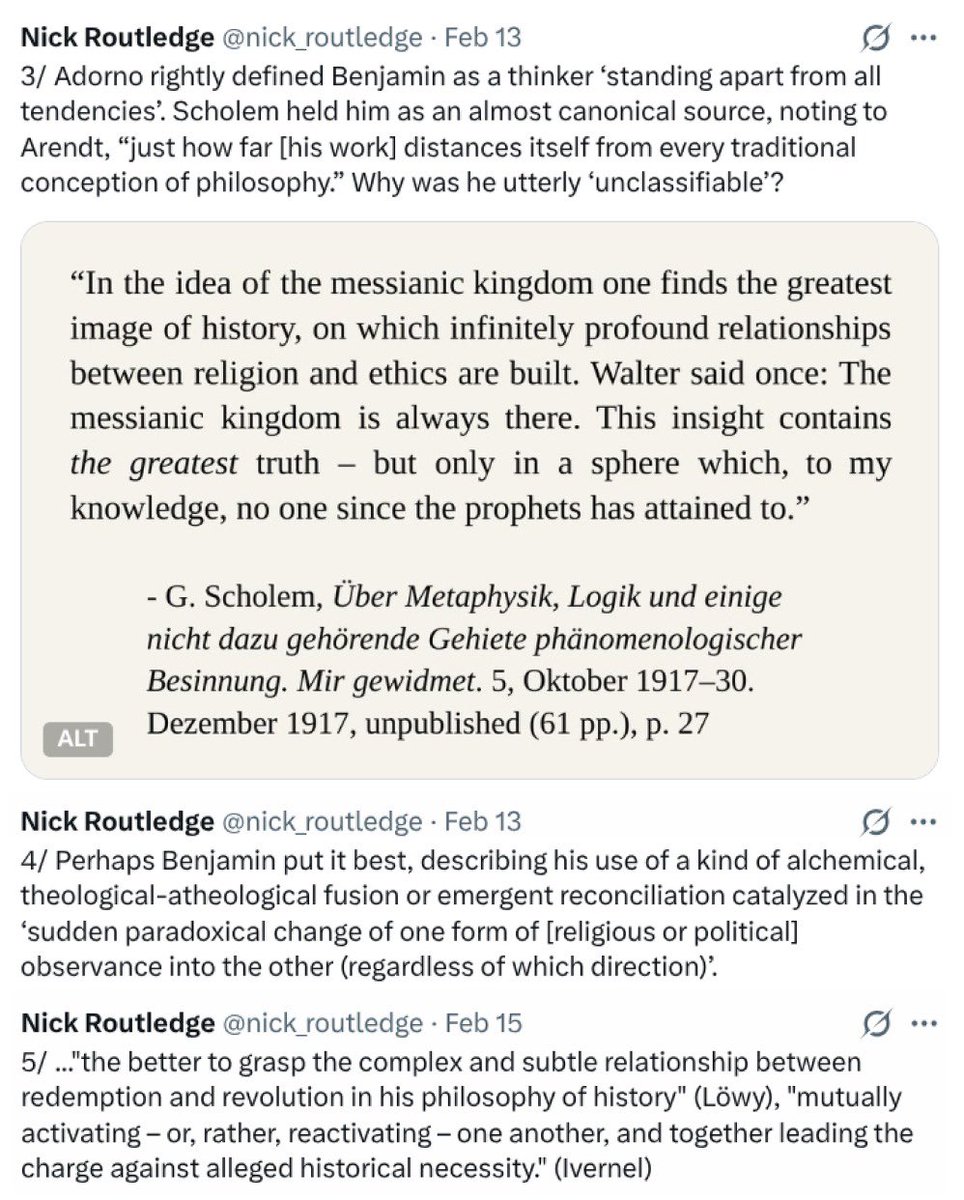
Image description
Extended description
3/ Adorno rightly defined Benjamin as a thinker ‘standing apart from all tendencies’. Scholem held him as an almost canonical source, noting to Arendt, “just how far [his work] distances itself from every traditional conception of philosophy.” Why was he utterly ‘unclassifiable’? “In the idea of the messianic kingdom one finds the greatest image of history, on which infinitely profound relationships between religion and ethics are built. Walter said once: The messianic kingdom is always there. This insight contains the greatest truth – but only in a sphere which, to my knowledge, no one since the prophets has attained to.” - G. Scholem, Über Metaphysik, Logik und einige nicht dazu gehörende Gehiete phänomenologischer Besinnung. Mir gewidmet. 5, Oktober 1917–30. Dezember 1917, unpublished (61 pp.), p. 27 Tweets: 4/ Perhaps Benjamin put it best, describing his use of a kind of alchemical, theological-atheological fusion or emergent reconciliation catalyzed in the ‘sudden paradoxical change of one form of [religious or political] observance into the other (regardless of which direction)’. 5/ ..."the better to grasp the complex and subtle relationship between redemption and revolution in his philosophy of history" (Löwy), "mutually activating – or, rather, reactivating – one another, and together leading the charge against alleged historical necessity." (Ivernel)
Open original document