
@tenshi_anna 2/ The wound is planetary and archetypal, as must be the repair. Where patriarchy fragments reality—against women, the earth, and life itself—its rebalancing is ontological: restored wholeness, already led by women, recovering capacities patriarchy trained itself not to see.
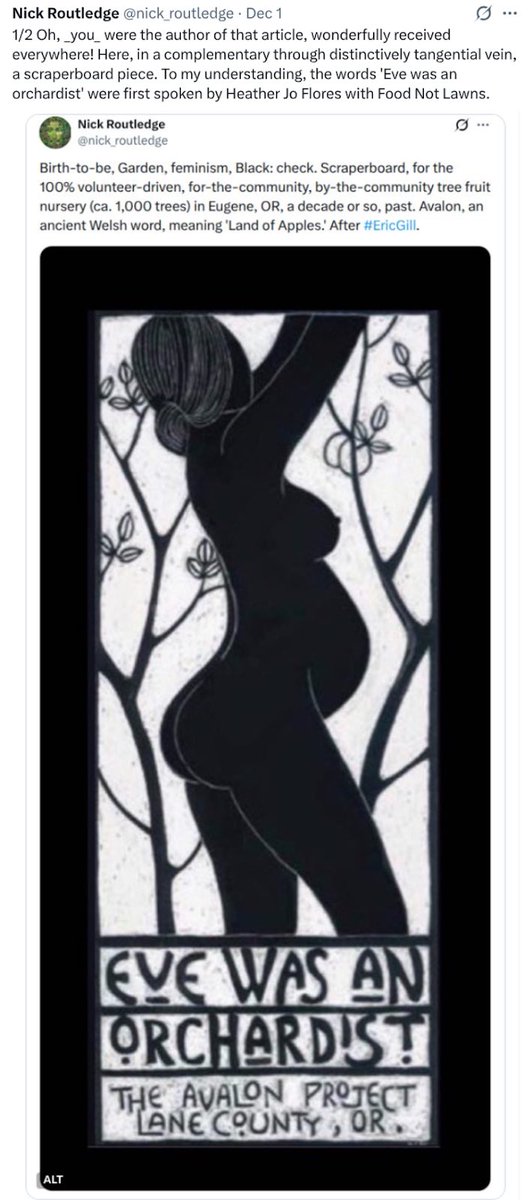
Image description
Original X alt text
Copy of tweet here: 1/2 Oh, _you_ were the author of that article, wonderfully received everywhere! Here, in a complementary through distinctively tangential vein, a scraperboard piece. To my understanding, the words 'Eve was an orchardist' were first spoken by Heather Jo Flores with Food Not Lawns. @nick_routledge Dec 26, 2020 Birth-to-be, Garden, feminism, Black: check. Scraperboard, for the 100% volunteer-driven, for-the-community, by-the-community tree fruit nursery (ca. 1,000 trees) in Eugene, OR, a decade or so, past. Avalon, an ancient Welsh word, meaning 'Land of Apples.' After #EricGill. Photo of scraperboard of a pregnant, orcharding Eve, with calligraphy, “Eve was an orchardist” and “The Avalon Project”
@joynessthebrave end\ A radical gardener, she intuited a deeply messianic unmaking of the scapegoat logic that turned Eve into a tale theologically criminalizing women's agency, reopening the Garden as a place of relational trust and reliable encounter, not of mistrust, accusation and control.
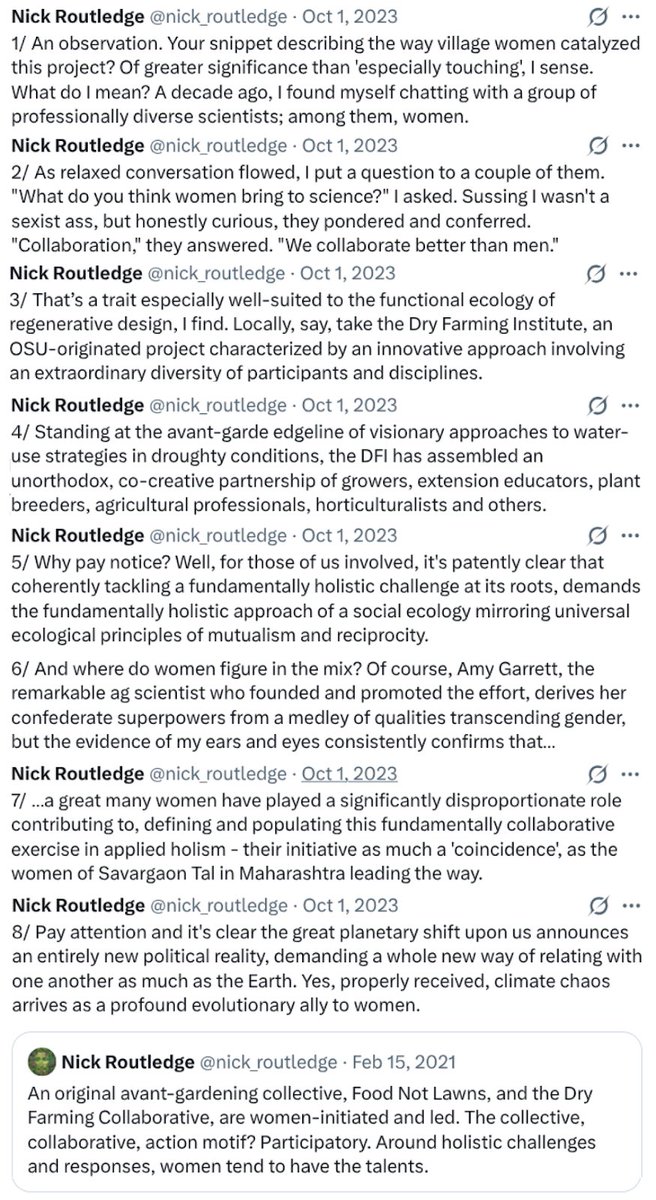
Image description
Extended description
Thread: 1/ An observation. Your snippet describing the way village women catalyzed this project? Of greater significance than 'especially touching', I sense. What do I mean? A decade ago, I found myself chatting with a group of professionally diverse scientists; among them, women. 2/ As relaxed conversation flowed, I put a question to a couple of them. "What do you think women bring to science?" I asked. Sussing I wasn't a sexist ass, but honestly curious, they pondered and conferred. "Collaboration," they answered. "We collaborate better than men." 3/ That’s a trait especially well-suited to the functional ecology of regenerative design, I find. Locally, say, take the Dry Farming Institute, an OSU-originated project characterized by an innovative approach involving an extraordinary diversity of participants and disciplines. 4/ Standing at the avant-garde edgeline of visionary approaches to water-use strategies in droughty conditions, the DFI has assembled an unorthodox, co-creative partnership of growers, extension educators, plant breeders, agricultural professionals, horticulturalists and others. 5/ Why pay notice? Well, for those of us involved, it's patently clear that coherently tackling a fundamentally holistic challenge at its roots, demands the fundamentally holistic approach of a social ecology mirroring universal ecological principles of mutualism and reciprocity. 6/ And where do women figure in the mix? Of course, Amy Garrett, the remarkable ag scientist who founded and promoted the effort, derives her confederate superpowers from a medley of qualities transcending gender, but the evidence of my ears and eyes consistently confirms that… 7/ …a great many women have played a significantly disproportionate role contributing to, defining and populating this fundamentally collaborative exercise in applied holism - their initiative as much a 'coincidence', as the women of Savargaon Tal in Maharashtra leading the way. 8/ Pay attention and it's clear the great planetary shift upon us announces an entirely new political reality, demanding a whole new way of relating with one another as much as the Earth. Yes, properly received, climate chaos arrives as a profound evolutionary ally to women. Quote tweet: An original avant-gardening collective, Food Not Lawns, and the Dry Farming Collaborative, are women-initiated and led. The collective, collaborative, action motif? Participatory. Around holistic challenges and responses, women tend to have the talents.
Open original document