
@jamespoulos Ludwig cuts both ways: if "the limits of our language are the limits of our world", then expanding our expressive range enlarges reality. A vernacular flanking religious-and-secular defenses, smuggled inside ordinary language, doesn't just describe a bigger world—it creates one.
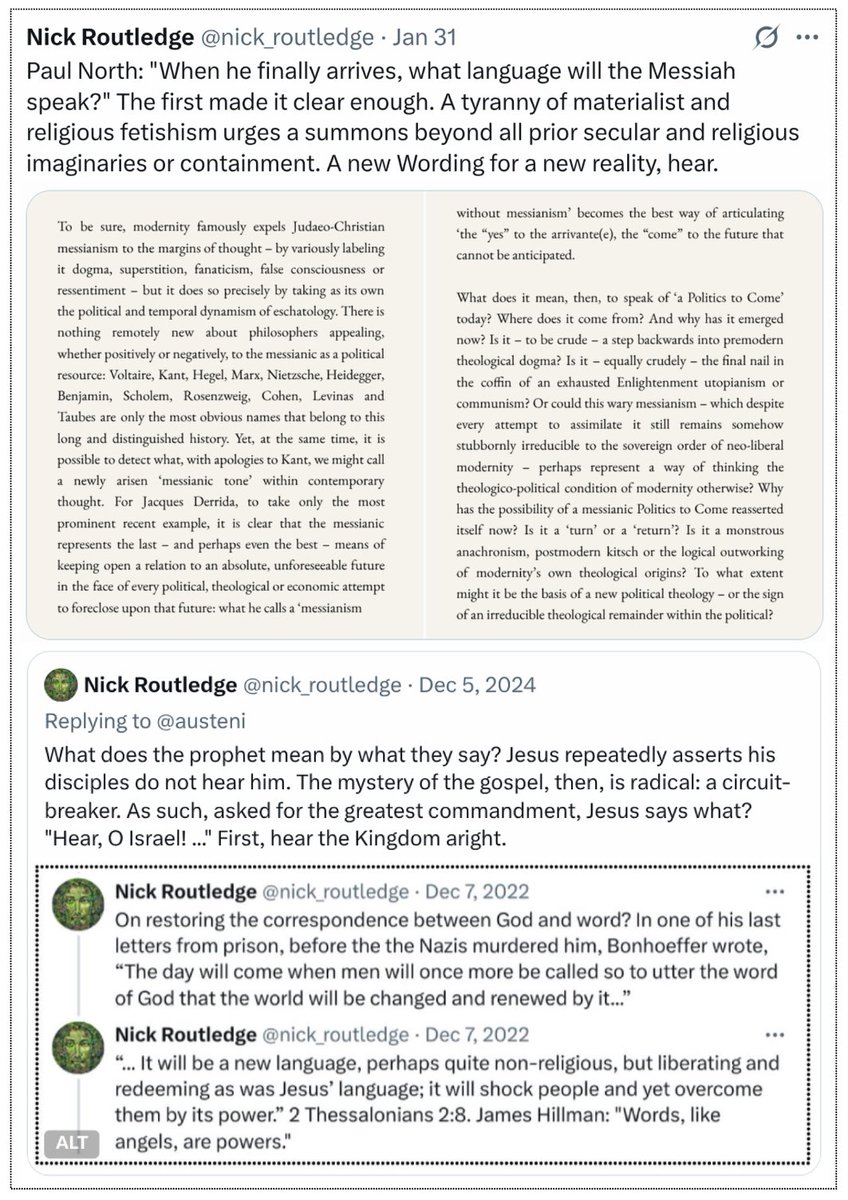
Image description
Original X alt text
Copy of tweet here: Text: Arthur Bradley and Paul Fletcher in The Politics to Come: Power, Modernity and the Messianic
Extended description
Pictured speaker / quoted attribution: Arthur Bradley and Paul Fletcher, The Politics to Come: Power, Modernity and the Messianic Recovered pictured passage; not a claim to the full source. Passage boundary: Only internal span omitted by saved first-book-paragraph ALT after eschatology and before Yet, at the same time. Do not replace the rest of ALT. Source: Preserve quoted-author distinctions; the containing tweet does not confer authorship. There is nothing remotely new about philosophers appealing, whether positively or negatively, to the messianic as a political resource: Voltaire, Kant, Hegel, Marx, Nietzsche, Heidegger, Benjamin, Scholem, Rosenzweig, Cohen, Levinas and Taubes are only the most obvious names that belong to this long and distinguished history. Retained uncertainty: ["Known gap S004 visually recovered from selected original. Book's columns flow across the internal picture boundary; no imagined missing sentence added."]
Open original documentExtended description
Pictured speaker / quoted attribution: Nick quoting Paul North Saved source record associated with pictured writing; full saved record, not an exact pictured excerpt. Passage boundary: When he finally arrives Source: archive.nickroutledge.org/post/1885333342822031610 Preserve quoted-author distinctions; the containing tweet does not confer authorship. @ncolloff Paul North: "When he finally arrives, what language will the Messiah speak?" The first made it clear enough. A tyranny of materialist and religious fetishism urges a summons beyond all prior secular and religious imaginaries or containment. A new Wording for a new reality, hear. t.co/YMvFCQvIvs Retained uncertainty: ["Known gap S004 visually recovered from selected original. Book's columns flow across the internal picture boundary; no imagined missing sentence added."]
Open original documentExtended description
Pictured speaker / quoted attribution: Nick quoting Bonhoeffer and Hillman separately Saved source record associated with pictured writing; full saved record, not an exact pictured excerpt. Passage boundary: What does the prophet mean Source: archive.nickroutledge.org/post/1864723067769065838 Preserve quoted-author distinctions; the containing tweet does not confer authorship. @austeni What does the prophet mean by what they say? Jesus repeatedly asserts his disciples do not hear him. The mystery of the gospel, then, is radical: a circuit-breaker. As such, asked for the greatest commandment, Jesus says what? "Hear, O Israel! ..." First, hear the Kingdom aright. t.co/jWnHCDzM71 Retained uncertainty: ["Known gap S004 visually recovered from selected original. Book's columns flow across the internal picture boundary; no imagined missing sentence added."]
Open original document@MCP011011 @BurkhartRj @johnrobb @MemeticCowboy @MemeticGuru @nema_cio @RedfearnMike The Reign arrives as clarity, presence hardening into light on the most difficult ground. When the Real breaks through, it redeems and heals, tethering us to something manifestly deeper than our divisions—the theo-dramatic force of meaningfulness transforming existence itself.
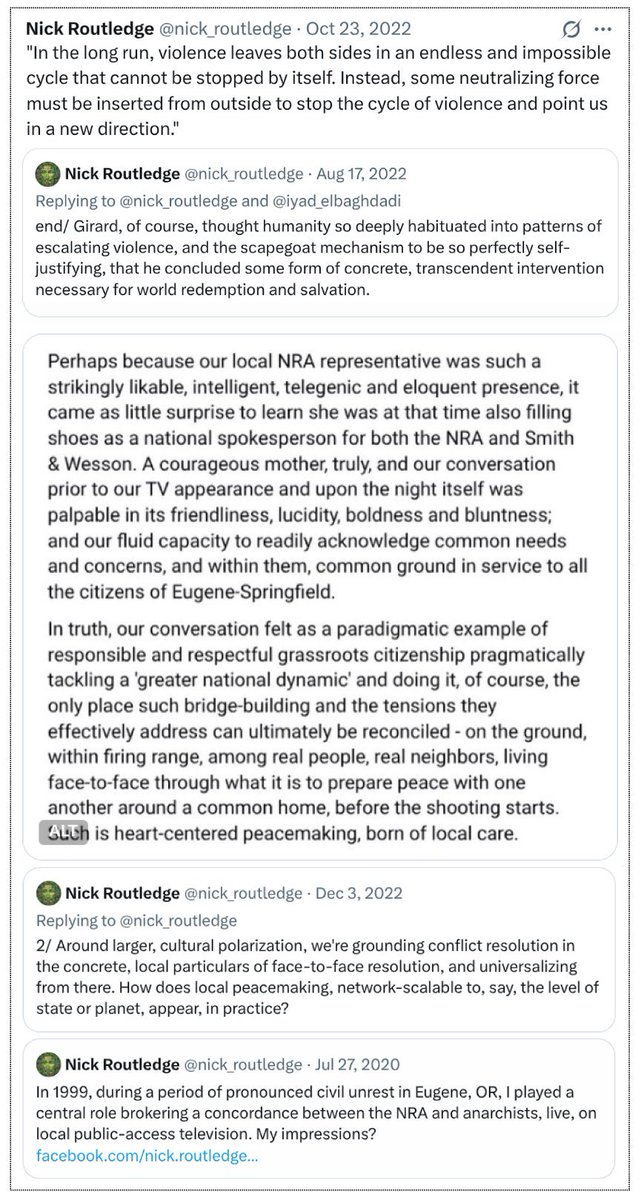
Image description
Original X alt text
Copy of tweet and quote tweet here: And image and quote tweets here:
Extended description
Pictured speaker / quoted attribution: Nick Routledge posting a quotation; quotation author not labelled in screenshot Saved source record associated with pictured writing; full saved record, not an exact pictured excerpt. Passage boundary: top In the long run Source: archive.nickroutledge.org/post/1584166786567933952 Preserve quoted-author distinctions; the containing tweet does not confer authorship. @CACRadicalGrace @RichardRohrOFM "In the long run, violence leaves both sides in an endless and impossible cycle that cannot be stopped by itself. Instead, some neutralizing force must be inserted from outside to stop the cycle of violence and point us in a new direction." t.co/iFZnYbMwYY Retained uncertainty: [{"passage": "Top quotation In the long run", "reason": "No quotation author labelled in pictured body; saved tweet is addressed to Rohr/CAC but addressees do not prove authorship."}]
Open original documentExtended description
Pictured speaker / quoted attribution: Nick Routledge referring to Girard Saved source record associated with pictured writing; full saved record, not an exact pictured excerpt. Passage boundary: end/ Girard Source: Preserve quoted-author distinctions; the containing tweet does not confer authorship. end/ Girard, of course, thought humanity so deeply habituated into patterns of escalating violence, and the scapegoat mechanism to be so perfectly self-justifying, that he concluded some form of concrete, transcendent intervention necessary for world redemption and salvation. 1/ Essentially eschatological, his later work. On one hand, he identifies our crazed, self-justifying lurch into total cataclysm: on the other, echoing Holderlin, "Danger itself invites the rescuing power", transcendent intervention as humanity's only realistic hope of survival. The ‘sacred violence’ at the heart of all “the kingdoms of this world” is no longer distinguishable from the counter-violence it opposes. The reciprocities of violence and counter-violence threaten to spin completely out of control. 6/ “People all over the world are employing intellectual, moral, and rhetorical ingenuity in an effort to endow the violence they favor with culture-founding authority, and all over the world they are failing” - Gil Bailie 7/ As such, “The idea of ‘limitless’ violence, suddenly looms up before us,” notes Girard. “For the first time,” he says, humanity faces “a perfectly straightforward and even scientifically calculable choice between total destruction and the total renunciation of violence.” 8/ More convinced than ever that reading Girard is a good starting point for reflecting on the circumstances we find ourselves in. Apt. His concern, he said, not religion, but its anthropology and, as such, the staggering features of Jesus' murder ultimately revealing the only way out of a revolving hall of projections, our "automatic, unconscious, ingrained and mimetic" escalating war of all against all. Quote tweet: Eliot: “Prophesy to the wind to the wind only for only The wind will listen.” The mimetic escalation of 'war of all against all' exponentiated to the planetary level? A global mob of False Deliverers offering up gathering points for national anguish? Why now? Girard, apt. Reciprocal action, mimesis, is both responsible for escalation and deescalation depending on what actions are being imitated. The reason that people fight more and more is that there is a truth approaching against which their violence reacts. Panic in the system. In the Christian world, it is Christ, the Son of God, who represents all the innocent victims and whose return is heralded by the very effects of the escalation to extremes. What will he declare? That we have gone crazy, that the adulthood of humanity, which he announced through the cross, is a failure. Postponing reconciliation always causes violence to increase. We have to think of reconciliation not as a consequence but as the reverse of the escalation to extremes. We have to at all costs avoid thinking of war as a passage towards reconciliation. It is more than ever up to each one of us to hold back the worst.” René Girard Retained uncertainty: [{"passage": "Top quotation In the long run", "reason": "No quotation author labelled in pictured body; saved tweet is addressed to Rohr/CAC but addressees do not prove authorship."}]
Open original documentExtended description
Pictured speaker / quoted attribution: Uncredited excerpt; saved Facebook capture associated with Nick, owner attribution not newly certified Saved source record associated with pictured writing; full saved record, not an exact pictured excerpt. Passage boundary: two NRA paragraphs Source: archive.nickroutledge.org/post/1966517111658045849 Preserve quoted-author distinctions; the containing tweet does not confer authorship. Another 'deleted post' just now resurrected from my FB archive file, this from 2017. -- I move deeply among dearest of friends who are armed to the teeth; and others who are passionate supporters of gun-control. Where do I stand? Thomas Merton affirms that enacting good faith collaboration between folks, building bridges of understanding across ostensible divides, is an essential Christian obligation. Standing in the middle, I find, involves sincerely holding hands with all sides. In this light, some of you who follow me here may recollect a posting I made some time ago detailing the key role I played brokering a concordance between local progressives and the NRA, live, on local public-access television, in 1999 - a grassroots, non-institutional response to the threat of what might euphemistically be termed 'public disorder' during a period of pronounced civil unrest in Eugene, prior to the approach of Y2K. Where that posting now is, I have no idea. Perhaps because our local NRA representative was such a strikingly likable, intelligent, telegenic and eloquent presence, it came as little surprise to learn she was at that time also filling shoes as a national spokesperson for both the NRA and Smith & Wesson. A courageous mother, truly, and our conversation prior to our TV appearance and upon the night itself was palpable in its friendliness, lucidity, boldness and bluntness; and our fluid capacity to readily acknowledge common needs and concerns, and within them, common ground in service to all the citizens of Eugene-Springfield. In truth, our conversation felt as a paradigmatic example of responsible and respectful grassroots citizenship pragmatically tackling a 'greater national dynamic' and doing it, of course, the only place such bridge-building and the tensions they effectively address can ultimately be reconciled - on the ground, within firing range, among real people, real neighbors, living face-to-face through what it is to prepare peace with one another around a common home, before the shooting starts. Such is heart-centered peacemaking, born of local care. I shot competitively for many years. Since childhood, I've moved among gun-toting friends in uniform and civvies. And what I have learned from such allies is that whether or not others understand it as such, 'gun-ownership' is not an externalized, objective phenomenon which can be effectively shaped the way we might, for example, determine a building code. Among my friends, owning guns is at heart a reflection of identity and experience essential to their deepest sense of safety and well-being. Without addressing the fundamental existential need that gun-ownership addresses for them, they inevitably experience 'gun-control' - and its perceived threat - as a pernicious, violent assault upon the very cornerstones of their world and, whether consciously or not, as a trigger for an intense countervailing response. Is anybody truly contemplating the way gun and ammunition sales explode into aggressive rebellion at the merest rumor of limits? This is our reality, and it is precisely because I am uncompromisingly committed to the path of non-violence in the cause of universal justice for all, gun-owners included, that I found myself naturally helping to build bridges of understanding, solidarity and common care among folks across all shades of gun opinion who share my abiding concerns surrounding social trends holding the potential for unwanted, mimetic violence. And this in a climate where so many leaders preach hatred and fear and division. We simply don't want anybody knocking on doors hereabouts, guns in hand. These days I don't even have to reach out for such assent. I've been twenty years in the hood and farmers, loggers, hunters, mill workers, growers, ciderists and, yes, gun-toting hippies and anarchists are none other than my closest and most trusted friends, supporters and collaborators. I adore them and would think not a moment before laying my life down for them. I'm often surprised by how powerfully I am in agreement with my NRA pals, in part because we are citizens to the largest and most lethal killing machine in human history, the self-declared and self-appointed raison d'être of which ("the world's policeman") is total, global, militarist hegemony. Home and abroad. Take a look around. In this regard, the obscene duplicity of larger political efforts to arrest the deaths of Americans by gun violence while the children of the world murdered, maimed and orphaned by our actions and actors - the U.S. has persistently refused to sign on to the global ban on cluster munitions - remain ignored, forsaken and condemned by a supremacist sensibility obsessed with its own self-importance, affirms to me that efforts such as our past president's to stem the carnage upon our own shores, while simultaneously waging war upon the world, amount to purblind, mendacious hypocrisy. Until we admit who we are across this Earth, how can we possibly have peace and safety in our own homes, streets and fields? Some would say, as did Goethe, a quandary remains. "How can I be if another is?" These days, perhaps, our conundrum might also be described as a choice between division and coming together, between limitless war and the universal renunciation of violence, globally. Well? Photo: local farmers (Carri and Jeff of Pitchfork& Crow) and seed growers (Sarah and Andrew of Adaptive Seeds) hamming it up after potluck. Retained uncertainty: [{"passage": "Top quotation In the long run", "reason": "No quotation author labelled in pictured body; saved tweet is addressed to Rohr/CAC but addressees do not prove authorship."}]
Open original documentExtended description
Pictured speaker / quoted attribution: Nick Routledge Saved source record associated with pictured writing; full saved record, not an exact pictured excerpt. Passage boundary: 2/ Around polarization and In1999 Source: Preserve quoted-author distinctions; the containing tweet does not confer authorship. Copy of thread here: 1/ Where civility meets meatspace, subsidiarity conflict resolution not only amounts to a primary facet of holistic governance models referred to as 'eco-social physicianship', it also defines an elemental requirement and power of functional society. Nils Christie, authoritative. · 2/ Around larger, cultural polarization, we're grounding conflict resolution in the concrete, local particulars of face-to-face resolution, and universalizing from there. How does local peacemaking, network-scalable to, say, the level of state or planet, appear, in practice? In 1999, during a period of pronounced civil unrest in Eugene, OR, I played a central role brokering a concordance between the NRA and anarchists, live, on local public-access television. My impressions? Retained uncertainty: [{"passage": "Top quotation In the long run", "reason": "No quotation author labelled in pictured body; saved tweet is addressed to Rohr/CAC but addressees do not prove authorship."}]
Open original document